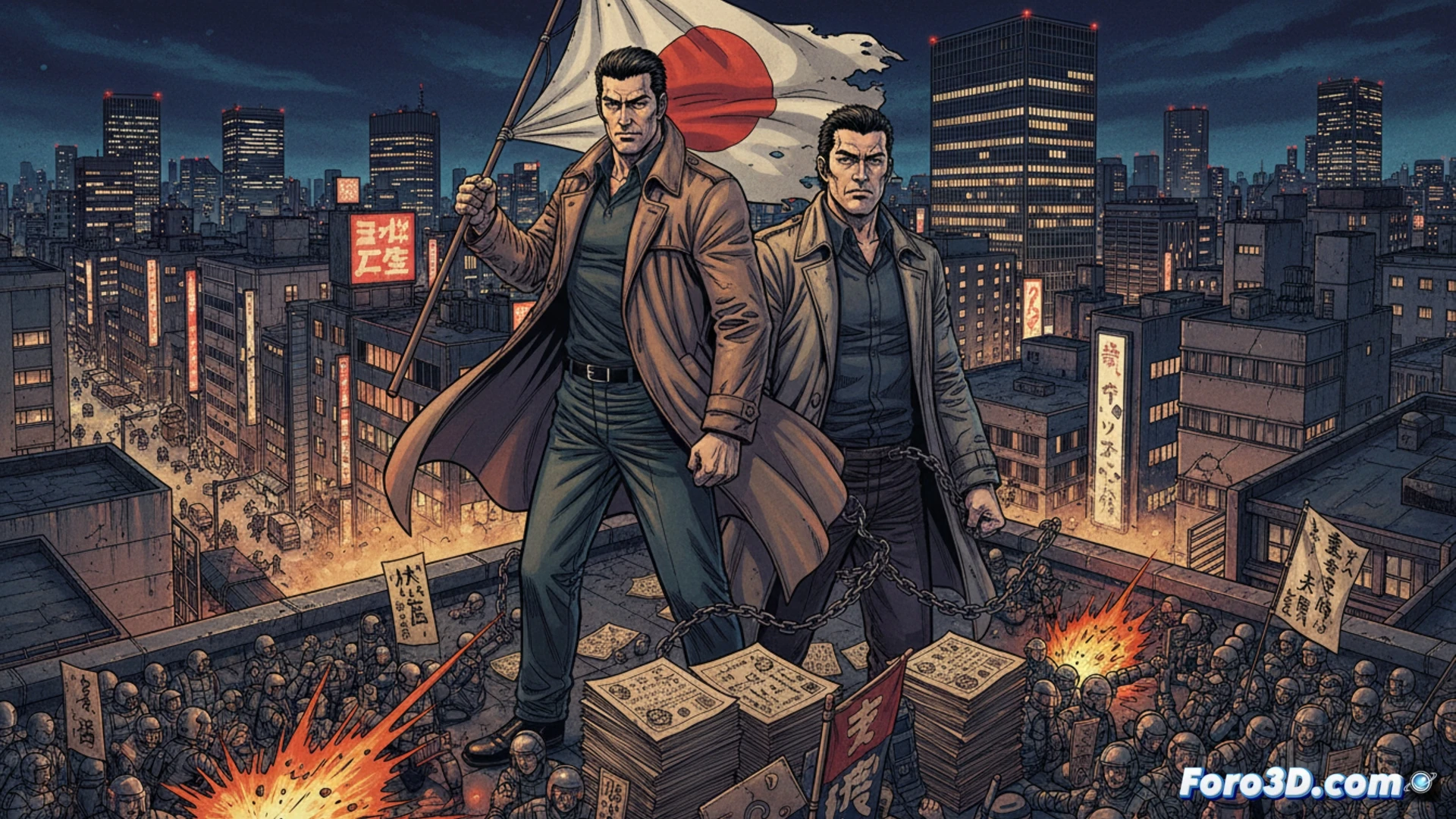
Sanctuary, the masterpiece by Sho Fumimura and Ryoichi Ikegami, transcends the action genre to become a graphic manifesto on power reform. The premise is brutally simple: two survivors of the Cambodian killing fields return to Japan with a pact. One will infiltrate politics, the other the Yakuza. From both fronts, they will seek to purge a corrupt system. But what elevates this work is not just its plot, but how Ikegami's drawing becomes a tool of visual denunciation.
Academic realism as a weapon of political denunciation 🎨
Ikegami's style, based on impeccable academic realism, is not a mere aesthetic ornament. It is a narrative and activist decision. By drawing politicians with the same anatomical precision as yakuza, the author eliminates the visual hierarchy between good and evil. The 90s fashion, the impeccable suits, and the Tokyo skyscrapers are not passive backgrounds; they are the stage setting of a system that oppresses and seduces. Each panel functions as a frame of denunciation, where the elegance of the characters contrasts with the structural violence they represent. In the context of today's digital activism, this technique is replicated through hyperrealistic 3D recreations of historical scenarios, seeking to generate the same critical immersion that Ikegami achieved with ink and pen.
Two sides of the same power: sequential art as resistance ⚔️
The duality of the pact in Sanctuary reflects the hybrid nature of activism: reform from within or destroy from without. The manga demonstrates that sequential art can convey messages of resistance without falling into pamphleteering. The survival in Cambodia is not gratuitous trauma, but the ideological engine that justifies the protagonists' violence. By relating this work to current digital techniques, we see how independent creators use immersive visual narratives to explore political corruption, directly inheriting Ikegami's approach: using aesthetics to seduce the reader and then hit them with social criticism.
How does the ultra-realistic visual style and power narrative of Sanctuary by Ikegami and Fumimura turn a 90s action manga into a tool of political criticism and visual activism that remains relevant in the digital age?
(PS: pixels also have rights... or at least that's what my latest render says)