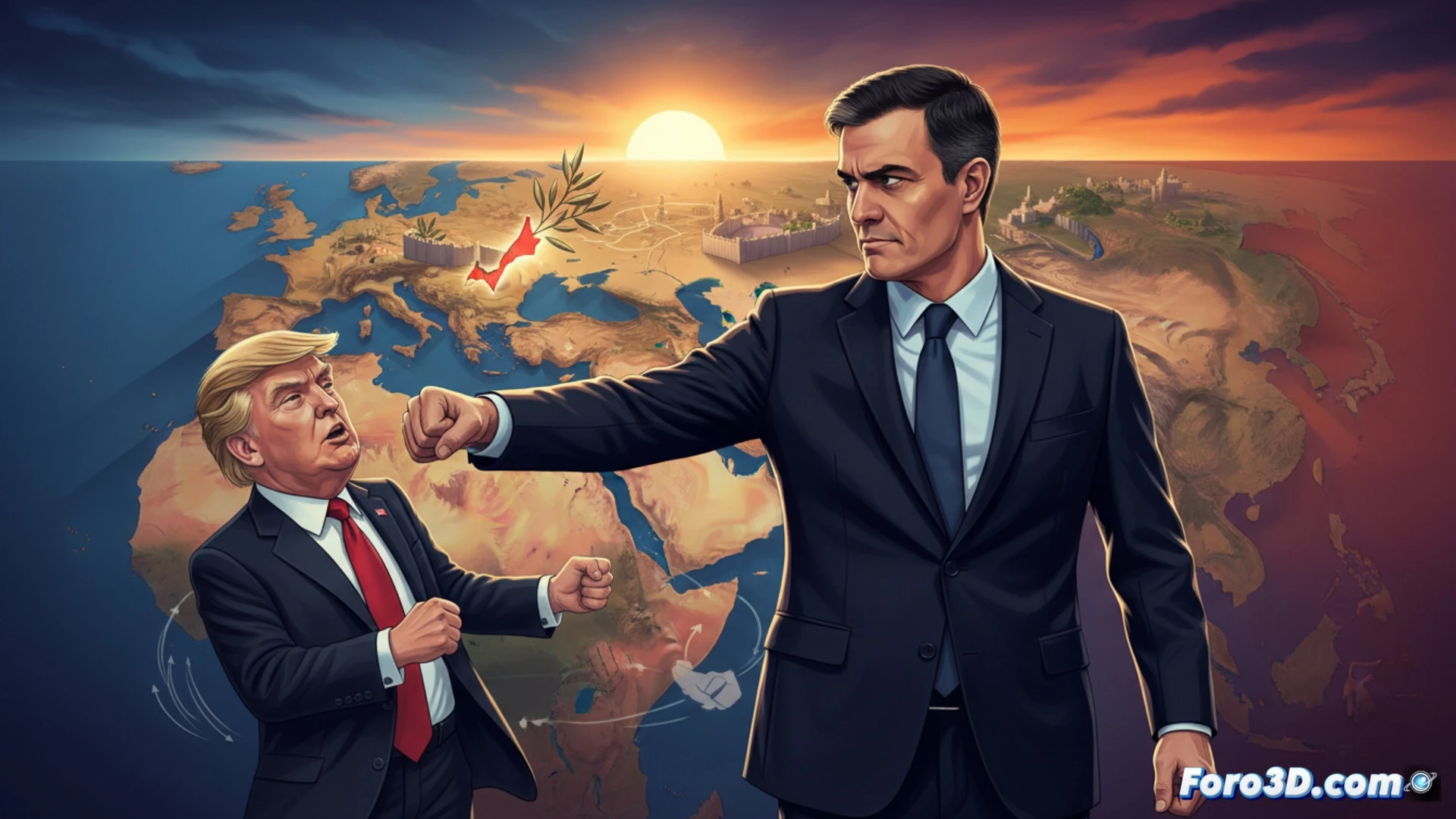
The President of the Spanish Government has toughened his foreign policy discourse. With direct criticism of Donald Trump's tariff policies and a clear stance on the Palestinian-Israeli conflict, Sánchez seeks a more autonomous international profile. This strategy, however, raises doubts about its impact on bilateral relations and the coherence of Spanish foreign policy.
Technological development as a geopolitical tool 🌐
In parallel with his diplomatic stance, Sánchez has promoted investment in semiconductors and renewable energies to reduce foreign dependence. The Perte Chip and alliances with European manufacturers aim to position Spain in the technological value chain. However, the execution of these projects is progressing slowly, and bureaucracy remains an obstacle to attracting private capital and specialized talent.
Sánchez against the empire of the tweet and the desert sand 🏜️
While Sánchez confronts Trump via official statements, Moncloa already fears that the Republican will respond with a tweet at 3 a.m. calling Spain a failed state. And in the Middle East, the solution lies in getting all parties to sit at a table, but without forgetting that the table in question is usually surrounded by chairs that no one wants to occupy. Diplomacy is a fine art, but sometimes it seems more like a game of Trivial Pursuit where no one can agree on the category.