The arrival of the Samsung Odyssey OLED G8 (G85SB) in the professional hardware market raises a key question for 3D artists: is a 34-inch ultra-wide panel with Quantum Dot OLED technology and 175Hz a viable tool for modeling and rendering, or is it still a monitor designed exclusively for gaming? We analyze its specifications from the digital designer's perspective, evaluating whether its 21:9 aspect ratio and color accuracy can displace traditional 4K monitors in the studio. 🖥️
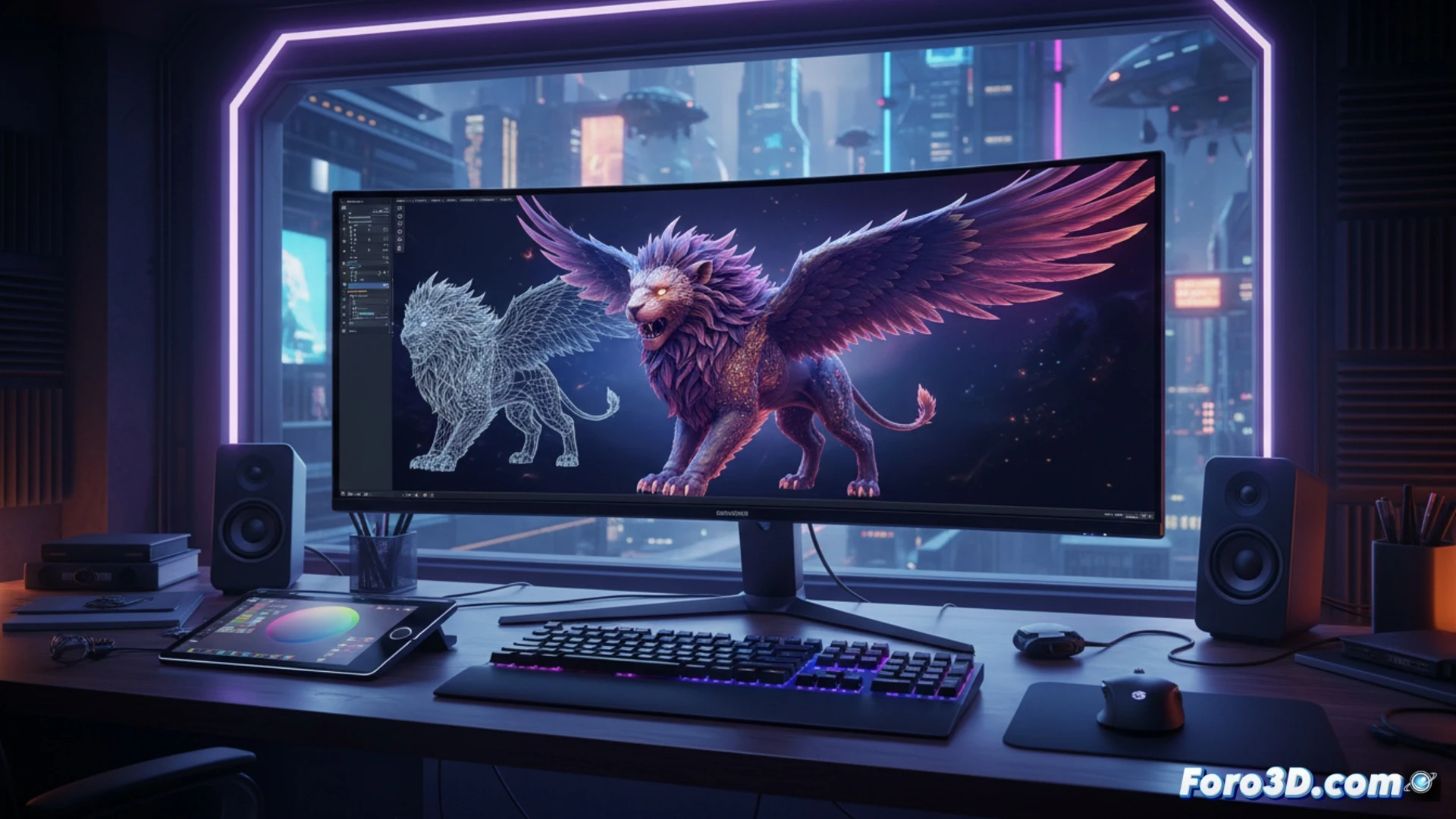
Color Accuracy and Response: Quantum Dot vs. IPS in PBR Workflows 🎨
For PBR material work, color fidelity is non-negotiable. The G85SB's Quantum Dot OLED panel offers absolute blacks and infinite contrast, resulting in much more realistic shadow and reflection visualization than any IPS. However, the Achilles' heel of OLED in the 3D realm is the risk of burn-in from static interface elements (toolbars, timelines). The 175Hz refresh rate, while seemingly excessive for modeling, is a blessing for animation: it allows previewing motion curves and particle simulations with a fluidity that eliminates ghosting, something a standard 60Hz 4K monitor cannot match. The UWQHD resolution (3440x1440) offers a sweet spot: more pixels than standard 1440p, but less demanding than native 4K, allowing high FPS rates in real-time viewports without sacrificing detail.
21:9 or 16:9? The Battle for Workspace ⚔️
The 21:9 aspect ratio is the differentiating factor. For a 3D professional, having a 34-inch wide timeline without needing to scroll, or being able to place two viewports (perspective and camera) side-by-side without overlapping, drastically optimizes workflow. Compared to a 16:9 4K monitor, the Odyssey G8 sacrifices vertical height, which can be annoying when editing nodes or reading code in scripting editors. The final decision depends on the user's profile: if you prioritize animation and immersive preview, the ultra-wide OLED wins hands down. If your daily work is high-polygon modeling and texture editing, a 32-inch 4K IPS remains king, though without the magic of OLED contrast.
What real advantages does the Samsung Odyssey G8's QD-OLED panel offer over a professional IPS monitor to ensure reliable color accuracy in lighting and texturing 3D scenes?
(PS: Your CPU runs hotter than the Blender vs. Maya debate)