The new Samsung AnyPlace Induction eliminates the restrictions of traditional hobs thanks to a matrix of coil-on-foil technology covering the entire surface. This design allows you to place any pot or pan anywhere, detecting its position and heating it instantly. For a 3D product designer, this concept represents a fascinating challenge in terms of modeling, rendering, and visual communication of the product.
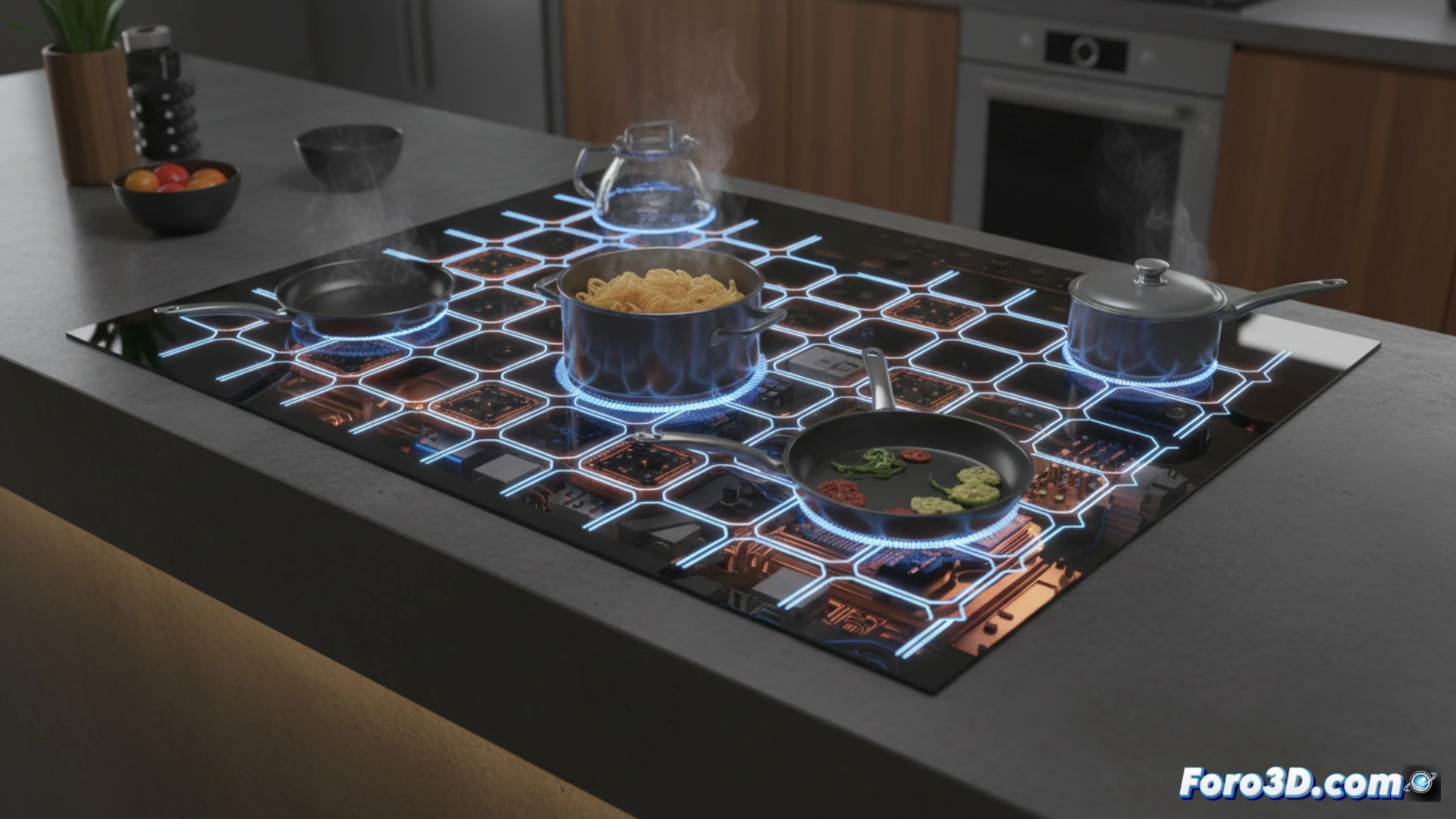
Modeling the coil matrix and magnetic field simulation 🔥
From a 3D modeling perspective, the key lies in representing the internal structure of the hob. Instead of the classic visible copper coils in exploded view renders, here we must model a thin, homogeneous layer that conceals the technology. The surface must be perfectly smooth to reflect light like black glass, but with a subtle detection pattern. Integrating the 7-inch touchscreen requires precise sub-modeling: a bezel with no visible edges and a UI interface simulating temperature control menus and active zones. When rendering, it is crucial to show how the magnetic field adapts to the pot's position, something we can simulate with a dynamic heat map on the surface.
Conceptual renders and comparison with traditional design 🎯
To communicate its advantage, the renders must contrast the AnyPlace with a conventional induction hob. While the traditional one shows fixed circles and marked zones, the new hob should be visualized with randomly offset pots, all heating simultaneously. A cutaway-style render would help showcase the coil-on-foil layer and the flat electronics. Finally, a 3D animated video showing the free movement of a pan across the surface, with the touchscreen responding in real-time, would be the perfect tool to present this product at trade shows or in digital catalogs.
What technical and 3D modeling challenges does simulating a coil-on-foil matrix present to achieve a homogeneous heat distribution in the Samsung AnyPlace Induction?
(PS: Designing a product in 3D is like being an architect, but without having to worry about the bricks.)