The fortress of Sacsayhuamán, located on the outskirts of Cusco, Peru, remains one of the greatest enigmas of pre-Columbian engineering. Its walls, composed of stone blocks weighing up to 128 tons, fit together with such absolute precision that not even a sheet of paper can slide between their joints. For digital archaeologists, this marvel is not only a testament to the past but the perfect challenge to apply the most advanced three-dimensional documentation techniques.
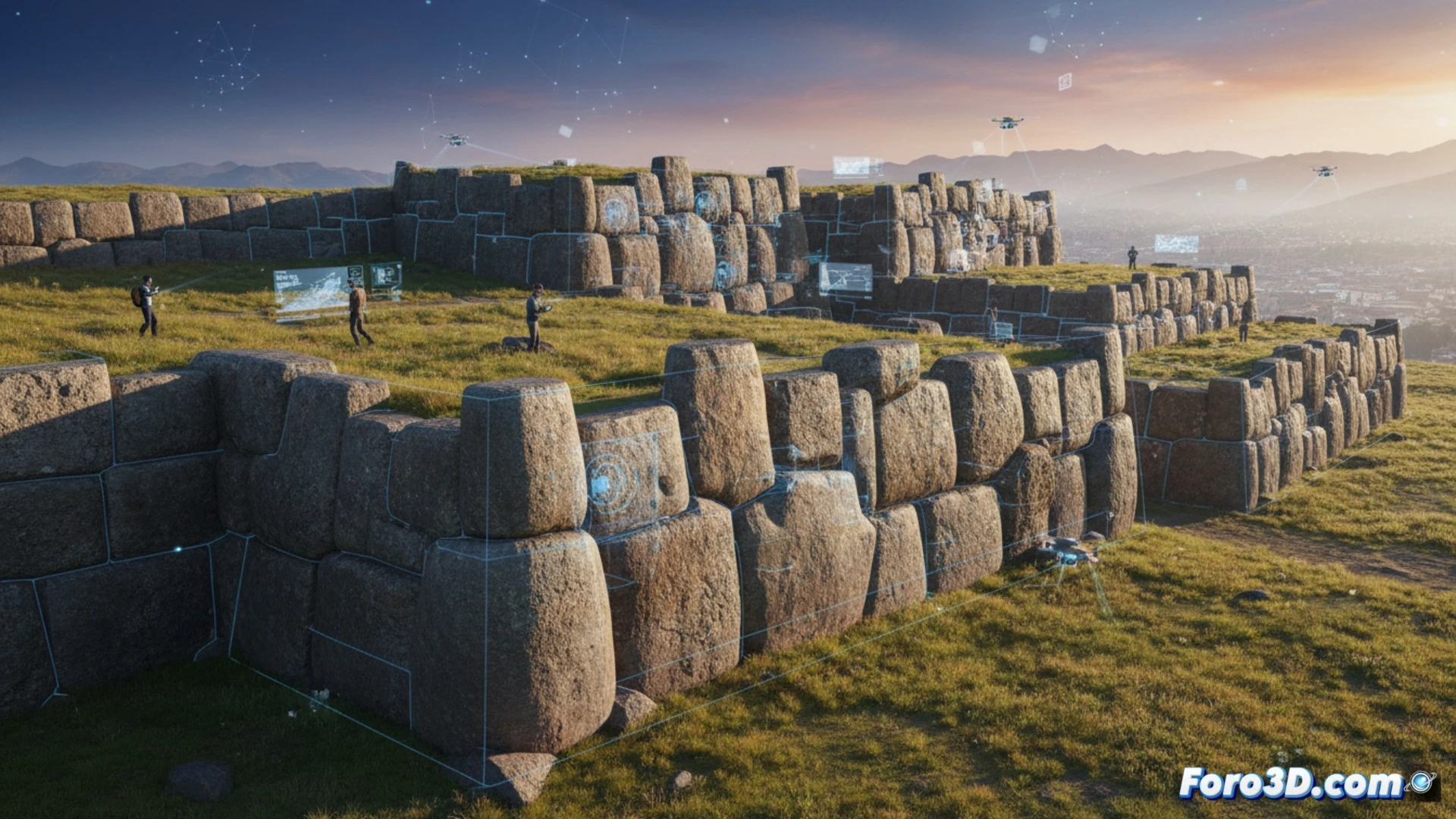
Photogrammetry and LiDAR: Millimeter precision at the service of heritage 🏛️
The analysis of Sacsayhuamán using high-resolution photogrammetry and LiDAR scanning allows capturing every irregularity, every angle, and every surface of its polygonal stones. Unlike traditional methods, these techniques generate point clouds with a density of millions of coordinates per square meter. The result is a digital twin that replicates the exact geometry of the structure. Researchers can then measure the joints, calculate the curvature radii of the blocks, and simulate virtual assembly processes. This non-invasive approach avoids any risk of physical damage while providing objective data to contrast theories about its construction, from the use of ramps to possible stone-softening techniques.
What does the digital model reveal that the human eye cannot see? 🔍
When comparing the 3D model with the actual structure, patterns invisible to the naked eye emerge. Analysis software reveals that the contact surfaces are not completely flat but slightly concave, suggesting a fitting mechanism based on friction and controlled wear. Micro-tool marks are also detected that could indicate the use of bronze chisels or, according to some hypotheses, molds made from an organic mixture. Digital archaeology does not solve the mystery, but it redefines it: we no longer ask how they moved those stones, but how they achieved a fit that our technology can barely replicate.
How can the 3D laser scanning of Sacsayhuamán resolve the debate over whether its stone walls, fitted with millimeter precision, were built using casting techniques or manual carving?
(PS: If you dig at a site and find a USB drive, don't plug it in: it could be Roman malware.)