An organ delivery drone crashes mid-flight without warning. Telemetry data shows no electrical or battery failures. The only clue is a subtle deformation in the wing casing. Through reverse engineering with Geomagic Wrap and CFD simulation in SimScale, a forensic team discovers that the alteration of the attack profile, caused by an external heat source, was sufficient to generate a catastrophic loss of lift.
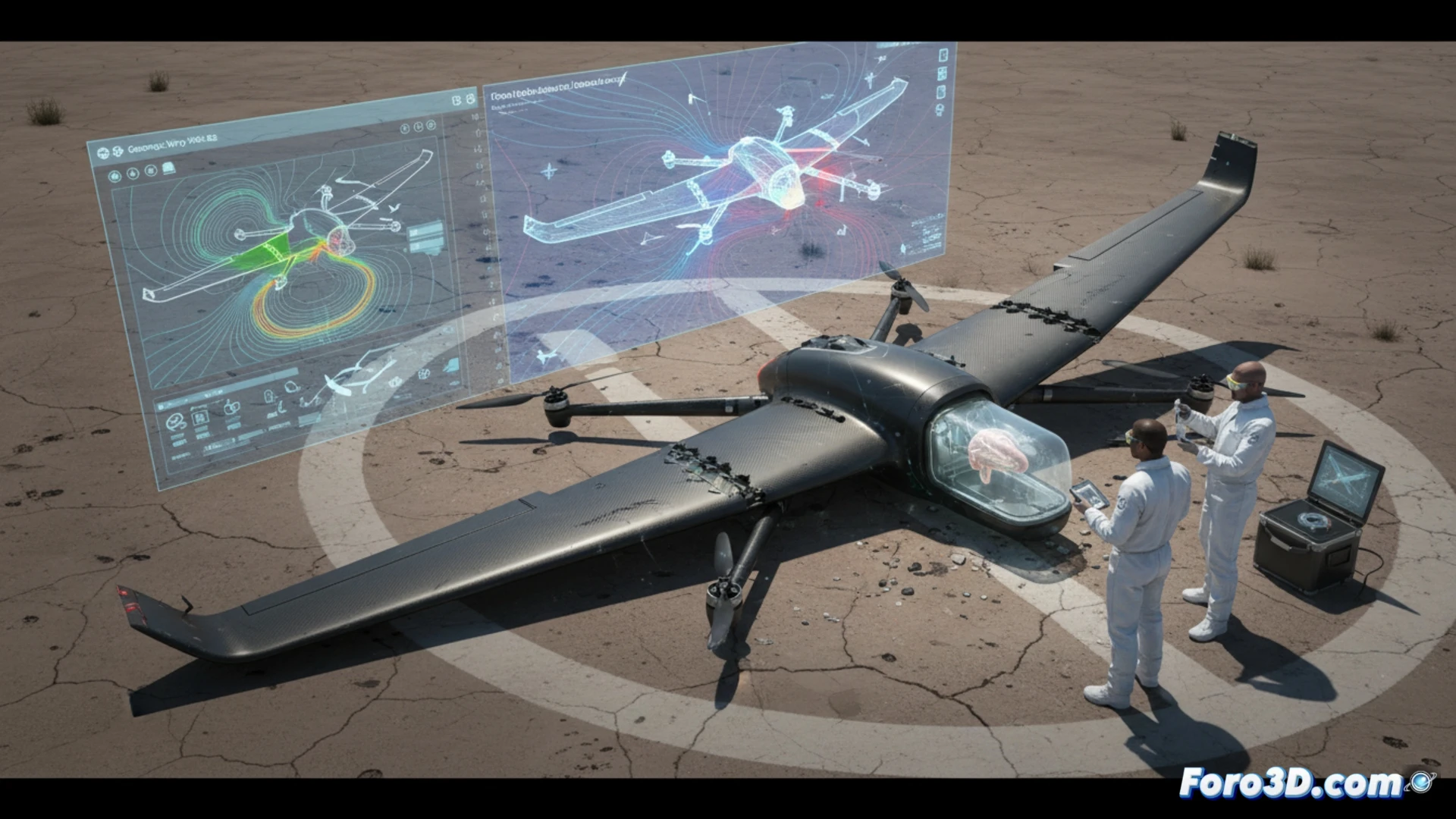
Virtual reconstruction and structural failure simulation 🛠️
The process begins with the 3D scanning of the damaged part. Geomagic Wrap allows generating a high-precision NURBS mesh from the deformed wing, comparing it with the original CAD model. This mesh is imported into SimScale to run an incompressible CFD analysis at cruising speeds. The results reveal that the deformation, barely 2 mm of bulging at the leading edge, breaks the laminar flow and generates a massive separation zone. Lift drops by 18% and the drag coefficient doubles, conditions that explain the uncontrolled descent. To document the case, Adobe Substance 3D Painter is used to map thermal damage textures onto the model, creating an exact visual replica of the evidence.
Lessons for emergency medical logistics 🚁
This case demonstrates that safety in critical drones cannot be limited to motor redundancy. A minimal sabotage, such as applying localized heat to a wing, can be lethal. The integration of digital twins and periodic CFD simulations should become a standard protocol. If every organ delivery drone had an updated simulation model, any deviation in its aerodynamic profile could be detected before takeoff, preventing catastrophes and saving lives.
Is it possible to detect, through CFD analysis, the presence of anomalous turbulence induced by aerodynamic sabotage in organ delivery drones when telemetry does not record obvious electrical or mechanical failures?
(PS: Simulating catastrophes is fun until the computer melts down and you are the catastrophe.)