An international study involving the United Kingdom, France, and the Netherlands reveals that exposure to specific flavors during pregnancy shapes children's food preferences years later. Researchers administered kale or carrot capsules to pregnant women, analyzed fetal reactions via ultrasound at weeks 32 and 36, and evaluated the children at three weeks of age and again at three years old. The results indicate a lasting olfactory memory: those who tasted carrots prenatally responded better to their smell at age three, while kale generated more negative reactions. Lead author Nadja Reissland suggests this finding may help parents foster healthy habits from the womb.
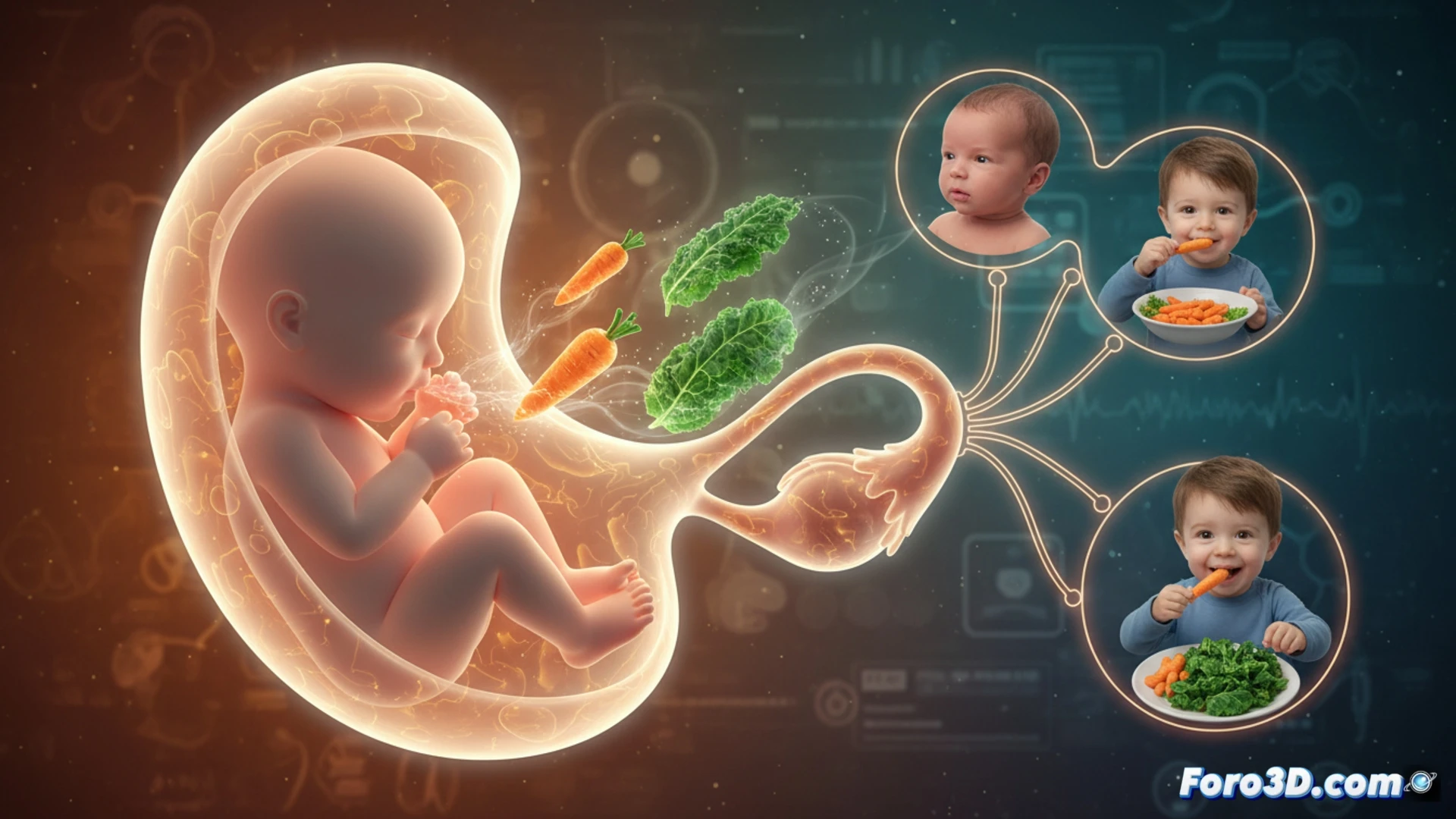
Technical visualization: 3D simulation of the flavor journey to the fetus 🧬
To apply this knowledge in the niche of nutrition and 3D food education, we propose the development of interactive three-dimensional models of carrots and kale that display their nutritional composition when rotated. These models would include animated layers showing how volatile compounds from each food travel through the maternal bloodstream to the amniotic fluid. Using animated 3D graphics, the process by which flavors reach the fetus could be simulated, highlighting the key weeks of olfactory development. This would allow parents to visualize the direct impact of their diet on preference formation, creating a powerful educational tool for prenatal clinics and nutritional tracking mobile applications.
Building healthy habits from the womb with 3D tools 🥕
This study opens a door to early intervention: if prenatal flavors create lasting memories, parents can use 3D models to plan menus that include vegetables from pregnancy. We suggest creating interactive resources where families visually explore the benefits of carrots (vitamin A) and kale (iron and fiber) through animations showing their fetal absorption. By combining science with three-dimensional modeling, we transform an academic finding into a practical strategy to reduce childhood food neophobia, empowering parents to cultivate healthy palates long before the first bite.
How 3D modeling of prenatal flavors could transform childhood food education and reduce resistance to healthy foods in early childhood
(PS: modeling an apple in 3D is easy; the hard part is making it not look like a sphere with a red texture)