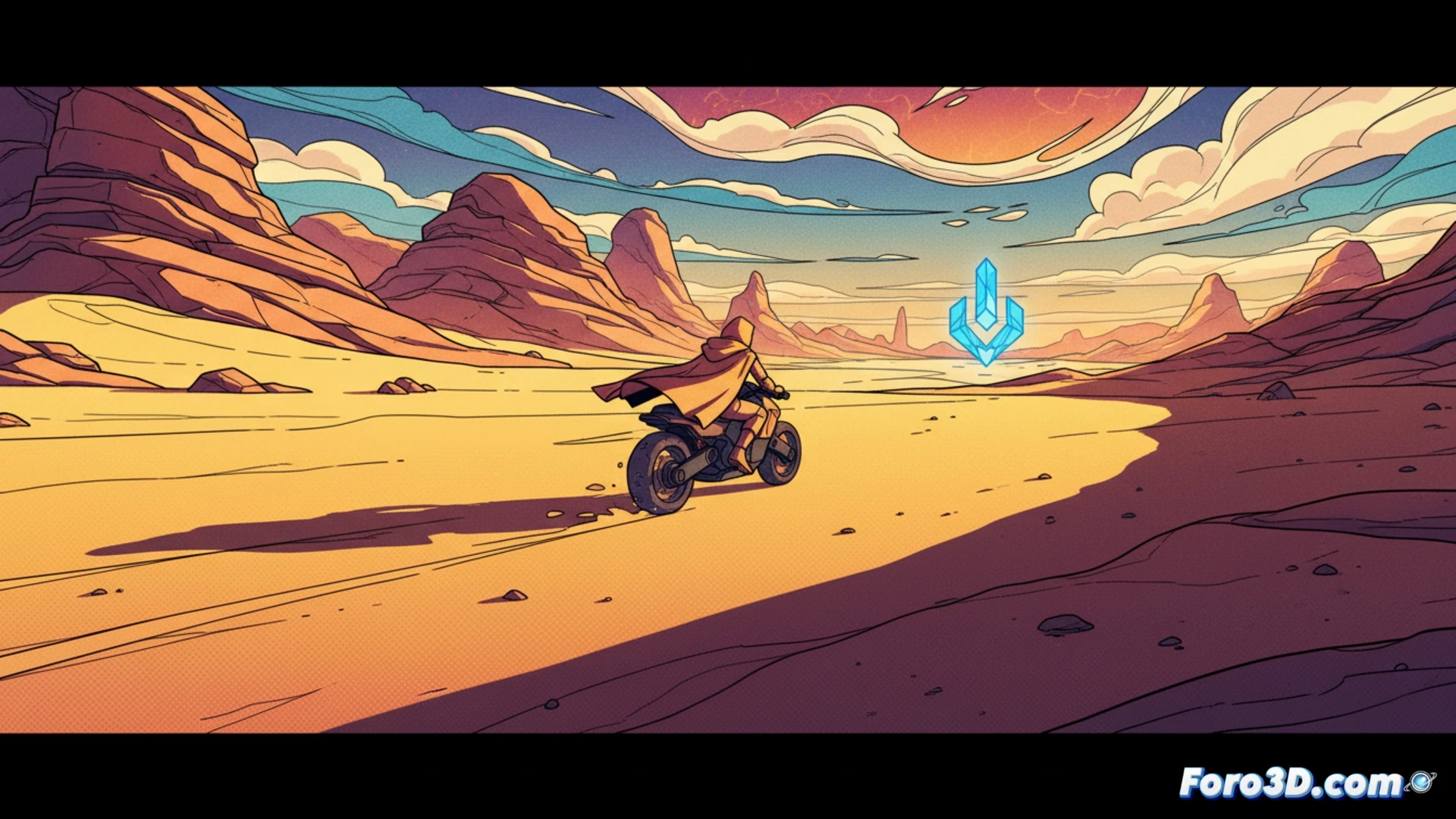
The independent video game Sable has captured the attention of the development community with its bold aesthetic gamble. Far from seeking photorealism, the team opted for an artistic direction that pays homage to the legendary illustrator Jean Giraud, known as Moebius. Using Unity as its base engine, the game combines crisp line art, flat colors, and a deliberately reduced frame rate for characters, creating a visual experience that feels like an interactive comic in motion. 🎨
Workflow: From 2D Pattern to Low-Poly 3D Model 🛠️
The production of Sable demonstrates an efficient hybrid pipeline for small studios. The design of textures and visual patterns is done in Adobe Photoshop and Illustrator, where the characteristic line art outlines and flat color palettes that define the world are created. These 2D assets are exported as textures to be applied to 3D models created in Blender. The architecture and vehicles are built with low polygonal count, a technical decision that not only saves resources in Unity but also reinforces the comic panel aesthetic. The key is that simple models allow the line art of the textures to stand out without competing with unnecessary geometric details.
Animation as a Narrative Tool 🎬
One of the most interesting technical risks of Sable is the deliberate reduction of the frame rate in character animations. While the world and vehicles move fluidly, the characters are animated at a few frames per second. This technique, far from being a mistake, evokes the feeling of stop-motion or a comic coming to life. For indie developers, this is a valuable lesson: technical limitations, when applied with artistic intent, do not detract from quality but rather build a solid narrative identity that differentiates the title in a saturated market.
How does Sable manage to translate Moebius's aesthetic into a 3D engine like Unity without losing the essence of the organic strokes and flat color characteristic of the artist?
(PS: 90% of development time is polishing, the other 90% is fixing bugs)