Film preproduction faces a constant dilemma: the speed of the sketch versus the precision of camera blocking. Runway Gen-3 Alpha addresses this blind spot with an AI model that prioritizes temporal consistency over chaotic generation. Far from being a random clip generator, this tool allows maintaining a character's identity, lighting, and object positions throughout a sequence—an essential requirement for any director looking to preview a long take or a dialogue without visual jumps.
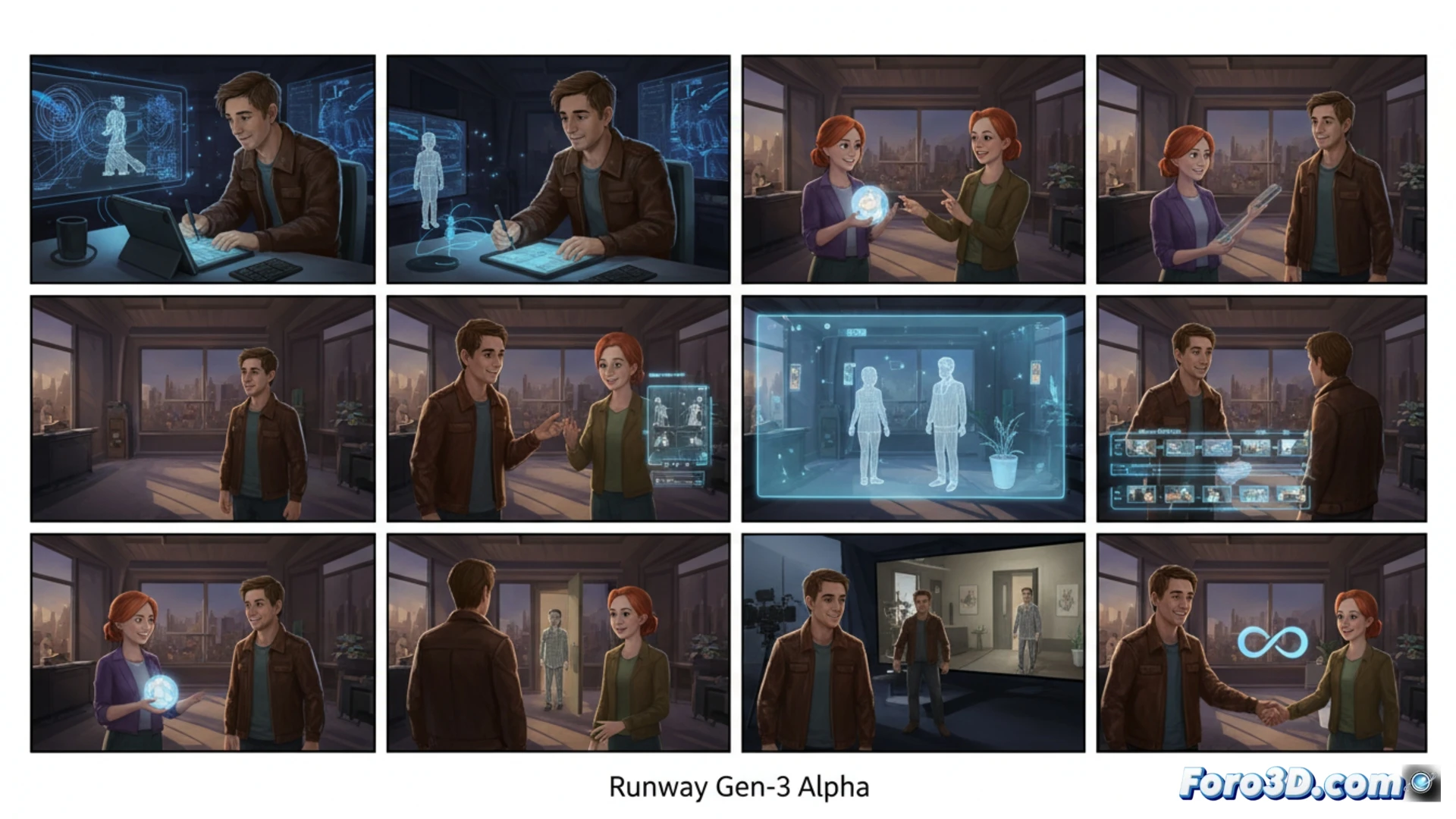
Temporal consistency and camera control in previsualization 🎥
Gen-3 Alpha's architecture differs from its predecessors by integrating a temporal attention system that links each frame to the previous one. For the storyboard artist, this translates into the ability to generate a lateral tracking shot or a dolly zoom without the background distorting or the main subject changing shape. In a hybrid workflow, the director can sketch a camera block in 3D (for example, in Blender or Unreal Engine), render a simple lighting base, and then pass that clip to Gen-3 Alpha to texture, add crowds, or refine facial expressions. The advantage over traditional 3D is speed: a complex 10-second shot can be ready for review in minutes, not hours. The limitation lies in the fact that artistic control is parametric, not absolute; the director trades brush detail for a coherence that was previously impossible to achieve with generative AI.
The director as curator of synthetic realities 🤖
The tool does not replace the director of photography, but redefines their role. Instead of physically adjusting a camera, the filmmaker now selects the correct latency between frames and trains the model to understand the physics of their scene. Runway Gen-3 Alpha allows executing complex shots like a reverse shot with a focus change or a 180-degree pan, maintaining the integrity of the actor's face. The final reflection is that preproduction is no longer a static sketch, but a kinetic rehearsal where AI acts as a digital stage director that respects continuity, though always under the supervision of a human eye that decides when the machine has correctly understood the story's tone.
How can Runway Gen-3 Alpha guarantee the coherence of visual continuity between automatically generated shots, without sacrificing the creative flexibility required by camera blocking in feature film preproduction?
(PS: Previz in film is like storyboarding, but with more possibilities for the director to change their mind.)