Indie video game development with a retro style faces the challenge of combining the limited aesthetic of pixel art with the fluidity demanded by a modern engine like Unity. Roots of Pacha is a perfect case study: it achieves surprisingly smooth wildlife animations and a dynamic seasonal cycle without sacrificing visual coherence. We analyze the key techniques every developer should know to emulate this result, from palette management to sprite optimization.
Animation techniques and real-time sprite optimization 🎮
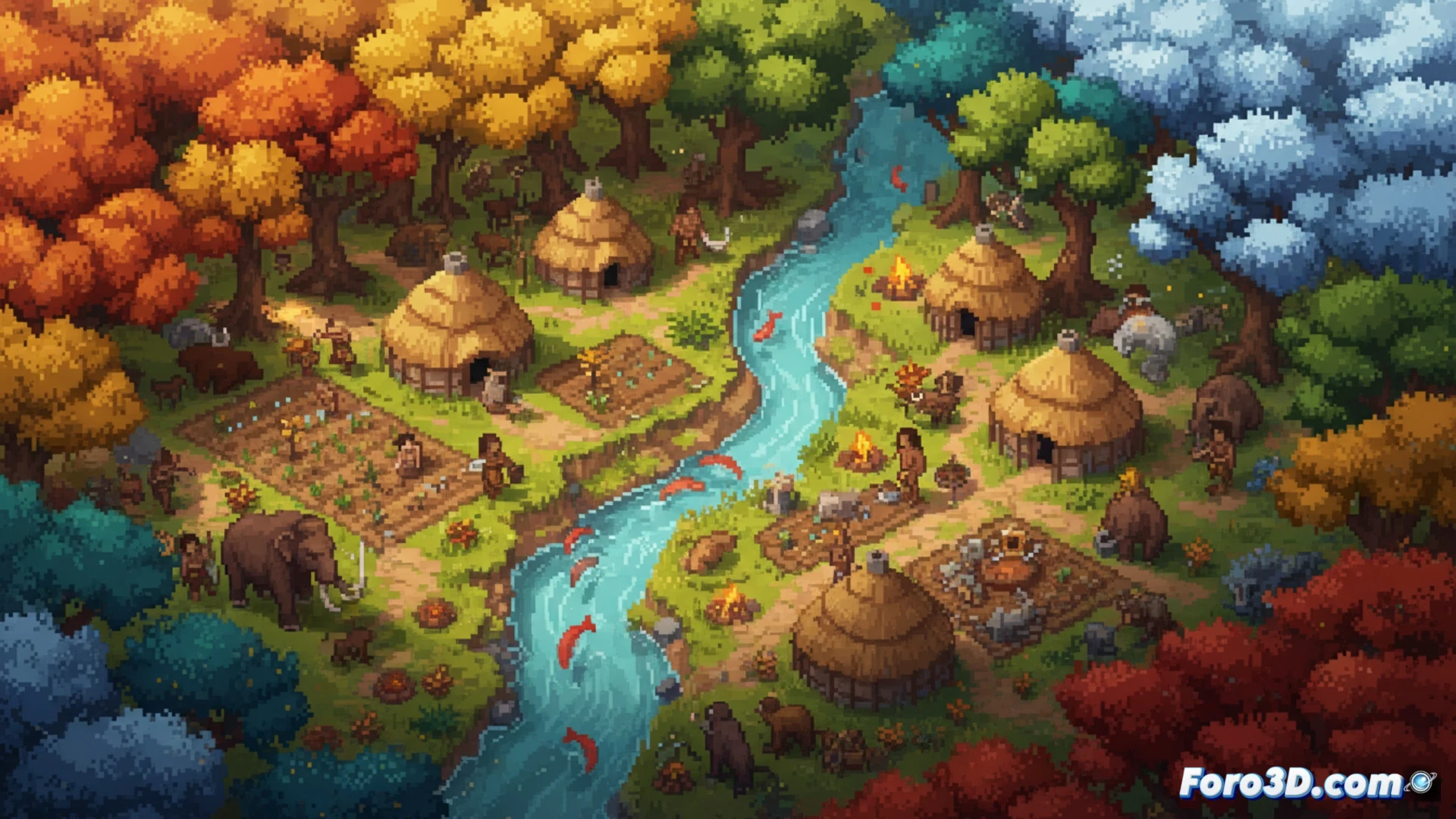
The key to Roots of Pacha's success lies in the use of spritesheets with frame interpolation. Instead of rigid 4 or 5 frame animations, the team implemented smooth transitions using C# coroutines that interpolate the position and rotation of animal bones. To avoid visual popping, each sprite was preloaded into an optimized texture atlas, reducing draw calls. The earthy color palette (ochers, browns, and muted greens) was managed through a custom Shader Graph that applies a dynamic LUT (Look-Up Table). This allows seasonal changes, such as snow or blooming, to modify the game's overall tone without replacing each individual asset. For indie developers, it is recommended to use Unity's Animator system with states parameterized by time variables (Time.time) instead of discrete triggers, which facilitates smoothness in movement loops.
Lessons for indies: technical simplicity with visual depth 🧠
Roots of Pacha demonstrates that a small team can achieve a coherent world without the need for complex 3D models. The main lesson is to prioritize resource management: use limited palettes (fewer than 32 colors per sprite) and compress textures to ETC2 format for mobile devices. Furthermore, the design of prehistoric mechanics (domestication, seasonal farming) benefits from careful level design planning in isometric 2D, where ground height is simulated with tile layers. For any indie, investing time in a season system based on animation curves (AnimationCurve) for sky color and global lighting is more cost-effective than manually painting 4 variants of each scenario.
How does Roots of Pacha balance the limited aesthetic of prehistoric pixel art with smooth animations in Unity without sacrificing retro authenticity?
(PS: a game developer is someone who spends 1000 hours making a game that people complete in 2)