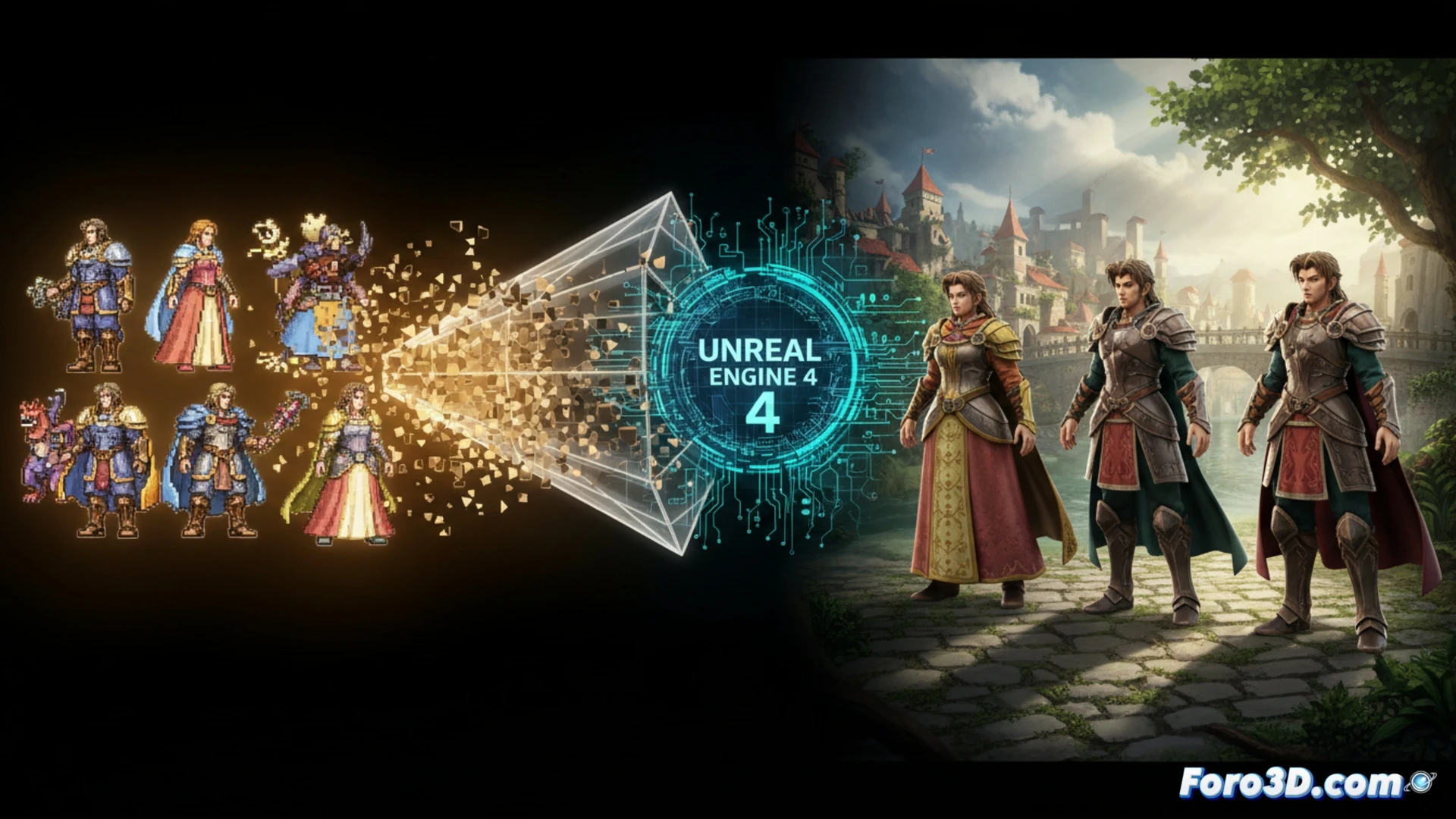
The recent release of Romancing SaGa 2: Revenge of the Seven represents a fascinating case study for developers. This remake is not limited to a simple facelift; it involves a complete migration from a 16-bit engine to Unreal Engine 4. The main challenge was translating 2D art (sprites) into a full three-dimensional environment, respecting the essence of Square Enix's original design. We analyze the artistic workflow and technical decisions behind this transformation. 🎮
Artistic Pipeline: From Sprites to Textured Models 🎨
The process begins in Autodesk Maya, where the base mesh for characters and environments is built. For classic enemies, the team turns to ZBrush, sculpting high-polygon details that are later retopologized to optimize performance on consoles and PC. Texturing in Photoshop focuses on maintaining the vibrant color palette and bold outlines of the original art. The technical key lies in Unreal Engine 4's shaders: Toon or stylized shaders are implemented that mimic cel-shading, preserving the 2D illustration appearance but with dynamic real-time lighting. This avoids the ragdoll effect and allows characters to integrate into detailed environments without losing their retro identity.
Dynamic Lighting and Optimization for the New Generation 💡
Dynamic lighting is the major qualitative leap. The team configured directional and point light systems in UE4 to simulate the time of day in dungeons and cities. However, the biggest technical challenge was optimization. Developers had to balance the high polygon density of models sculpted in ZBrush with performance on varied hardware. Aggressive LODs (Level of Detail) were implemented, and UE4's ambient occlusion system was used to reduce the load in outdoor scenes. The result is a remake that runs at 60 FPS on current-generation consoles, demonstrating that a pipeline based on Maya and ZBrush can be efficient if the asset hierarchy is planned from the start.
As a developer, what practical lessons about asset optimization and performance in Unreal Engine 4 can be extracted from the 3D pipeline of Romancing SaGa 2: Revenge of the Seven to achieve a high-quality aesthetic on limited hardware like the Nintendo Switch?
(PS: game jams are like weddings: everyone is happy, nobody sleeps, and you end up crying)