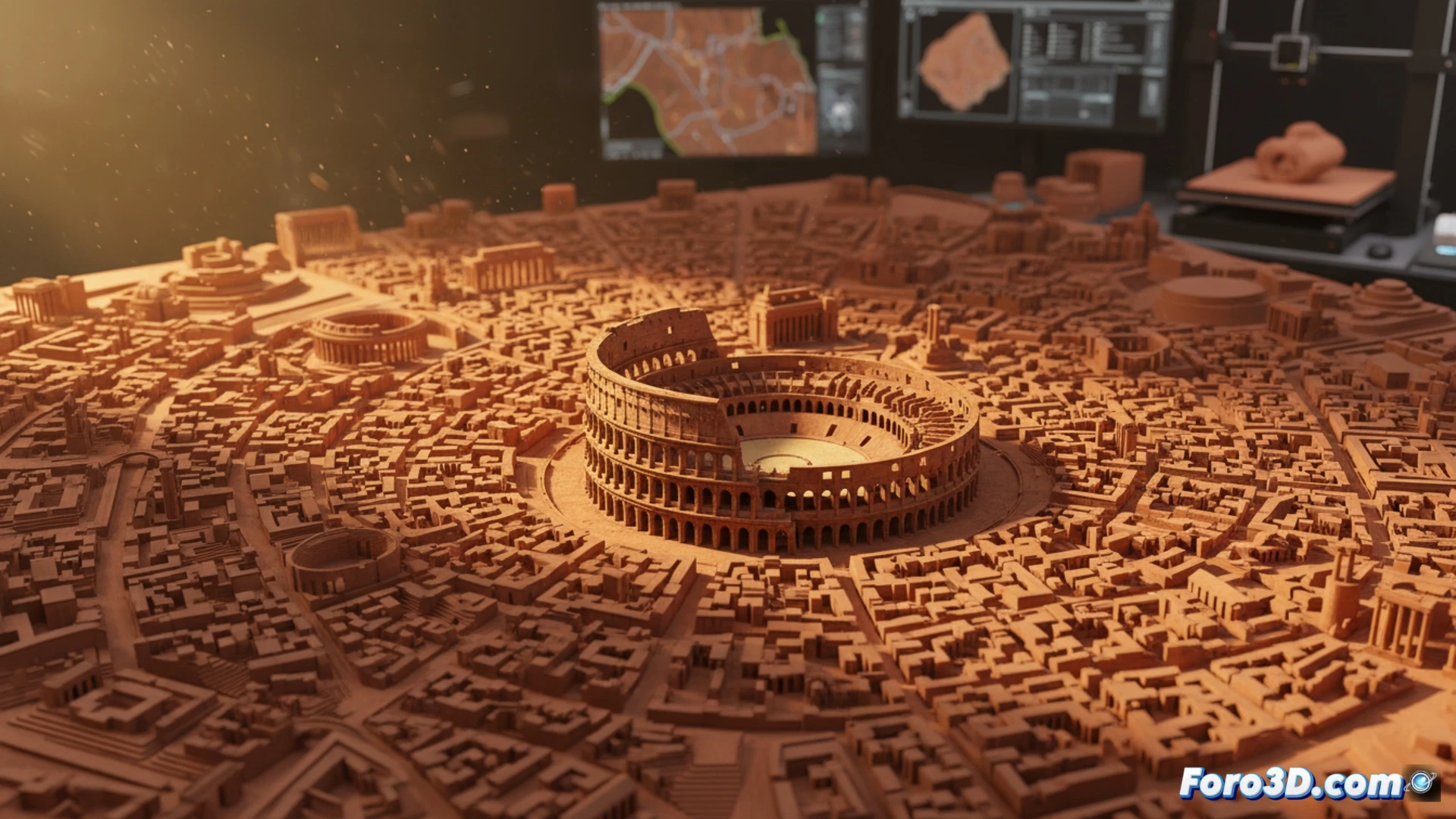
3D printing technology has achieved a milestone in digital archaeology: a scale model of ancient Rome, made entirely of terracotta using selective laser sintering (SLS). This project not only reproduces the Colosseum or the Forum but captures the original topography of the seven hills and the complete urban layout. The combination of historical data with digital modeling allows for precise recreation, offering an unprecedented scientific outreach tool.
Selective Laser Sintering: Precision in Powder 🏛️
The SLS process uses a high-power laser to fuse polymer or ceramic powder particles, layer by layer. For this model, terracotta powder was used, a material that replicates the texture and color of original Roman bricks. The key advantage of SLS over other technologies, such as FDM, is its ability to create complex geometries without the need for structural supports. This allows for reproducing fine details like aqueducts, arches, and staircases, as well as the irregular terrain relief. The resulting parts are strong and dimensionally stable, ideal for a scale assembly that must withstand handling and display.
A Bridge Between Archaeological Data and Tactile Experience 🔍
Beyond the technical achievement, this project demonstrates how SLS 3D printing democratizes access to heritage. Archaeologists can validate hypotheses about urban layout by physically holding an exact replica of the terrain. For the public, the model offers a sensory immersion that a screen cannot match. Terracotta, a humble yet history-laden material, emotionally connects with the past. This approach does not replace excavation but complements it, turning abstract data into a tangible experience that educates and inspires.
How is archaeological precision balanced with the technical concessions necessary in SLS printing when reproducing Roman structures at scale?
(PS: and remember: if you can't find a bone, you can always model it yourself)