The comic Superman: Red Son by Mark Millar is not just an alternate history; it is a visual manifesto that hijacks the iconography of the American hero to dress it in the aesthetic of socialist realism. The work uses Russian Constructivism, with its angular lines and bold typography, to build a discourse where art does not decorate, but indoctrinates. This analysis explores how the comic medium becomes a tool of visual activism, reimagining a cultural symbol to question the foundations of capitalism and the Cold War.
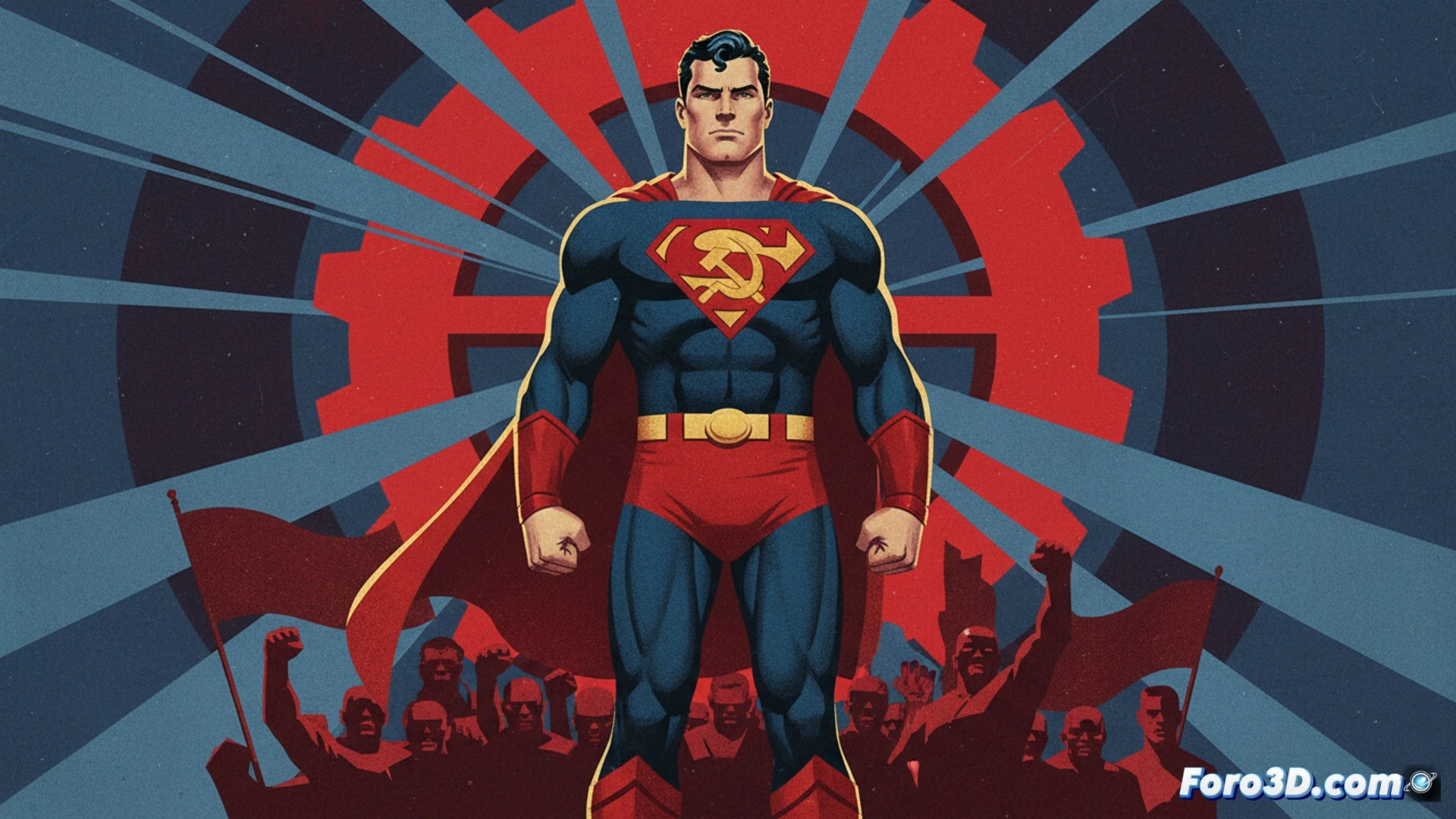
2D Constructivism and its Translation to 3D Environments 🎨
The art of Dave Johnson and Killian Plunkett relies on extreme chromatic contrast: cadmium reds on gray and steel blue backgrounds, evoking Soviet-era posters. For a 3D modeler, the key lies in hard directional lighting and sharp shadows that replicate the chiaroscuro of lithographs. When recreating scenes like Superman's speech in Moscow, one must use procedural textures that mimic the grain of newsprint and low-poly meshes for buildings, prioritizing silhouette over detail. Kal-El's suit, with its S replaced by the hammer and sickle, requires precise UV mapping so that the symbol does not lose its propagandistic power when rendered.
The Comic as Activism: Rewriting the Icon ✊
By stripping Superman of his American identity, Red Son demonstrates that art is an ideological battlefield. The work not only criticizes capitalism but exposes how visual aesthetics shape political perception. For the digital activism niche, this comic is a perfect case study: it shows that modifying a single visual element (the shield on the chest) can invert the meaning of an entire myth. 3D technology today allows for the creation of immersive virtual exhibitions where the user walks among those Soviet posters, experiencing firsthand how art can be the sharpest tool of political dissent.
Do you think digital art can have more political impact than traditional art?