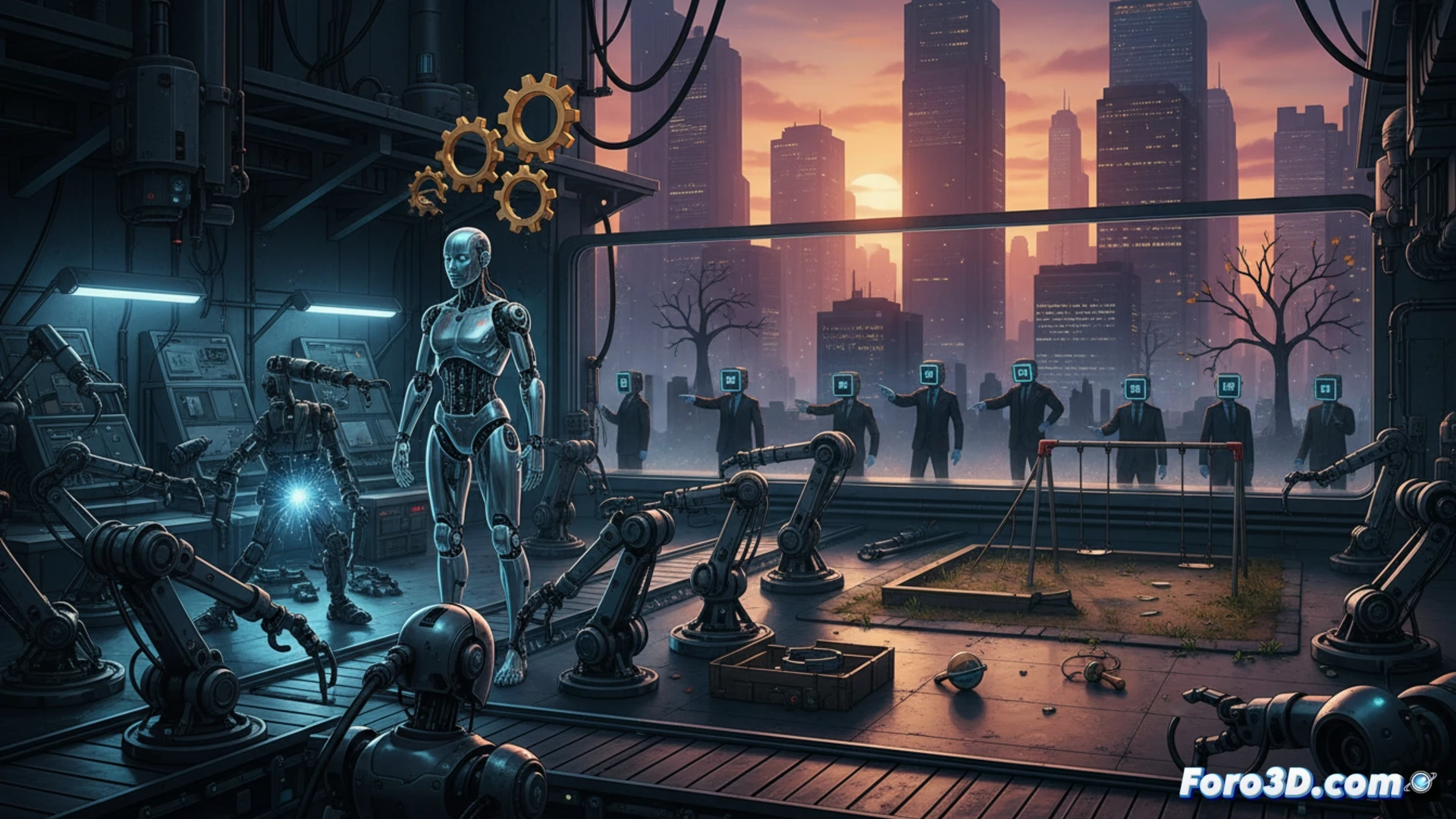
The news exposes an evident contradiction: while birth rates plummet due to job insecurity and lack of support for raising children, companies prefer to invest in robots to maintain production. Instead of guaranteeing decent conditions that allow people to start families, the choice is to replace workers. Thus, the system reveals its priority: machines before people.
Automation as a patch for an exhausted model 🤖
From a technical point of view, robotics and artificial intelligence advance to optimize processes and reduce costs. However, their massive implementation without work-life balance policies or fair wages deepens inequality. Automation systems do not create internal demand nor solve the underlying problem: a population that cannot afford to have children. Investment goes into sensors and mechanical arms, not into daycare centers or parental leave.
The new daycare is called an automated factory 🏭
Soon we will see robots in aprons bottle-feeding dummy babies, because why raise humans when you can program a hydraulic arm that doesn't ask for a raise or cry at night. Companies have discovered the ultimate trick: if there are no young workers, metal workers are manufactured. Of course, when the machines ask for retirement, they shouldn't complain.