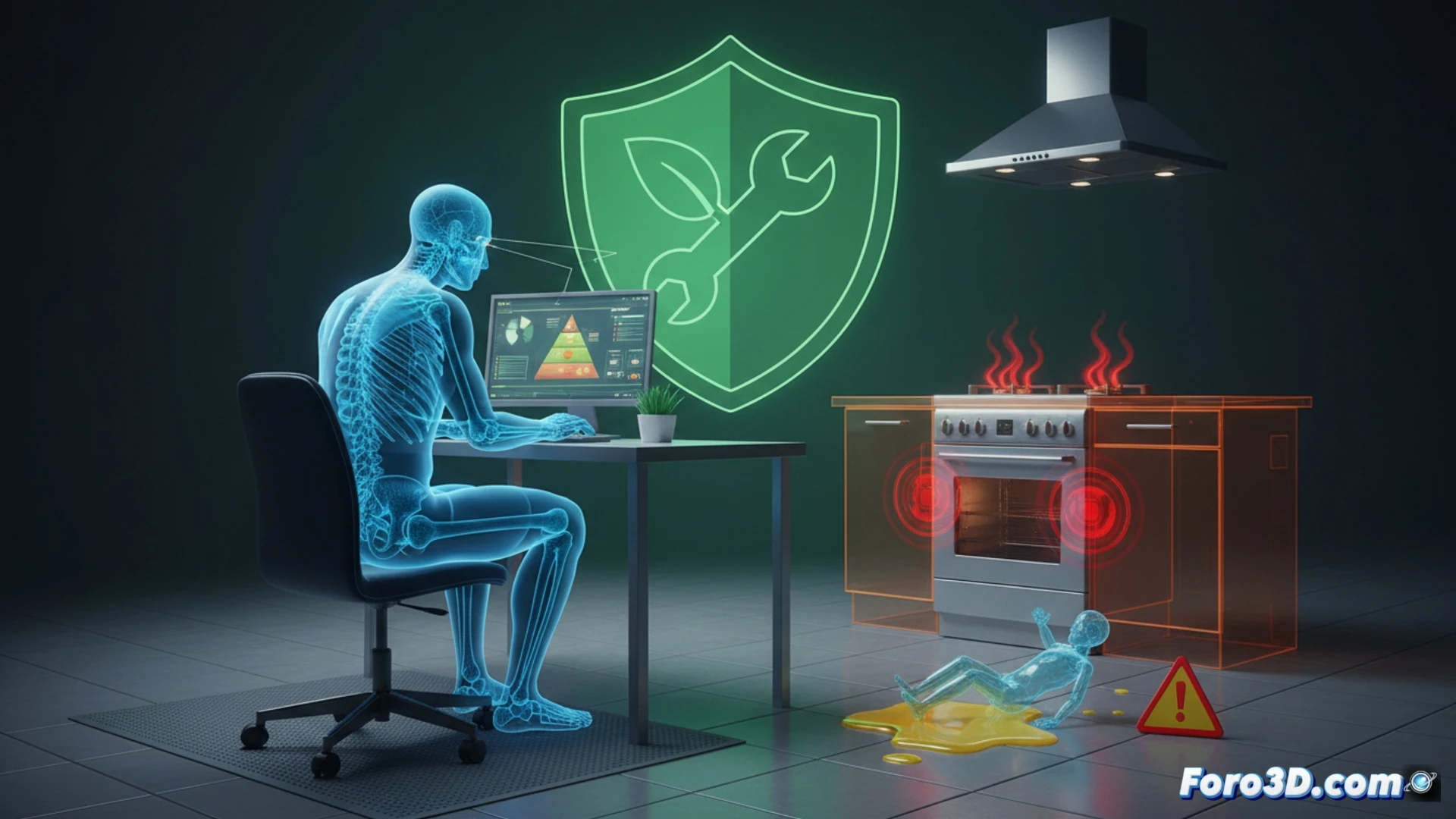
The profession of a dietitian, although focused on food health, hides occupational risks that are often overlooked. Sedentary behavior in front of the computer, visual fatigue from long hours of dietary planning, and forced postures during consultations combine with physical dangers in institutional kitchens: burns from hot surfaces, falls on greasy floors, and overexertion when handling food loads. We analyze how 3D modeling can transform prevention.
3D Modeling for Ergonomic and Environmental Prevention 🛡️
Three-dimensional visualization allows for accurately recreating the risk scenarios of the dietitian. Sustained forced postures during patient care can be modeled, simulating cervical and lumbar strain using biomechanical avatars. Visual fatigue can also be represented with heat maps on the computer screen, indicating areas of high eye strain. In the kitchen environment, interactive 3D infographics highlight danger areas: greasy floors with slippery textures, hot surfaces labeled with virtual thermometers, and optimized load trajectories to avoid overexertion. This methodology is ideal for occupational risk prevention courses in the nutrition and food education sector.
Technology as an Ally for Professional Well-being 💡
Beyond theory, the use of 3D environments allows the dietitian to safely experience the consequences of poor postural habits or a poorly designed environment. By simulating falls or burns in a virtual space, the need for non-slip footwear, anti-fatigue mats, and active breaks is better internalized. This visual and educational approach not only reduces accident rates but also dignifies a key profession in public health, reminding us that caring for the caregiver is the first step towards healthy eating.
How can 3D visualization of sedentary behavior and postural fatigue in dietitians transform the prevention of occupational risks in the field of nutrition and food education
(PS: modeling an apple in 3D is easy, the hard part is making it not look like a sphere with a red texture)