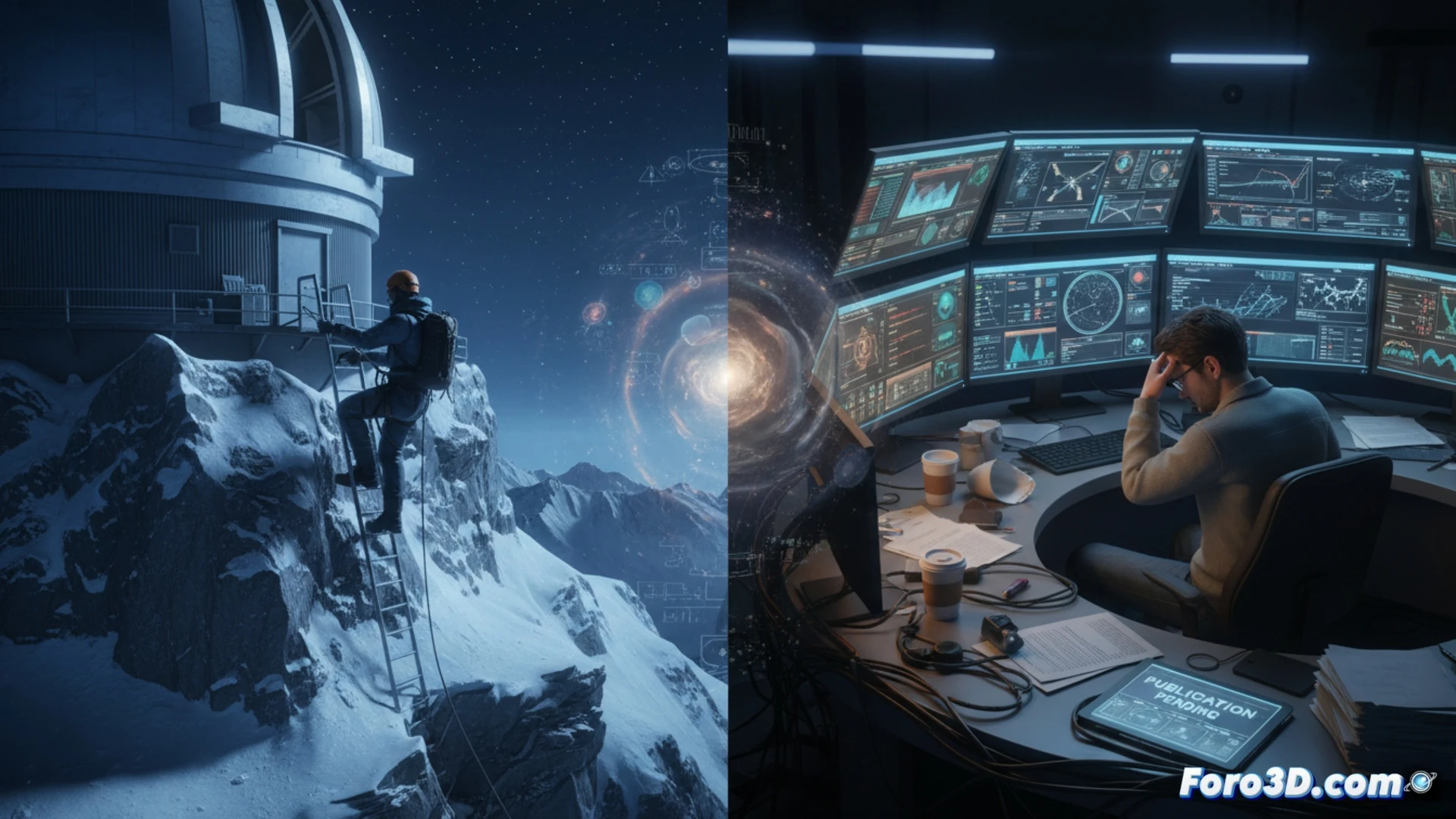
Astrophysics, despite its romantic aura of stellar discovery, hides a complex work reality. The professional faces a duality of environments: the high-altitude observatory, with risks of falls, hypothermia, and altitude sickness; and the digital office, where eye strain, a sedentary lifestyle, and publication stress generate chronic pathologies. We analyze these factors from the perspective of scientific visualization.
3D Modeling of Extreme Environments and Physiological Data 🌌
To represent these risks, we propose a digital twin of the observatory. The 3D model must include icy walkways and the open dome to simulate falls, integrating temperature and oxygen sensors to map hypothermia zones. In parallel, an office scene is created with high-resolution screens. Here, scientific visualization comes to life: we overlay eye strain graphs based on the Bunsen-Roscoe Law, stress heat maps derived from heart rate variability, and an animated timeline of the astrophysicist's circadian cycle, showing how night work desynchronizes sleep.
Humanizing Data for Effective Prevention 🛡️
The true value of this interactive infographic is not just aesthetic, but communicative. By seeing in 3D how a night at the telescope generates anxiety spikes or how eight hours in front of monitors deforms posture, the viewer understands the magnitude of the problem. Visualizing altitude sickness as a pressure layer on the skull or hypothermia as a blue color gradient on the body makes an abstract risk tangible, a key tool for awareness and designing safety protocols.
How can a 3D visualization effectively represent invisible occupational hazards, such as exposure to cosmic radiation or eye strain from analyzing astronomical data, to raise awareness among astrophysicists about their safety in the work environment?
(PS: fluid physics for simulating the ocean is like the sea: unpredictable and you always run out of RAM)