The craft of the artisan watchmaker involves a series of chronic occupational hazards that directly affect the professional's quality of life. Eye strain from working with millimeter-sized parts, forced postures of the neck and hands, exposure to solvents and cleaning oils, cuts from precision tools, and the stress derived from the required accuracy are constant threats. Faced with this scenario, digital jewelry and goldsmithing offer a significant paradigm shift.
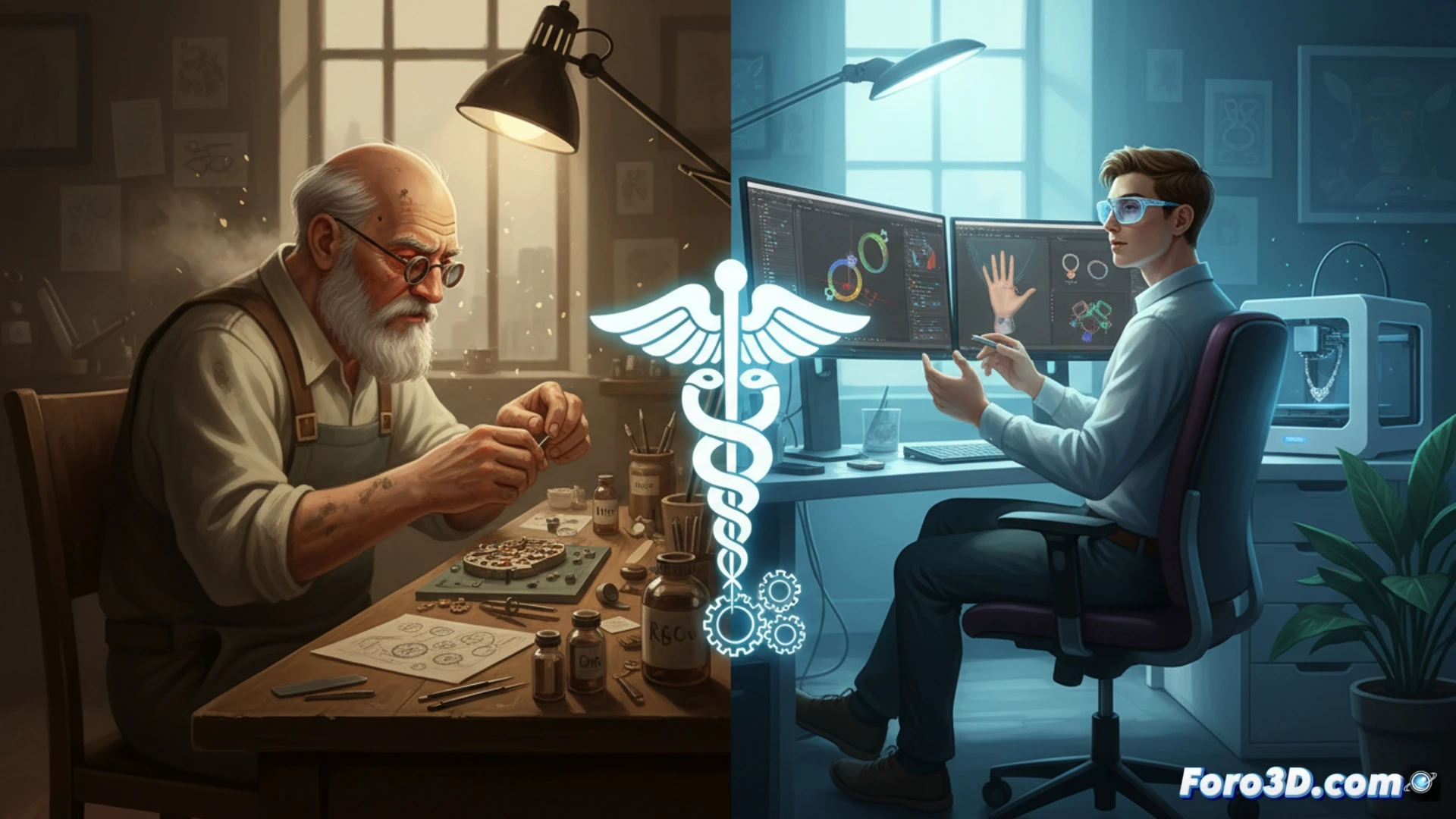
Ergonomics and safety: CAD vs. direct manipulation 🛡️
In the traditional workshop, the watchmaker spends hours bent over a bench with binocular loupes, straining the cervical spine and eye muscles. The introduction of 3D modeling (CAD) moves the design phase to an adjustable computer screen in height and distance, drastically reducing eye strain and static postures. Furthermore, by replacing the manipulation of real parts with virtual models, the need to use solvents and cleaning liquids during the prototyping phase is eliminated, thus avoiding contact dermatitis and the inhalation of toxic vapors.
Precision without stress: the value of additive manufacturing ⚙️
The pressure to avoid damaging a tiny mechanism with a cut or excessive force is a constant source of stress in manual watchmaking. Additive manufacturing, such as 3D printing for lost wax or directly in metal, minimizes the risks of cuts and forced postures. The digital artisan programs the machine and supervises the process, delegating the physical execution to the equipment. This not only protects the professional's health but also allows for greater precision without the physical wear and tear demanded by the traditional method.
Is it possible to mitigate the chronic ergonomic risks of the artisan watchmaker's trade by applying principles of 3D design and digital manufacturing in the creation of tools and workstations?
(PS: 3D jewelry allows you to wear jewels that don't exist... until you print them.)