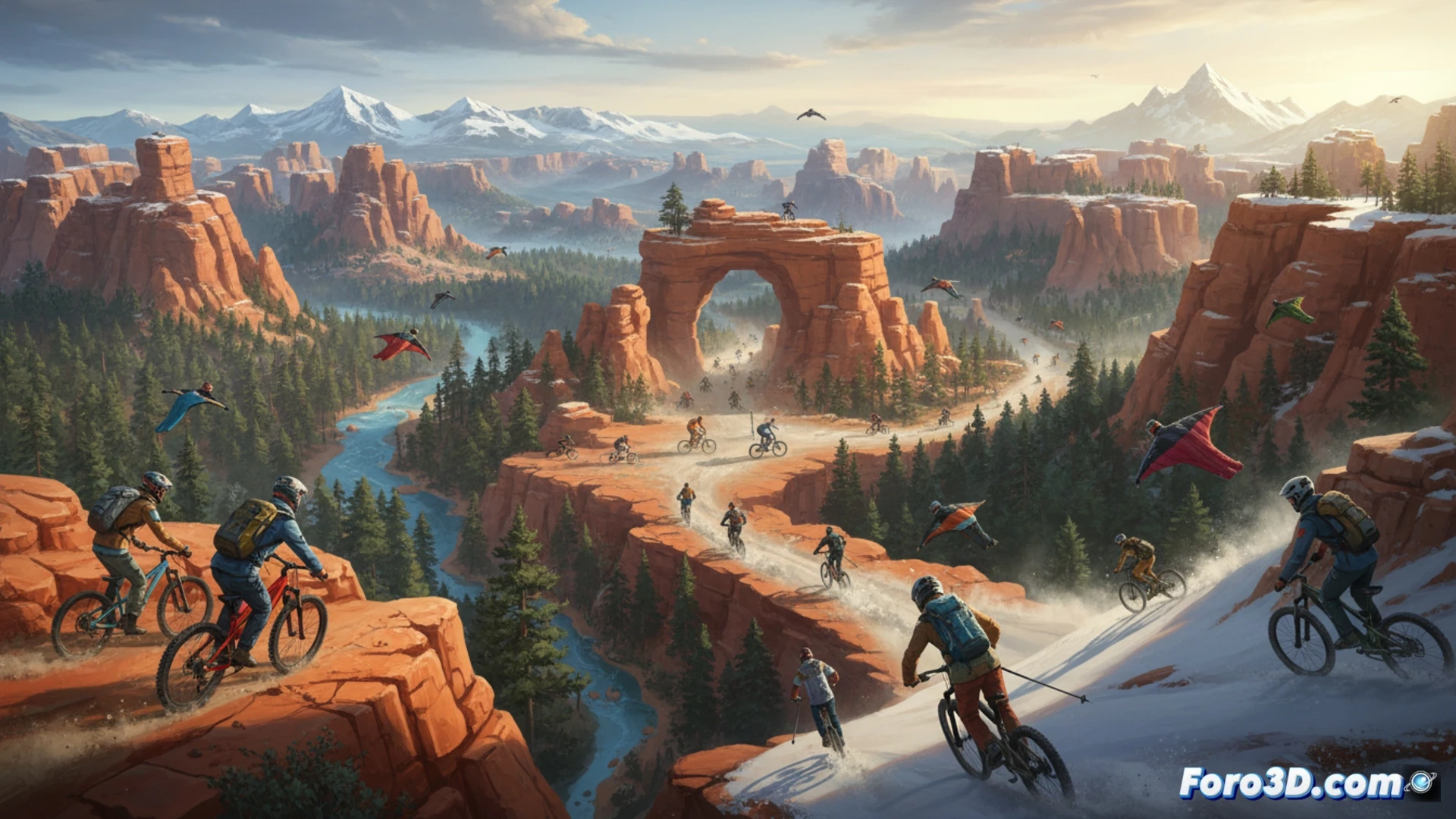
Riders Republic represents a unique technical challenge within Ubisoft's catalog: a sports open world where speed and massiveness collide. The proprietary engine, a direct evolution of the one used in Steep, was redesigned to manage the complexity of rendering over 50 simultaneous players on screen. This massive multiplayer capability, far from being a simple addition, demanded deep optimization of the graphics pipeline to maintain fluidity without sacrificing the visual fidelity of the national parks.
GIS Integration and Modeling in Maya 🏔️
The terrain base in Riders Republic is not fictional. The development team used GIS (Geographic Information Systems) tools to import high-resolution height maps of real locations such as Bryce Canyon and Yosemite. These raw elevation data were processed and refined in Autodesk Maya, where artists corrected artifacts and added vegetation and rock details. The result is a topography that maintains the real geological essence but adapted to the game's arcade physics. This workflow allows slopes and rock formations to be geographically coherent, a crucial detail for race tracks.
The Cost of Massiveness in Real Time ⚡
Synchronizing 50 avatars on high-definition terrain is not trivial. Ubisoft's engine implements an aggressive level of detail (LOD) system that reduces the geometry of distant players to simple silhouettes, and uses a predictive occlusion technique to hide racers not visible behind the terrain. The true technical achievement lies in the balance: the engine prioritizes physics calculations for the 10 closest players, while the rest are synchronized through state updates, thus achieving a massive race that feels dense but technically viable on consumer hardware.
How did the developers of Riders Republic manage to synchronize in real time the physics of 50 players on a procedural terrain generated by satellite without compromising the stability of Ubisoft's proprietary engine?
(PS: 90% of development time is polishing, the other 90% is fixing bugs)