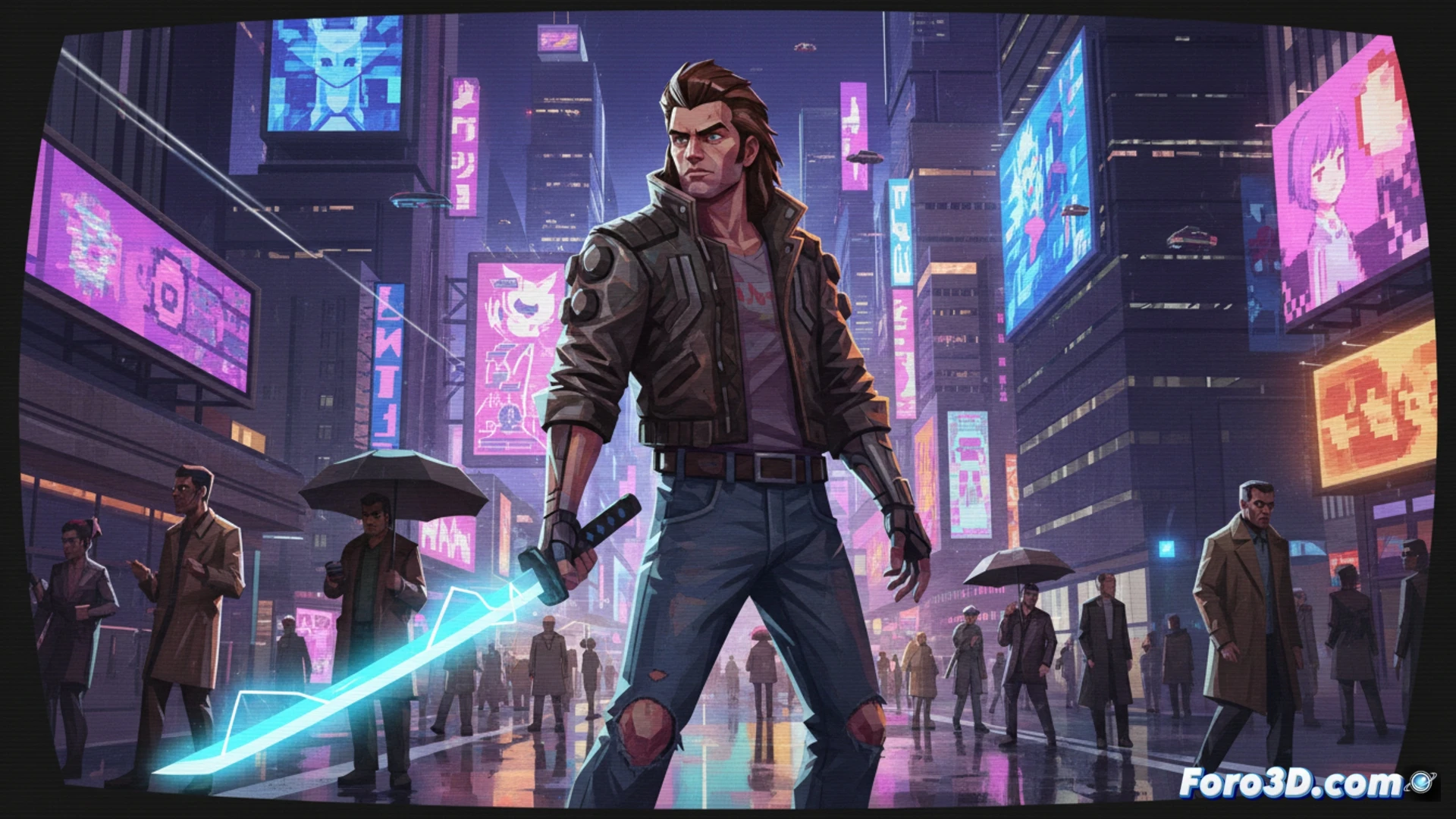
Mullet MadJack has captured the attention of the indie community for its ability to fuse 90s anime aesthetics with a neon-saturated cyberpunk environment, all executed in Unity. Far from being a simple visual filter, the game demonstrates a meticulous technical workflow that combines low-poly modeling, custom shaders, and a post-processing system that emulates the distortion and flicker of a CRT monitor. For developers seeking performance without sacrificing personality, this title offers valuable lessons on how to optimize a retro style without falling into mere nostalgia.
Workflow: Assets, shaders, and post-processing in Unity 🎮
The visual foundation of Mullet MadJack begins in Photoshop, where assets are designed with limited color palettes and thick lines, mimicking the limited animation of the 90s. In Unity, the use of neon shaders is key: emission effects are applied to simple geometries to simulate light tubes, avoiding the use of costly dynamic lights. Custom post-processing is the real trick. Instead of relying on Asset Store assets, the team implemented a Volume profile that includes chromatic aberration, film grain, and CRT scanlines with pixel interpolation. To maintain 60 FPS on modest hardware, it is recommended to use a low render resolution (e.g., 540p) and scale with a point filter to avoid smoothing, replicating the original pixelated look.
Tips for indies: how to achieve the effect without dying trying 💡
If you want to replicate this style in your Unity project, prioritize coherence over complexity. Use a color palette of no more than 16 tones per scene and limit particle usage. For the CRT effect, a simple scanline shader combined with a slight barrel distortion in post-processing is sufficient; you don't need to emulate the full tube physics. Additionally, disable anti-aliasing and use textures with power-of-two resolution (256x256). The success of Mullet MadJack demonstrates that true retro charm lies not in technical fidelity, but in artistic intent and smart optimization.
How did Mullet MadJack manage to replicate the 90s anime aesthetic in Unity without sacrificing performance in high-density visual cyberpunk scenarios?
(PS: game jams are like weddings: everyone is happy, no one sleeps, and you end up crying)