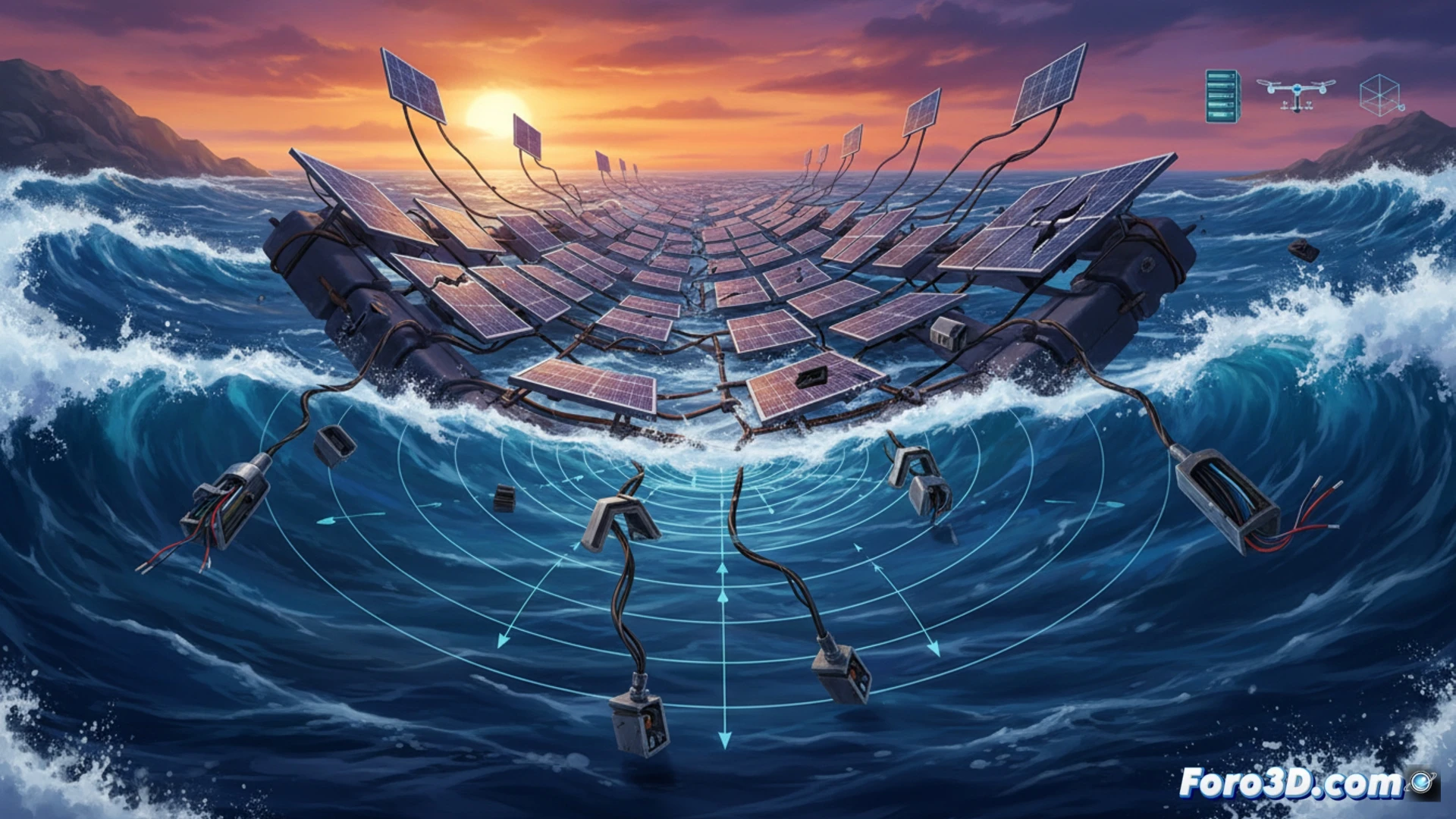
A silent catastrophe unfolded in a floating solar park when the structure began vibrating in unison with the waves. The CFD simulation, using Orca3D and Ansys Fluent, showed that the natural frequency of the floats matched that of the sea, generating a resonance that amplified forces until the connectors fractured. The total sinking of the platform, documented with Agisoft Metashape, now serves as a warning for the marine renewable energy industry.
Technical analysis of structural failure due to hydrodynamic resonance 🌊
The digital model, created in Orca3D, simulated the real wave conditions of the site. When running the analysis in Ansys Fluent, engineers detected an exact match between the wave frequency and the fundamental vibration mode of the panel array. This resonance caused vertical displacements of up to 2 meters, exceeding the elastic limit of the stainless steel connectors. Cyclic fatigue, accelerated by the increasing amplitude, fractured the anchor points in less than 4 hours. The debris, photogrammetrized with Agisoft Metashape, confirmed that the fractures showed signs of fatigue failure rather than direct impact, validating the CFD prediction.
Lessons for the future: digital twins as a safeguard 🛟
This collapse highlights the need to implement digital twins in renewable infrastructure. The combination of Blender to visualize the failure sequence and CFD data allowed recreating the disaster in real time, identifying the exact point of no return. If the park had been equipped with sensors and a predictive model, the resonance would have been detected in time to evacuate or modify the ballast. The industry must integrate these simulations from the design phase, not as a luxury, but as a mandatory safety protocol to prevent nature from turning innovation into rubble.
What critical parameters of the fluid-structure interaction in the CFD simulation went unnoticed, allowing the natural frequency of the solar park to match that of the waves to the point of collapse?
(PS: Simulating catastrophes is fun until the computer crashes and you are the catastrophe.)