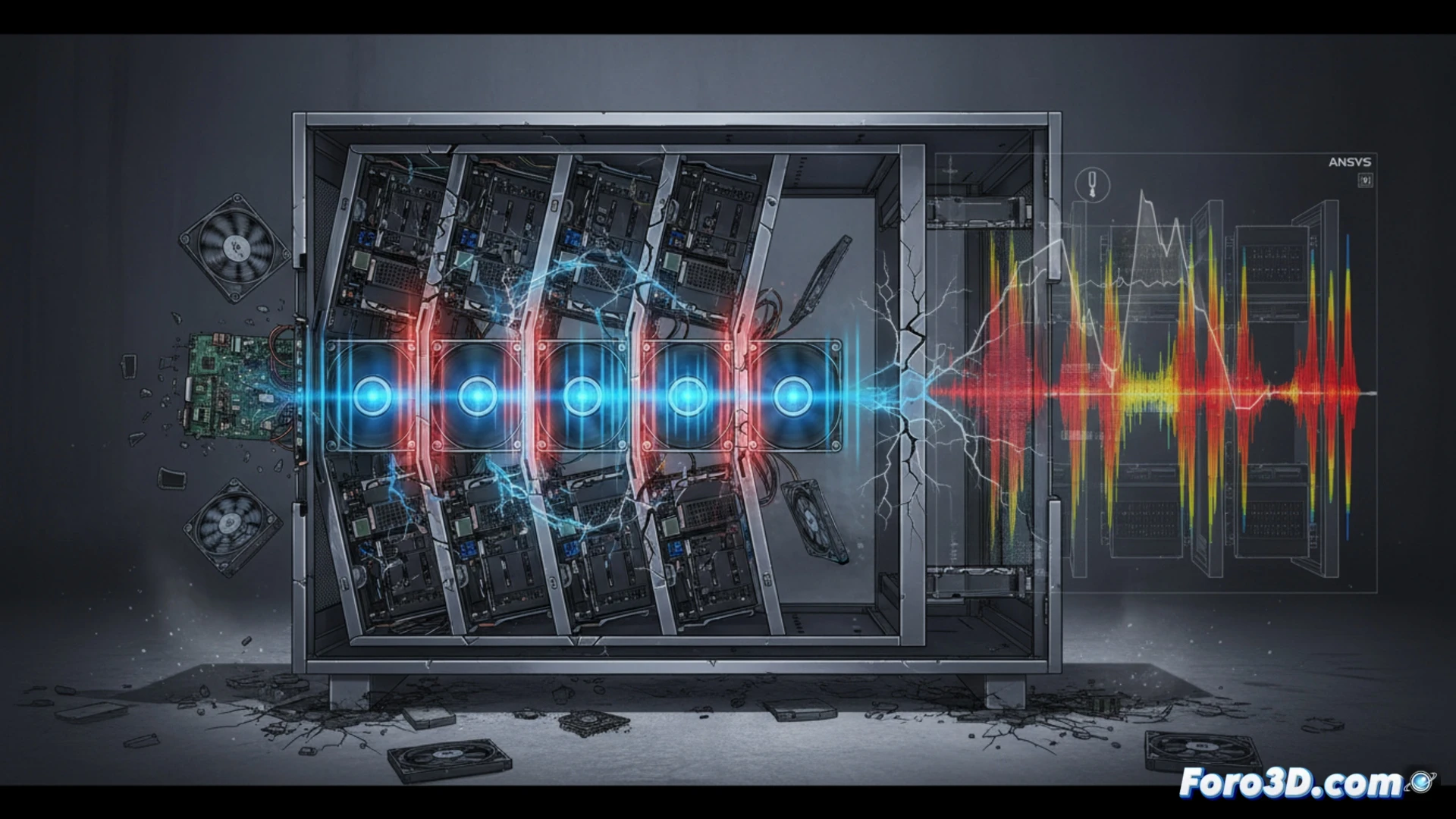
In a massive data center, the simultaneous failure of multiple servers alerted engineers. The origin was neither thermal nor electrical, but mechanical: excessive vibrations in HDD hard drives. A 3D mapping revealed that the high-speed fans, operating at 7200 RPM, coincided with the natural frequency of the metal rack, generating a harmonic resonance phenomenon that amplified deformations until causing fatigue failures in the disk mounts.
Modal analysis with ANSYS and 3D mapping in MATLAB 🔧
To diagnose the problem, a modal analysis was performed in ANSYS. The rack structure was modeled with steel profiles and typical data center boundary conditions were applied. The study identified the first natural frequency of the rack at 118 Hz, dangerously close to the fan excitation frequency (120 Hz). A cyclic stress simulation was run using high-cycle fatigue in ANSYS Mechanical, revealing stress concentrations at the welded joints of the rails. Additionally, MATLAB was used to process accelerometer data and generate a 3D map of vibration amplitudes. This map showed high-energy nodes at the hard drive anchor points, confirming that the localized resonance exceeded the fatigue strength limit of the aluminum mounts.
Lessons for critical infrastructure design ⚠️
This case demonstrates that material fatigue simulation should not be limited to isolated components. The interaction between cooling systems and the support structure can generate unpredictable failure modes. The solution involved redesigning the fan mounts with viscoelastic dampers and stiffening the rack's side panels, shifting their natural frequency above 150 Hz. In high-density environments, modal analysis and 3D vibration mapping are indispensable tools for ensuring long-term mechanical integrity.
What vibration analysis methodology do you recommend for identifying and isolating critical resonance frequencies in the side panels of a server rack before structural fatigue manifests?
(PS: Material fatigue is like yours after 10 hours of simulation.)