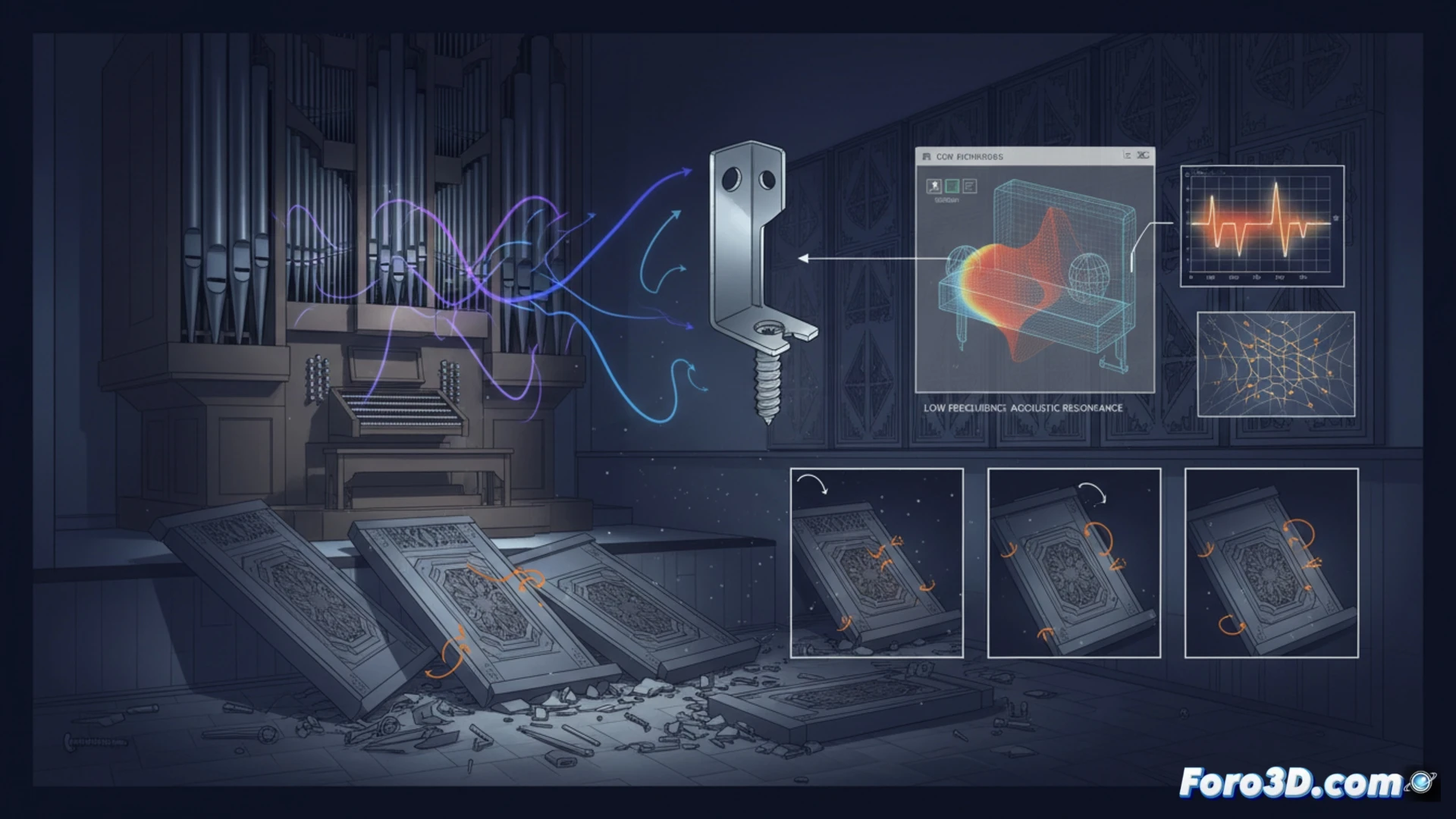
During a dress rehearsal, several large-format wooden panels collapsed onto the orchestra seating of a large auditorium. The initial hypothesis pointed to an installation defect, but forensic analysis revealed a more subtle cause: sympathetic resonance generated by the low frequencies of a pipe organ. This technical article details how the fastening system was modeled and the fatigue cycle was simulated to confirm the structural failure induced by sound pressure.
Parametric modeling and acoustic-structural simulation 🎵
The first step was to reconstruct the exact geometry of the panels and their fastening clips in Rhino, using Grasshopper to parameterize the critical variables: wood thickness, modulus of elasticity, and distance between anchors. This geometry was exported to Odeon, where the sound spectrum of the pipe organ in the 20 to 80 Hz range was introduced. The acoustic simulation calculated the sound pressure exerted on each panel, revealing peaks of 110 dB at the 32 Hz frequency. These pressure data were translated into cyclic loads on the clips. To validate the model, the fractured clips were scanned with Artec Studio; the fracture surface analysis showed propagation striations typical of vibration fatigue, coinciding with the resonance frequency identified in Odeon.
Lessons on designing against acoustic fatigue 🔧
The case demonstrates that material fatigue depends not only on obvious mechanical loads but also on seemingly harmless acoustic phenomena. The resonance frequency of the clips, calculated at 31.5 Hz, was dangerously close to the organ's fundamental frequency. This disregard for acoustic-structural coupling in the design of fastenings turned a musical rehearsal into a collapse risk. The integration of tools like Odeon and Grasshopper now allows predicting these failure modes before installation, preventing similar disasters in future auditoriums.
In the documented case, how was it determined that the acoustic resonance frequency generated during the dress rehearsal exceeded the fatigue limit of the structural adhesive of the wooden panels, and what simulation methodology would you recommend to predict this failure in future auditorium designs?
(PS: Material fatigue is like yours after 10 hours of simulation.)