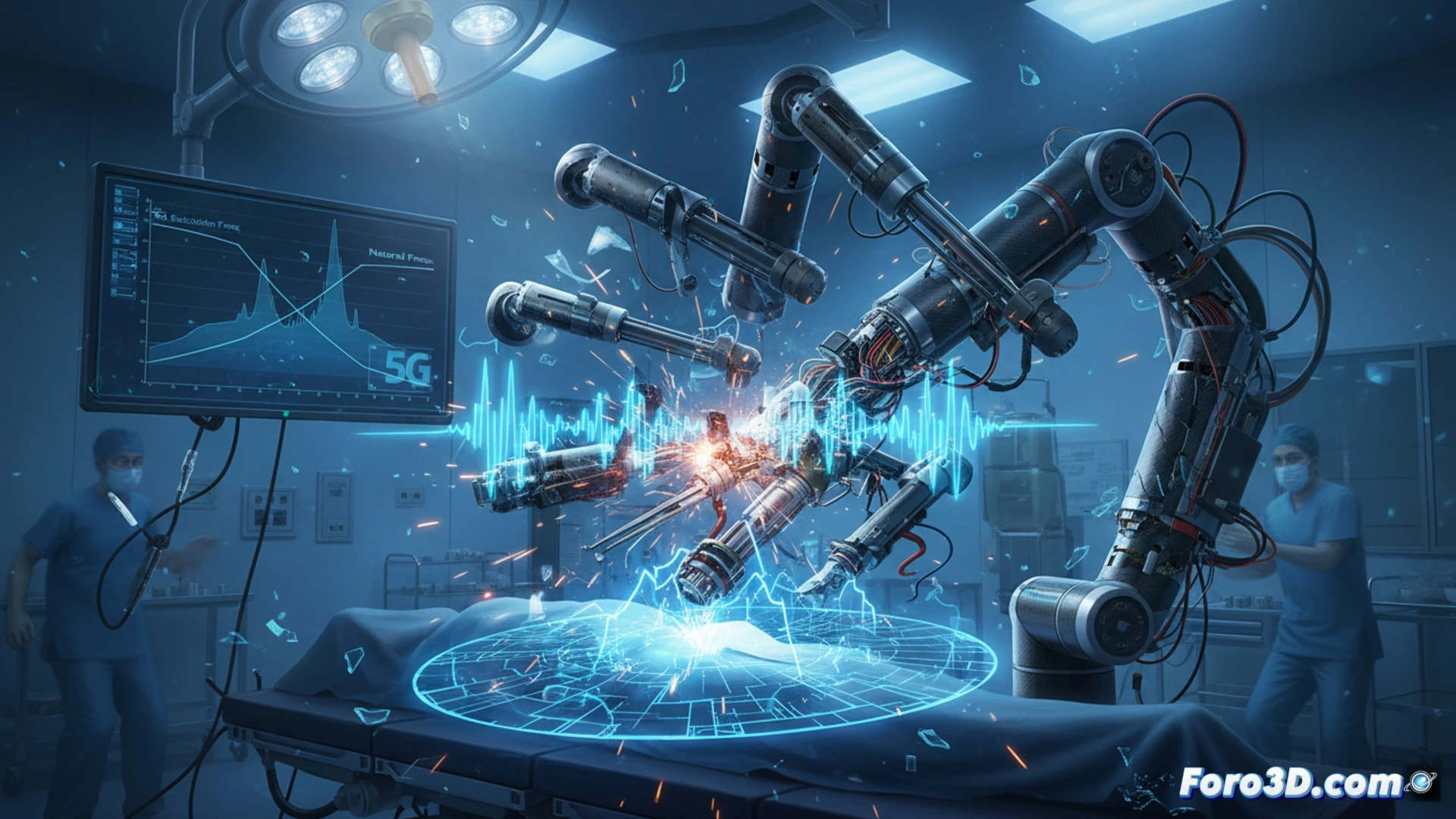
Last month, a 5G-assisted remote surgery procedure ended in a technical disaster when the robotic arm executed an erratic movement that fractured its structure. The initial investigation pointed to a software error, but the dynamic model revealed the truth: a synchronization failure in the 5G network induced an excitation frequency that matched the natural frequency of the end effector, causing destructive mechanical resonance in milliseconds.
Dynamic modeling and modal analysis in MATLAB/Simulink 🤖
The engineering team replicated the incident in MATLAB/Simulink using a rigid body model with flexible joints. By injecting the variable delay measured in the 5G network (latency spikes of 12 ms), the PID control system attempted to compensate for the difference, generating an overdamped correction signal. The subsequent modal analysis, performed with the system identification tool, detected an amplitude peak of 14.2 dB at a frequency of 8.7 Hz, corresponding to the second torsional vibration mode of the arm. For the visual simulation, the CAD model was imported from Blender to CoppeliaSim, where the structural flutter phenomenon was reproduced. The finite element mesh, processed in MeshLab, showed a stress concentration at the elbow that exceeded the yield limit of titanium.
Digital twins as a barrier against latency 🛡️
This case demonstrates that latency in 5G networks is not just a delay issue, but a mechanical risk factor in cyber-physical systems. A digital twin that integrates the dynamic model in real-time could predict these critical frequencies and block dangerous commands before resonance manifests. Remote surgical robotics needs to move from offline simulation to closed-loop validation with hardware-in-the-loop, where CoppeliaSim and MATLAB act as guardians of structural integrity.
The risk of electromagnetic resonance induced by 5G networks in surgical robotic arms can be mitigated through shielding or signal filtering without compromising the ultra-low latency required for telesurgery.
(PS: Simulating robots is fun, until they decide not to follow your orders.)