POC Lab has introduced two new technical resins for additive manufacturing that mark a milestone in industrial safety: Nylon-Like UL94 V-0 ESD and HT-240C UL94 V-0 ESD. Both materials integrate a V-0 flammability rating and electrostatic discharge (ESD) protection through carbon nanotubes and graphene, offering a dual solution for environments where fire and static electricity are critical risks.
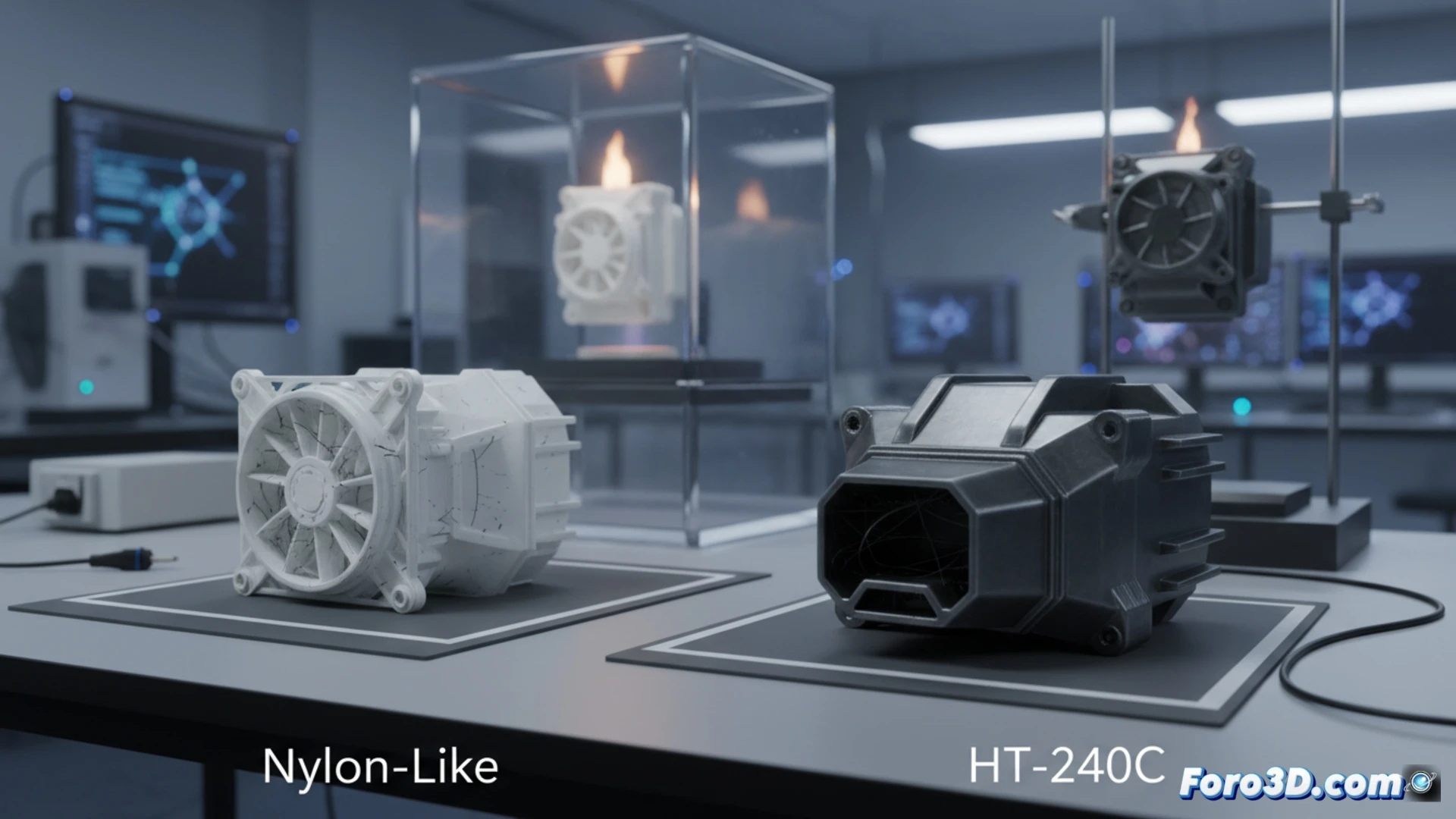
Property visualization: Thermal resistance and surface conductivity 🔥
To understand the performance of these resins, it is useful to visualize their properties in comparative 3D graphs. The HT-240C supports continuous temperatures of up to 240 degrees Celsius, while the Nylon-Like remains stable up to 180 degrees Celsius. On the surface conductivity axis, both achieve a resistivity of 10^6 ohms per square, an ideal value for dissipating charges without causing short circuits. A three-dimensional bar chart could show how the HT-240C surpasses the Nylon-Like in stiffness and elastic modulus, while the latter offers greater elongation and impact resistance. Additionally, electrostatic stress simulations reveal how carbon nanotubes form a conductive network that channels static electricity to ground, preventing dangerous buildups in electronic components.
Functional duality as a new standard in manufacturing ⚙️
The combination of UL94 V-0 and ESD in a single resin is not just a technical advancement, but a response to the need to simplify processes in sectors such as aerospace and automotive. Previously, engineers had to apply conductive or flame-retardant coatings to printed parts, adding steps and potential failures. With these materials, the intrinsic property of the polymer eliminates that extra layer, reducing costs and improving reliability. The open question is whether the 3D printing market will adopt this trend towards multifunctional materials, or if extreme specialization will continue to dominate the development of technical resins.
What practical implications does the combination of UL94 V-0 classification and ESD properties in Nylon-Like and HT-240C resins have for the design of electronic components subjected to high temperature?
(PS: Visualizing materials at the molecular level is like looking at a sandstorm with a magnifying glass.)