The National Commission of Markets and Competition (CNMC) has imposed a precautionary measure forcing Renfe to cede part of its workshops to Iryo for heavy maintenance, despite the original agreement only covering light work. Renfe has appealed the decision before the National Court, which will study the case without suspending the opening of the facilities. This conflict exposes tensions between the defense of competition and the property rights of critical infrastructures, a classic scenario in digital compliance where regulatory decisions generate quantifiable economic impacts.
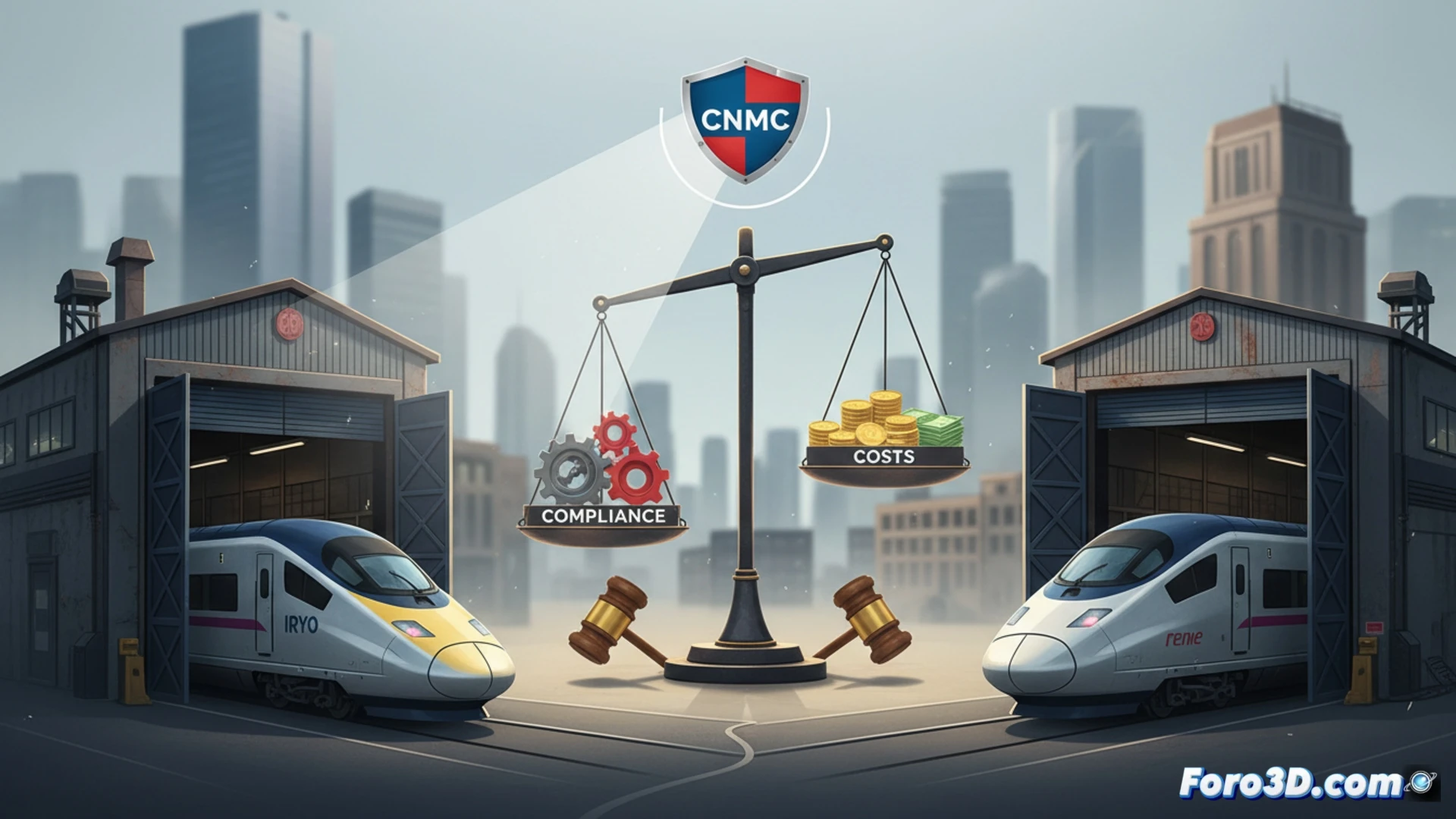
Conflict map: precautionary measures and judicial appeals 🚂
The legal structure of the case follows a procedural flow that can be visualized in three phases: first, the CNMC issues a resolution forcing Renfe to open its workshops, arguing that without this measure Iryo would be at a competitive disadvantage by having to send its trains to Italy. Second, Renfe files an administrative appeal before the National Court, which evaluates the legality of the decision. Third, the Court imposes a precautionary measure that maintains the obligation to cede while the merits of the case are resolved. A 3D diagram could show how these three entities (Renfe, CNMC, Court) interact in a cycle of recursive decisions, where the economic impact materializes in estimated losses of 60 million euros and 1.2 million seats per year for Renfe, according to its own calculations.
Alternative scenarios and compliance lessons ⚖️
Simulating alternative regulatory scenarios allows anticipating outcomes: if the National Court rules in favor of Renfe, the original contractual balance would be restored and Iryo would be forced to build its own workshops, but effective competition would be delayed. If it confirms the precautionary measure, a precedent of forced infrastructure cession would be established, with implications for future operators. From a digital compliance perspective, this case demonstrates that the absence of clear regulatory planning in railway maintenance generates transaction costs that must be visualized through economic impact and resolution time graphs. The final decision, pending before the Court, will define whether the Spanish railway market prioritizes immediate competition or legal certainty of contracts.
How can digital compliance in the railway sector balance the obligation to cede infrastructure to competitors with the need to ensure safety and cost control in maintenance?
(PS: verification systems are like print supports: if they fail, everything collapses)