Fragmentation is the silent enemy of archaeological heritage. In Copán, Honduras, a Maya stela shattered by time has found a second life in the digital space. The virtual reassembly process not only seeks to restore the original form of the piece but also establishes a non-invasive conservation protocol. Combining high-precision photogrammetry with parametric modeling, this project demonstrates how 3D technology can restore coherence to an object without a single finger touching the original stone.
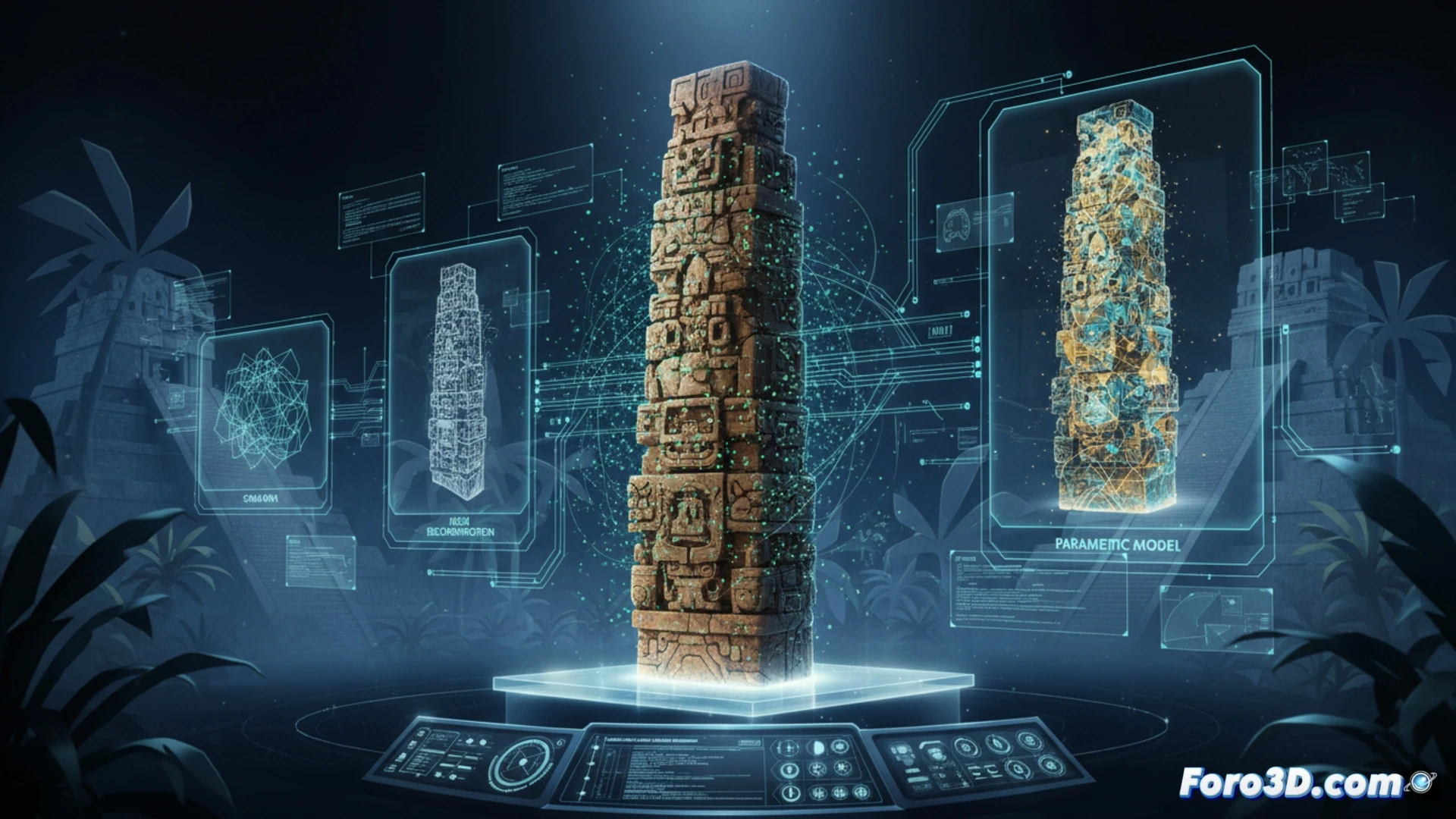
Workflow: Metashape, ZBrush, and Geomagic Design X 🛠️
The process begins with Metashape, where a set of high-resolution photographs is converted into a dense point cloud. Each fragment of the stela is captured separately, generating base meshes that are then exported to ZBrush. Here, the digital sculptor polishes the fractured edges and fills in eroded areas using dynamic brushes, respecting the original morphology of the glyphs. The key to the workflow lies in Geomagic Design X, where the digitized fragments are aligned using surface fitting algorithms. This reverse engineering software allows calculating the center of gravity of each piece and simulating the structural assembly, identifying real contact points between the blocks. The result is a solid model that anticipates how the stela should rest in the physical world.
Restoring without touching: the value of the virtual 🏛️
The great advantage of this approach is total reversibility. In a physical restoration, gluing fragments with resins or metal anchors involves an irreversible risk of chemical or mechanical damage. Digital reconstruction, on the other hand, allows epigraphers to study the arrangement of the hieroglyphs from any angle, and conservators to plan a minimal intervention. The Copán stela is no longer lost in the dust; it exists as an exact file, ready to be 3D printed or analyzed without haste. It is proof that, sometimes, to save a stone, the best thing is to turn it into data.
How to optimize the technical workflow of photogrammetry and fragment alignment to minimize the loss of epigraphic detail in the 3D reassembly of the Maya Stela of Copán
(PS: and remember: if you can't find a bone, you can always model it yourself)