The restoration of cultural heritage has taken a quantum leap with the application of 3D technologies. A recent success story has been the virtual recovery of a charred manuscript, where the paper, reduced to ashes and completely illegible to the naked eye, has been read again thanks to a meticulous process of digitization and algorithmic reconstruction.
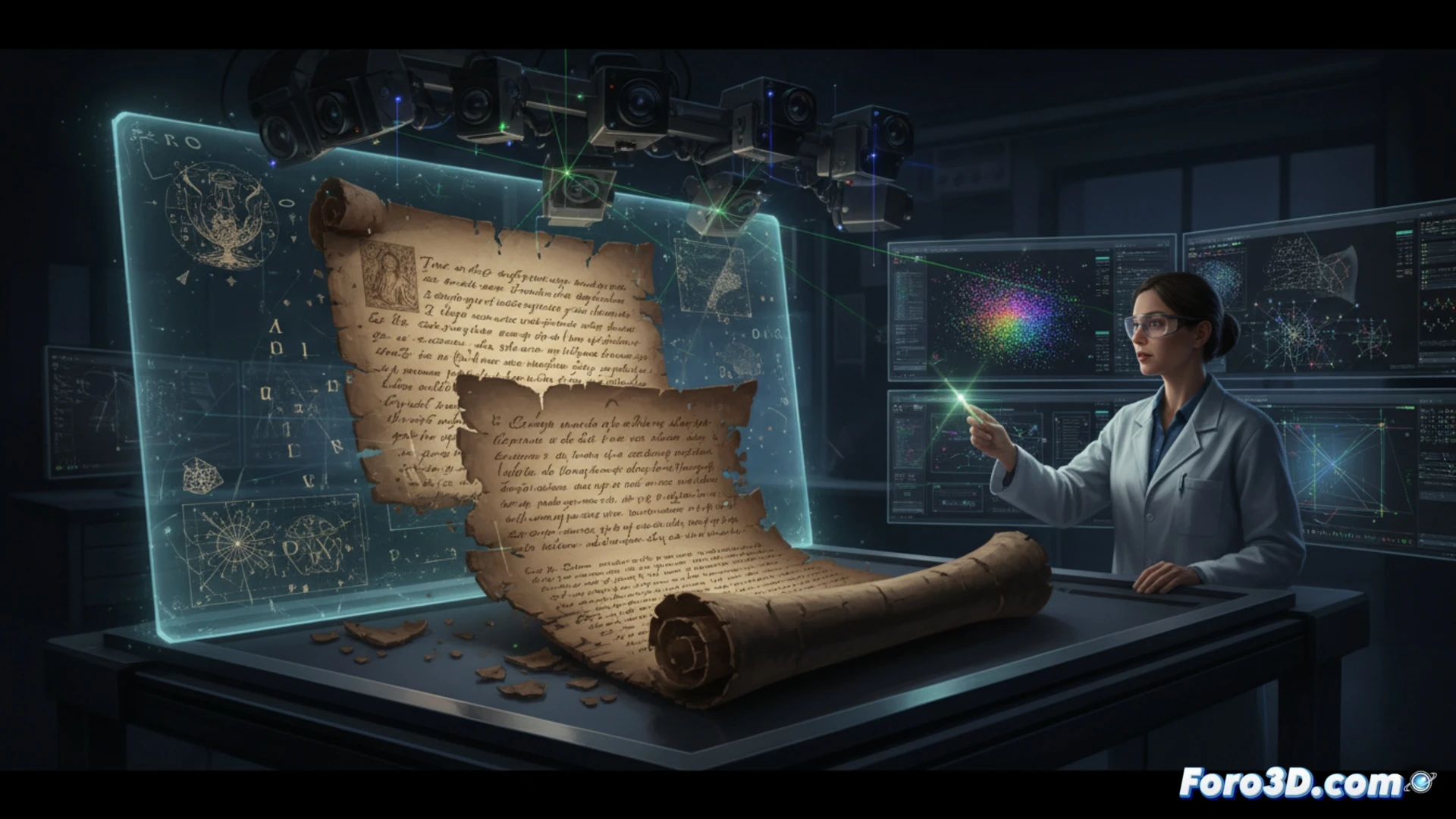
High-Resolution Photogrammetry and Algorithmic Reconstruction 🔬
The technical process begins with capturing the geometry of the carbonized document. Since any physical contact could disintegrate the piece, close-range photogrammetry with controlled and polarized lighting is used. Hundreds of high-resolution images are taken from multiple angles, capturing not only the surface texture but also the micro-deformations of the volume. The photogrammetry software generates a dense point cloud and a polygonal mesh model. The key lies in post-processing: contrast-based segmentation algorithms isolate areas with residual ink, while digital restoration tools (such as intelligent cloning and noise removal) reconstruct the parts of the text that carbonization had visually fused.
Towards an Interactive 3D Model for Research 🖥️
The final result is not just a flat image, but an interactive textured 3D model. This digital asset allows paleographers to rotate, zoom in, and illuminate the manuscript virtually from any angle without the risk of physical handling. Additionally, cross-sections of the paper thickness can be generated to analyze ink penetration. This workflow demonstrates that 3D technology not only preserves but also reveals information that the human eye, or even a traditional microscope, could not extract from such a fragile object.
What specific technical challenges did you face when digitally reconstructing the ink and support layers of a charred manuscript without damaging its original structure?
(PS: Restoring virtually is like being a surgeon, but without blood stains.)