The recovery of three female bodies from the waters of Brighton, off Madeira Drive, activated the Sussex Police protocol this week. Chief Superintendent Adam Hays confirmed the opening of an investigation to identify the victims and clarify the circumstances of the incident. In these cases, spatial documentation and the simulation of aquatic dynamics are crucial for forensic reconstruction.
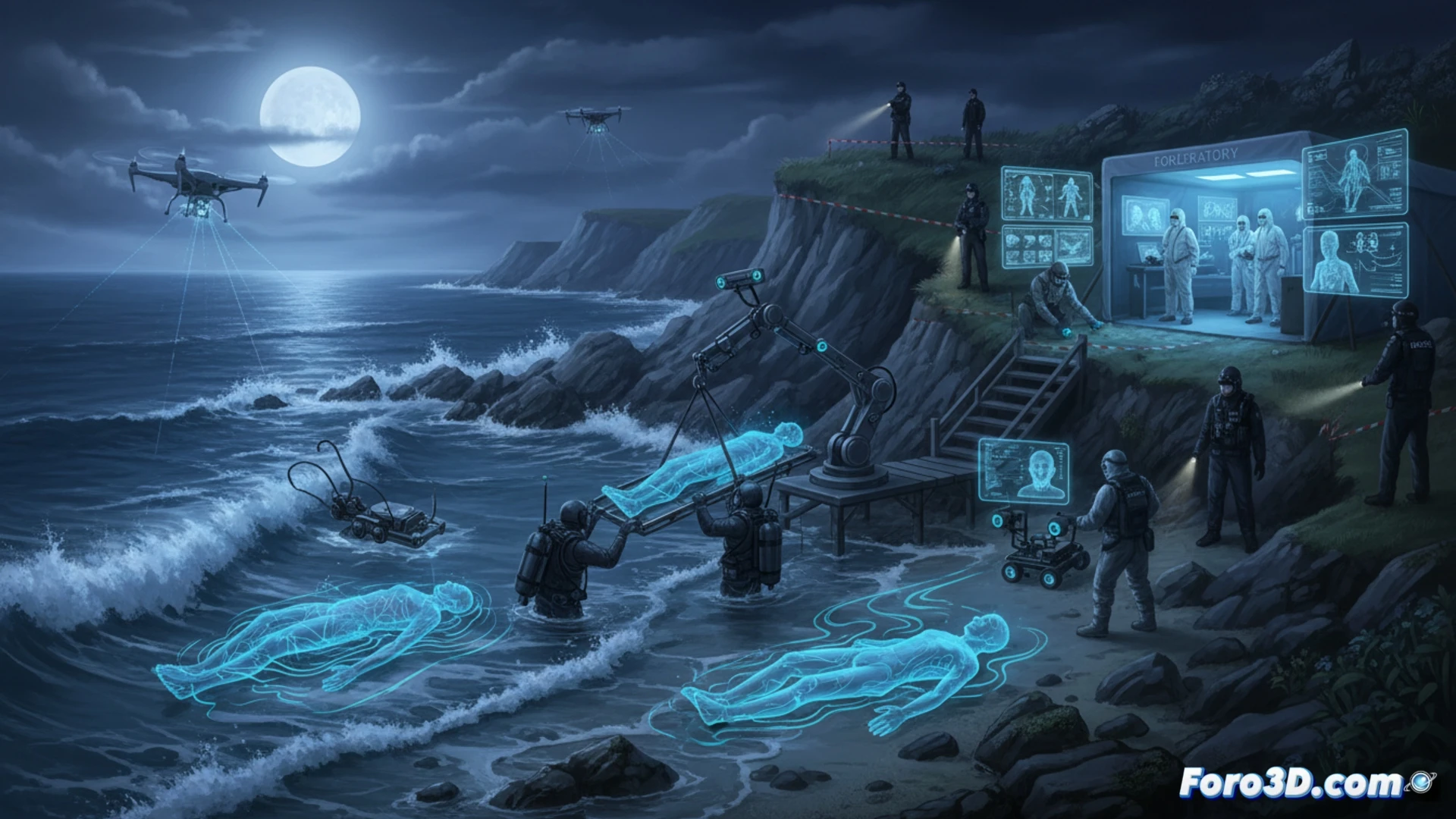
Underwater photogrammetry and current simulation 🌊
To minimize evidence alteration, the forensic team could deploy an underwater photogrammetry system using high-resolution cameras mounted on aquatic drones or ROVs. This process captures hundreds of images of the seabed and the position of the bodies, generating a high-fidelity textured 3D model. Simultaneously, coastal LiDAR scanning would document the shoreline and structures of Madeira Drive, allowing analysts to georeference potential entry points into the water. By integrating this data with a current simulation model (CFD), investigators can calculate drift trajectories, estimate the point of origin, and refute or validate testimonies, all within a digital workflow that preserves the scene immutably.
The liquid scene as digital evidence 🔍
The sea does not preserve traces in the same way as solid ground. Therefore, adapting Forensic Pipeline protocols to aquatic environments requires a rapid response and a hybrid methodology combining hydrography with virtual reality. The 3D reconstruction of this incident in Brighton not only helps determine the cause of death but also sets a technical precedent for future interventions, demonstrating that even a dynamic and hostile scene can be frozen into an accurate digital model for judicial analysis.
Which photogrammetry software do you think would best reveal the details of the scene?