In August 1994, Winnipeg witnessed an unusual weather phenomenon: a thunderstorm carried corn kernels from a damaged silo and dropped them over a residential area. For a visual effects artist, this event represents a fascinating technical challenge: simulating thousands of solid objects impacting roofs, streets, and gardens. Below, we break down the ideal pipeline to recreate this chaos using Houdini, Maya XGen, and RealFlow.
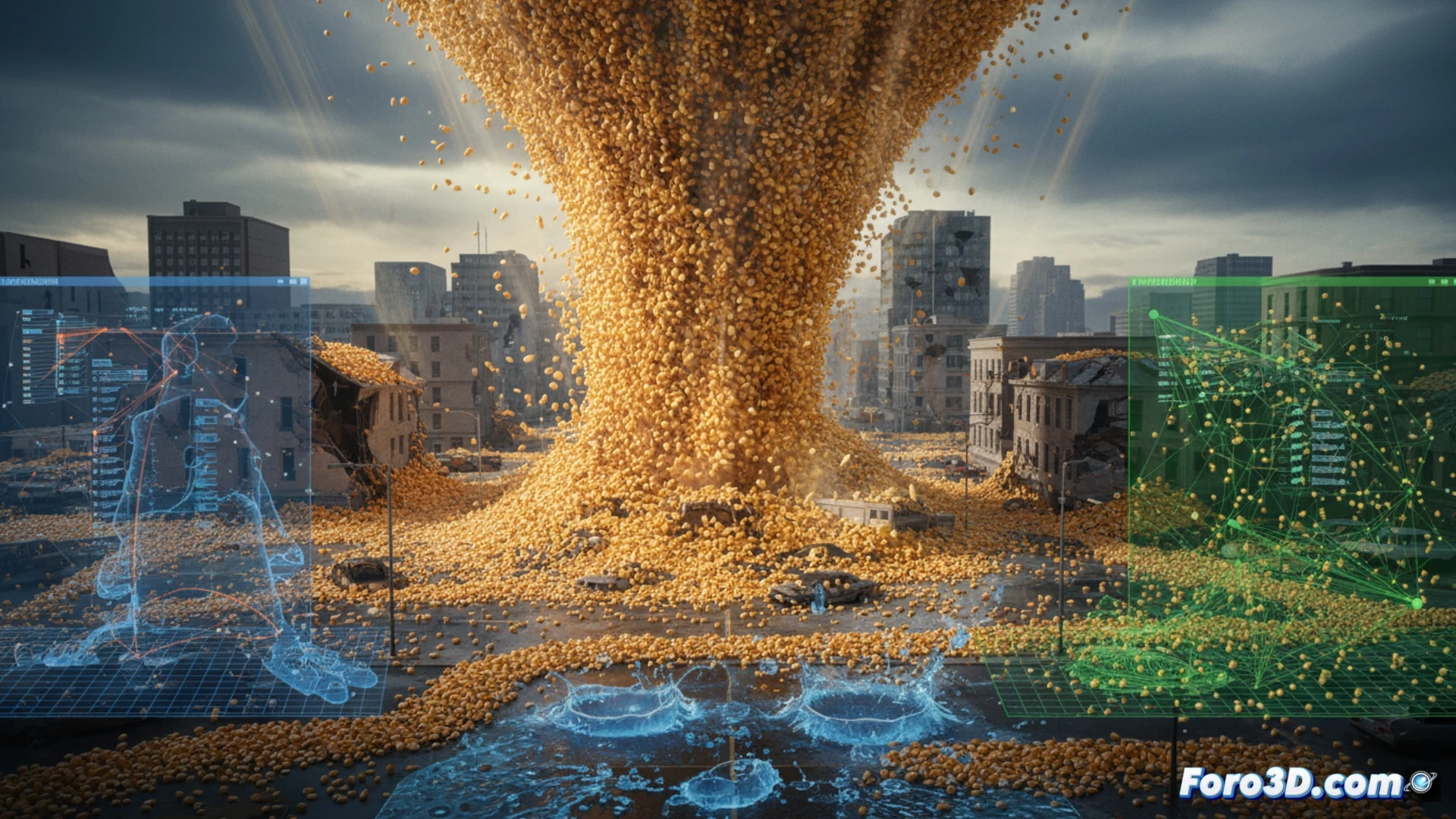
Technical Pipeline: From Particle to Realistic Kernel 🌽
The heart of the simulation lies in Houdini and its Grains system. We start by generating a volume emitter that releases 50,000 spherical particles from a height of 200 meters, with an initial velocity influenced by a turbulent wind field. We activate particle collisions against a low-resolution proxy of the houses and the ground. For modeling the individual kernels, we use Maya XGen, creating a geometry descriptor that instances a detailed corn kernel (with a yellow color texture and slight roughness) onto each point of the simulation. Finally, for interaction with liquid surfaces or puddles, we employ RealFlow, importing the collision mesh from Houdini and using fluid particles to simulate the splashing and dispersion of water when struck by the kernels.
Realism Lies in the Secondary Details 💧
To prevent the simulation from looking like a video game, we must add layers of detail. In Houdini, we apply random rotation noise to each kernel so they don't fall perfectly aligned. In the rendering phase, lighting is key: a soft directional light simulating the post-storm cloudy sky, combined with soft contact shadows. The implicit sound of impacts is visually reinforced with small dust clouds (simulated as low-opacity particles) rising at each collision point. This way, we transform a meteorological rarity into a believable and spectacular visual sequence.
As a VFX artist, what was the biggest technical challenge in simulating the physics of corn kernels in Houdini so they behaved realistically during the storm, and how did you solve the integration of that data with Maya for the final render?
(PS: VFX are like magic: when they work, no one asks how; when they fail, everyone sees it.)