On December 9, 2009, the sky over Tromsø, Norway, became the canvas of an anomalous phenomenon: a luminous spiral of colossal proportions that rotated for minutes before collapsing into a black dot. Officially linked to the failure of a Russian Bulava missile, the event offered a complex visual spectacle combining fluid dynamics, particle dispersion, and gravitational collapse. For a VFX artist, this incident represents a perfect technical challenge to simulate the interaction between cryogenic fuel and the ionosphere.
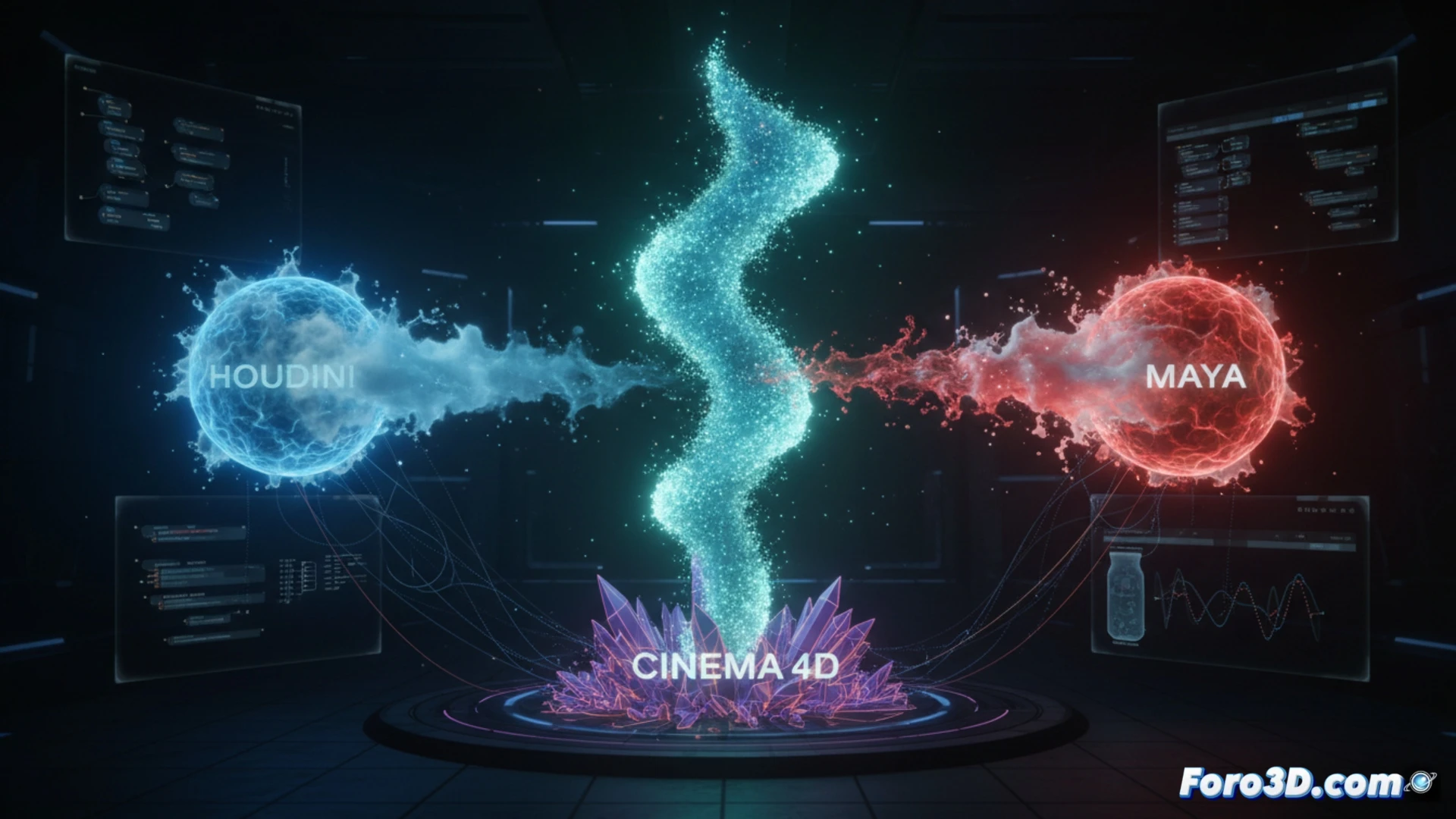
Technical Pipeline: From Missile Physics to Volumetric Simulation 🚀
The core of the recreation lies in Houdini, using a pyro solver smoke. The vorticity parameter must be high (values between 300 and 500) to generate the initial swirl, while density must decay exponentially from the center outward, mimicking fuel expansion. The collapse phase is achieved by reversing the velocity field direction and applying a temperature attribute that cools abruptly. In Maya, an nParticle system is emitted with velocity inheritance from the Houdini volume, setting particle opacity to fade at the spiral's edge. Finally, Cinema 4D receives the volume cache and particles; the render key is a volume shader with anisotropic scattering that emulates sunlight reflected in the upper atmosphere, using a color gradient from bluish-white to reddish-orange at the ejection point.
The Lesson of Failure: Simulating the Impossible 💡
Beyond the technical parameters, this case demonstrates how nature can be the best reference material for a technical artist. The missile failure was not an error, but an accidental choreography of fluids in weightlessness. By simulating this event, we learn that the key is not in the perfection of the physics engine, but in the artistic interpretation of instability. The Norwegian spiral reminds us that the best visual effects are born when real physics and creative license collide, creating something the audience remembers as impossible, but technically is just a set of well-tuned parameters.
As a VFX artist, what specific integration challenges did you encounter when combining Houdini's procedural simulation with character rigging in Maya and post-processing in Cinema 4D to recreate such an unpredictable light phenomenon as the Norwegian Spiral?
(PS: VFX are like magic: when they work, no one asks how; when they fail, everyone sees it.)