In September 1859, a coronal mass ejection struck Earth with an intensity never before recorded in the modern era. The Carrington Event caused auroras visible as far as the Caribbean and melted global telegraph systems. Today, we analyze how to reconstruct this atmospheric cataclysm using cutting-edge tools like Unreal Engine 5, Houdini, and MATLAB to understand its current destructive potential. 🌩️
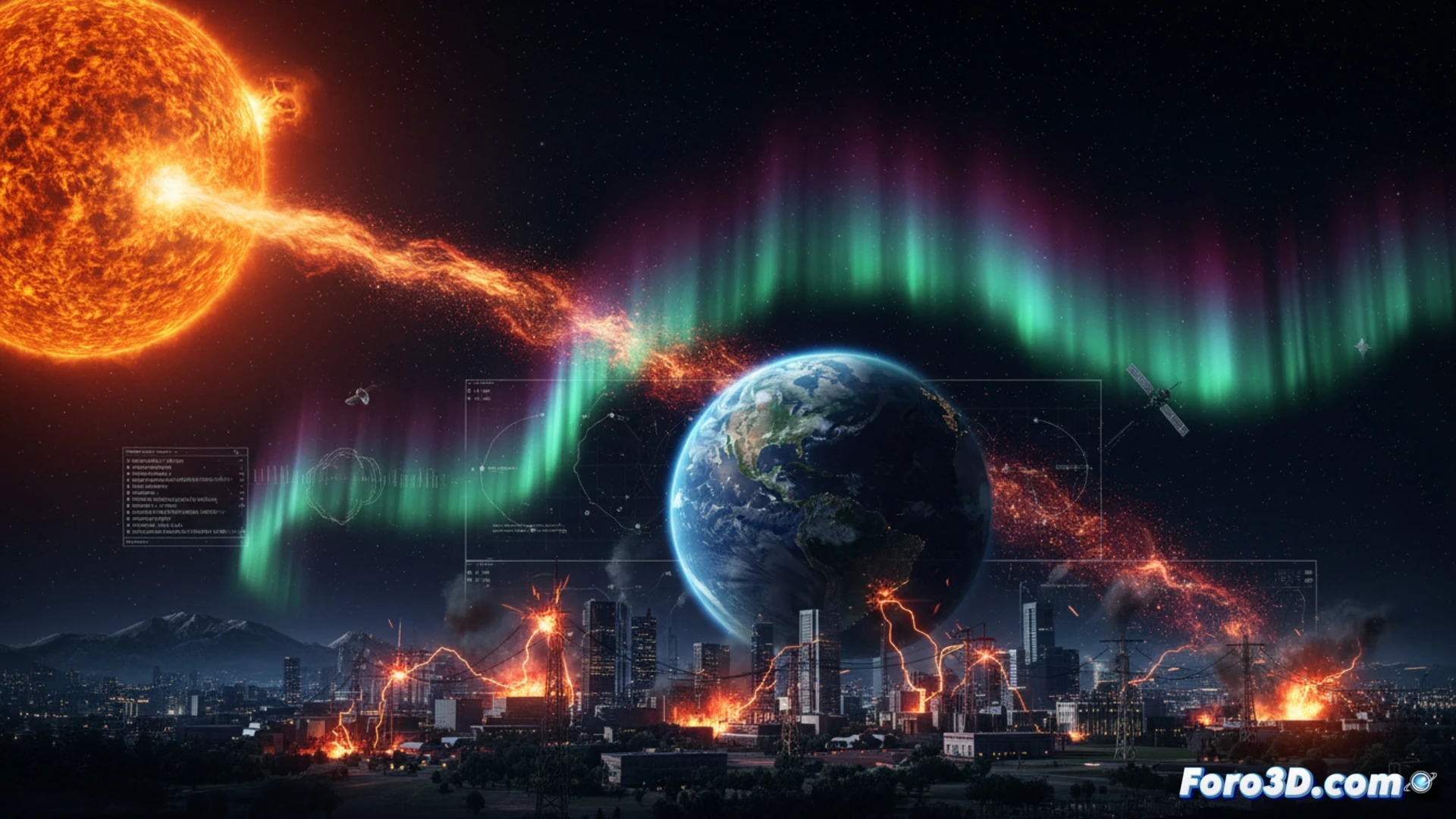
Technical pipeline: Simulation of auroras and solar particles 🚀
To recreate the visual impact, the workflow is divided into three phases. First, MATLAB processes historical data of Earth's magnetic field and solar wind intensity, generating particle density maps. Then, Houdini receives this data to model the dispersion of protons and electrons using VEX, creating particle volumes that mimic interaction with the atmosphere. Finally, Unreal Engine 5 with Niagara imports these volumes as dynamic particle systems, applying emission shaders for green and red auroras, and simulating the electromagnetic flicker that could affect virtual infrastructures.
Lessons for the 21st century: Latent risk and prevention ⚠️
The simulation of the Carrington Event is not just an aesthetic exercise. With current dependence on satellites and power grids, a similar storm could cause catastrophic damages valued in trillions of dollars. By modeling these scenarios in real-time, we can train early warning systems and design preventive shutdown protocols. 3D technology allows us to see the past to protect ourselves from the future, turning a historical disaster into an interactive lesson in resilience.
What technical methodology would you use to synchronize the solar storm data with the simulation in Unreal Engine 5, Houdini, and MATLAB to achieve an accurate recreation of the Carrington Event?
(PS: Simulating catastrophes is fun until the computer melts down and you are the catastrophe.)