On September 6, 1881, the northeastern United States was plunged into premature darkness. A pale, sickly sun hung over a yellowish sky, causing chickens to roost at noon. This phenomenon, recorded as the Great Thumb Fire or Yellow Day, was not supernatural but the result of massive wildfires that, combined with extreme low atmospheric pressure, saturated the air with soot and ash particles.
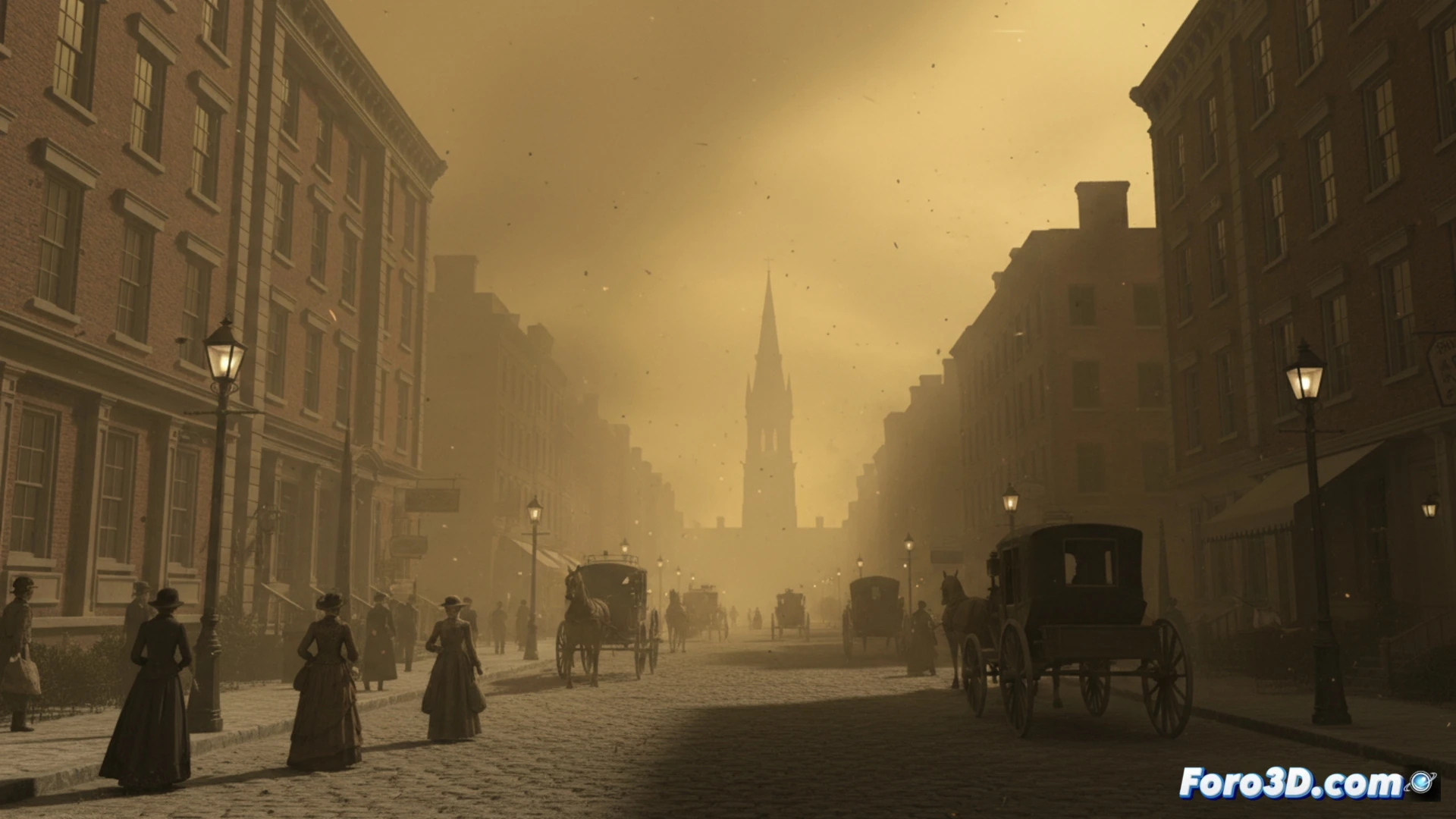
Simulation of Atmospheric Dispersion from Wildfires 🌫️
To emulate this event in Unreal Engine 5, the Sky Atmosphere system is the key tool. Aerosol density and turbidity parameters were pushed to extreme values, replicating the high concentration of PM2.5 and PM10 particles generated by biomass combustion. A volumetric smoke layer was modeled in Blender and imported as a variable density mesh. The visual result shows how sunlight, passing through this layer, undergoes dominant Mie scattering, deflecting short wavelengths (blue) and predominantly allowing yellow and reddish tones through. The low atmospheric pressure was simulated by reducing the base air density in the Sky Atmosphere, which altered refraction and accentuated the global darkening effect, validating the historical hypothesis that smoke trapped in a thermal inversion layer blocked 95% of direct sunlight.
Visual Lessons for Disaster Prevention 🛡️
Recreating the Yellow Day is not just an exercise in technical realism. Comparing screenshots from our simulation with modern photographs of fires in California or Australia reveals an identical pattern of atmospheric coloration. This demonstrates that, although simulation technology has advanced, the physics of the disaster remains unchanged. Visualizing these events in 3D allows emergency teams and urban planners to anticipate how light and visibility will behave during a catastrophe, improving evacuation strategies and the design of early warning systems.
As a developer, how do you balance historical accuracy with the need to generate a striking visual atmosphere when recreating the atmospheric phenomenon of the Yellow Day of 1881 in Unreal Engine 5?
(PS: Simulating disasters is fun until your computer melts down and you are the disaster.)