Valve's Source engine, famous for Half-Life 2, left an indelible mark on the industry with its object physics and industrial aesthetic. Voices of the Void is a fascinating case study because it manages to emulate that essence using Unreal Engine 4, an engine with very different rendering philosophies. The trick isn't in replicating the code, but in understanding the visual and interaction rules that defined an era, adapting them to a modern pipeline with Blender and UE4.
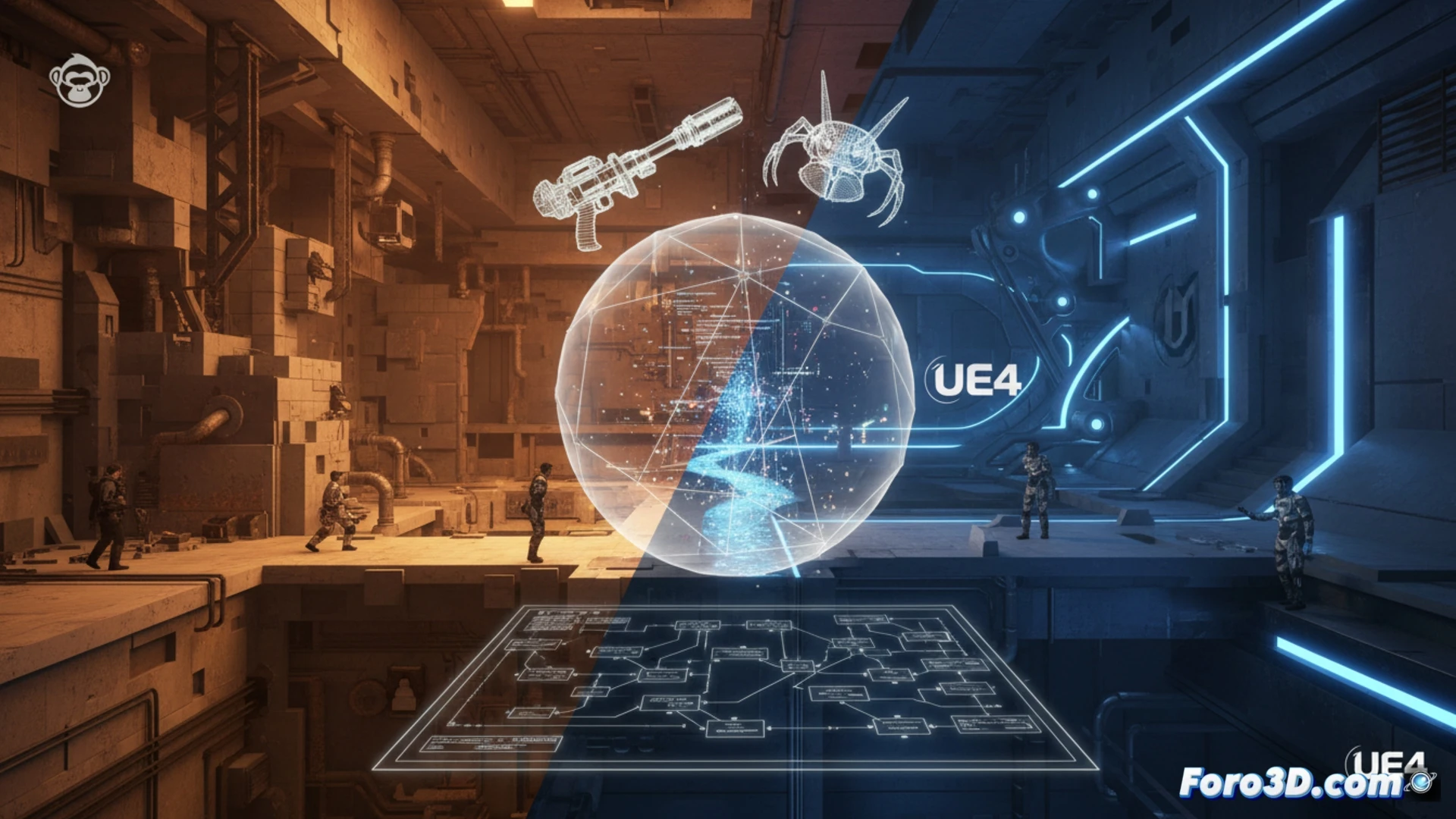
Reverse engineering the Source aesthetic: Shaders and physics simulation 🎮
To mimic the flat lighting and hard specular reflections of Source, the development team likely opted for shaders based on the Blinn-Phong model instead of UE4's standard PBR. Textures, created in Blender, are baked with a desaturated color palette and low-resolution normal maps to simulate the technical detail of 2004. Regarding physics, the key was adjusting the gravity and friction of objects in UE4's Chaos physics engine so that cubes and barrels had that floating weight and immediate response characteristic of Source. The technical science fiction simulation is achieved through monitor screens that run real-time rendered textures with scanline and CRT noise shaders, emulating the Half-Life 2 interface.
Tactile interactivity and the Blender-UE4 workflow 🛠️
The true achievement of Voices of the Void is interactivity. Objects are not only picked up, but levers are manipulated and panels are typed on. This is achieved with UE4 blueprints that detect channel collisions and activate specific bone animations. The workflow involves modeling low-poly assets in Blender with a simple collision mesh and exporting to UE4 with the FBX plugin. Optimization is key: superfluous details are avoided to maintain that retro feel, prioritizing gameplay over photorealism, demonstrating that visual fidelity doesn't always reside in pixels, but in the virtual world's response.
How was the interactive physics system and characteristic weight feel of the Source engine emulated in Unreal Engine 4 for Voices of the Void without sacrificing performance?
(PS: 90% of development time is polishing, the other 90% is fixing bugs)