Frogwares has released the remake of Sherlock Holmes The Awakened, a complete reconstruction from scratch of the original 2007 title. The project abandons old technical limitations to adopt Unreal Engine 4 as its main foundation. The studio not only updated graphics but also rewrote the production pipeline to integrate facial motion capture and volumetric lighting systems. This article analyzes the key technical decisions that allowed transforming a classic game into a modern experience, detailing the flow between Maya and UE4, and the optimization challenges for previous and new generation consoles.
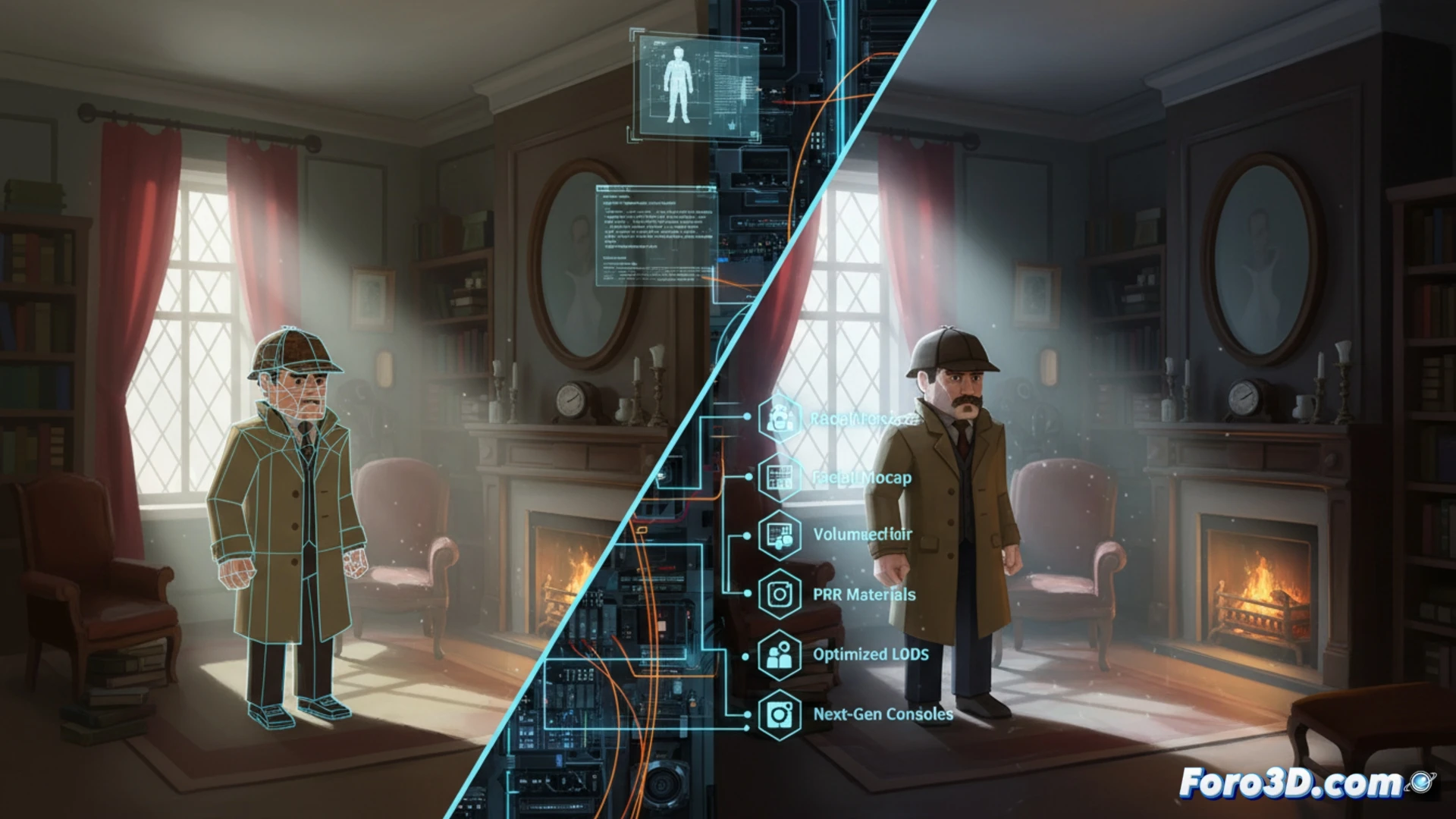
Pipeline from Maya to Unreal Engine 4: facial capture and volumetric lighting 🎭
The workflow began in Maya, where all assets were modeled from scratch, prioritizing high-resolution geometry for faces and environments. Facial motion capture was integrated through recordings of real actors, whose data was processed in Maya to generate precise blendshapes. These assets were then imported into Unreal Engine 4, where the team applied volumetric lighting with dynamic shadow cascades and scattering fog. For previous generation consoles (PS4 and Xbox One), texture resolution was reduced and the number of dynamic lights per scene was limited. On PS5 and Xbox Series X|S, partial ray tracing was enabled for reflections and ambient occlusion, maintaining stable 60 fps thanks to an adaptive LOD system.
Technical lessons for indie developers 🛠️
This remake demonstrates that rebuilding a game from scratch in Unreal Engine 4 does not require an AAA budget, but rather rigorous pipeline planning. The key is to separate facial capture from environment rendering to avoid bottlenecks. Additionally, optimization for two console generations forced Frogwares to use visibility culling systems and BC7 texture compression. For small studios, the advice is to prioritize volumetric lighting as a narrative element, as it transforms the atmosphere without needing extra polygons. A clean flow between Maya and UE4, with strict naming conventions, reduces import errors and speeds up iterations.
What specific technical challenges did Frogwares face when rebuilding Sherlock Holmes The Awakened from scratch in Unreal Engine 4, especially in adapting the gameplay mechanics and narrative of the original 2007 title?
(PS: shaders are like mayonnaise: if they break, you start all over again)