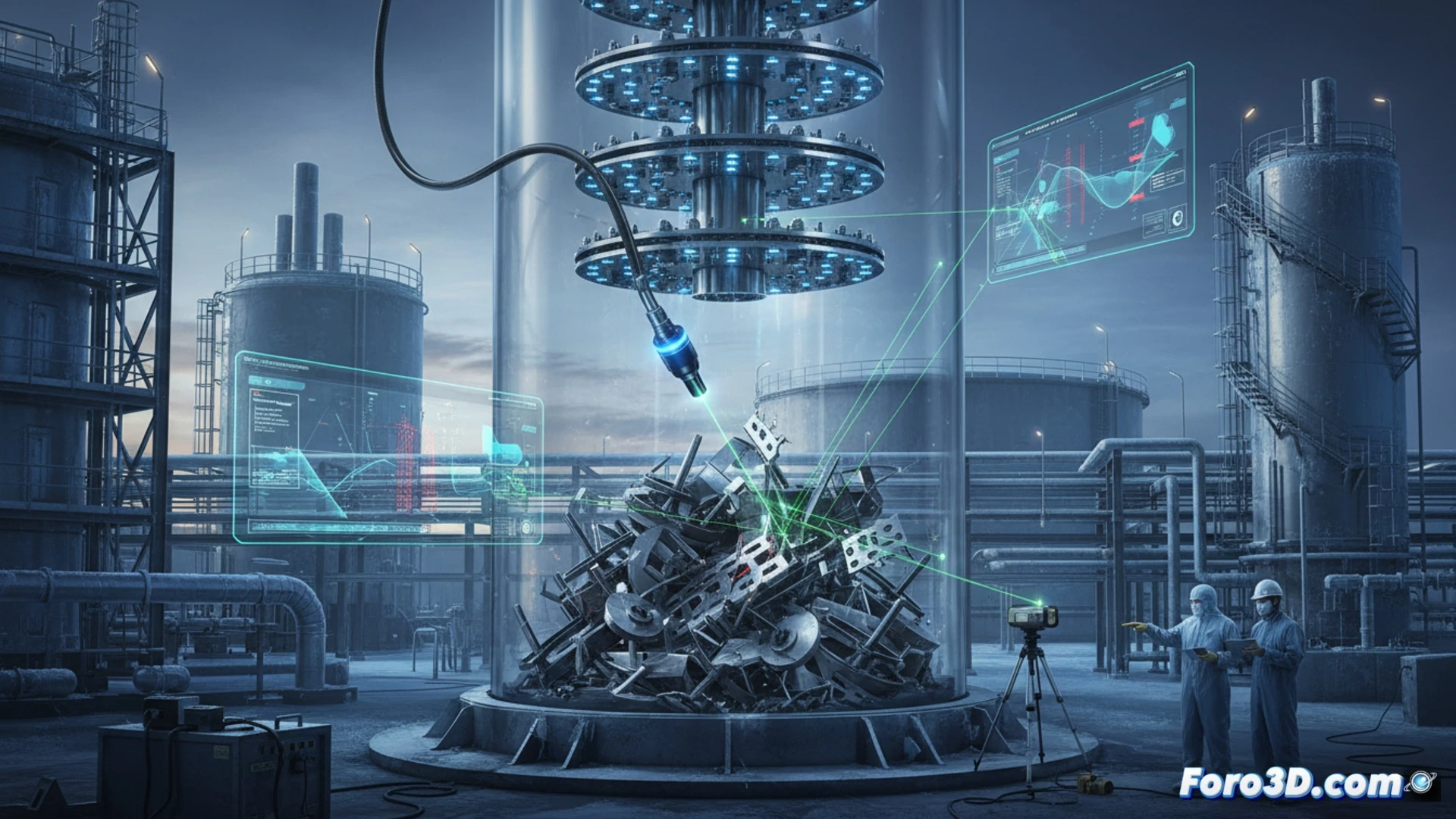
A liquid oxygen plant suffered a critical shutdown due to an abrupt internal pressure drop. Visual inspection was impossible due to cryogenic insulation. Digital borescoping and FARO Scene scanning were used to create a point cloud of the column's interior. The 3D reconstruction revealed a massive collapse of the distillation trays, deformed and stacked at the bottom, evidencing a structural failure due to liquid overload.
Flooding Overload Simulation in ANSYS Mechanical 🔧
With the real geometry extracted from the FARO Scene point cloud, the post-collapse state was modeled and compared with the original design in Revit. The main discrepancy was the absence of drain spaces between trays. The clean model was imported into ANSYS Mechanical to simulate the flooding hypothesis. Applying a hydrostatic pressure equivalent to a liquid column on the bottom tray, the finite element analysis showed that the Von Mises stress exceeded the yield limit of 304L stainless steel exactly at the welds of the support bars, coinciding with the fractures observed in the borescope.
Lessons from the Digital Twin for Failure Prevention 💡
The forensic validation confirmed that a poorly calibrated level control valve allowed excess liquid, exceeding the hydraulic capacity of the trays. The integration of Revit (design), FARO Scene (reality), and ANSYS (physics) allowed not only diagnosing the root cause but also redesigning the emergency drains. This case demonstrates that forensic 3D modeling is the ultimate tool to turn a structural collapse into an opportunity for improvement in process engineering.
Would you consider accumulated material fatigue?