The reconstruction of a hit-and-run on a bobsleigh track presents unique challenges due to high speed, banked curves, and unpredictable impact angles. In this technical article, we detail the forensic workflow integrating PC-Crash, RealityCapture, and Blender to analyze blind spots, calculate centrifugal speed, and validate impact trajectories in high-speed curved environments.
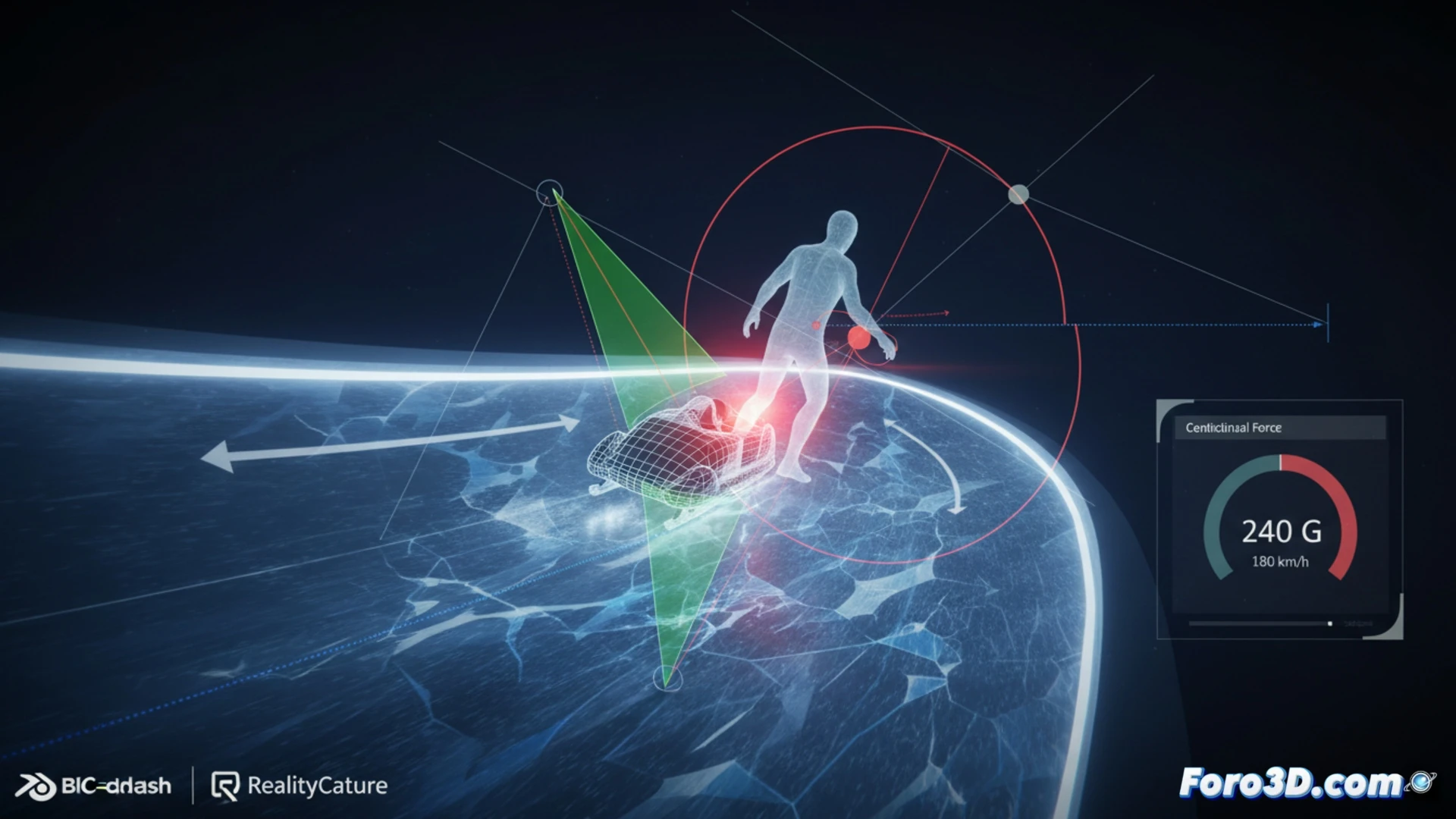
Technical workflow: photogrammetry, simulation, and visualization 🛷
The process begins with RealityCapture to generate an accurate 3D model of the track from scene photographs. This model is exported to PC-Crash, where the dynamics of the vehicle and pedestrian are defined. The software calculates the centrifugal speed in the curve and simulates the impact trajectory, considering the driver's blind spots. Finally, Blender imports the PC-Crash data to render a physical visualization of the event. This combination allows adjusting parameters such as the coefficient of friction and the height of the center of gravity, validating the forensic hypothesis with real kinematic data.
Reflection on the forensic methodology in high-speed curves 🔍
The integration of these tools demonstrates that the analysis of hit-and-runs on curved tracks cannot be limited to linear calculations. Centrifugal speed and blind spots generate critical deviations in the trajectory of both the pedestrian and the vehicle. This multidisciplinary approach, combining photogrammetry, dynamic simulation, and 3D visualization, elevates the precision of forensic reconstruction, allowing investigators to present solid conclusions in judicial or road safety contexts.
How does the simulation of centrifugal forces in banked curves affect the accuracy of the forensic reconstruction model of a hit-and-run on a bobsleigh track?
(PS: In scene analysis, every scale witness is a small anonymous hero.)