The reconstruction of explosions in armored vehicles requires a forensic workflow that integrates real geometry capture, impact simulation, and ballistic analysis. This article details the technical pipeline for triangulating IED fragment trajectories and estimating the energy released, using Artec Studio for scanning, SpeedForm and Visual-Crash for simulation, and material penetration methods for energy validation.
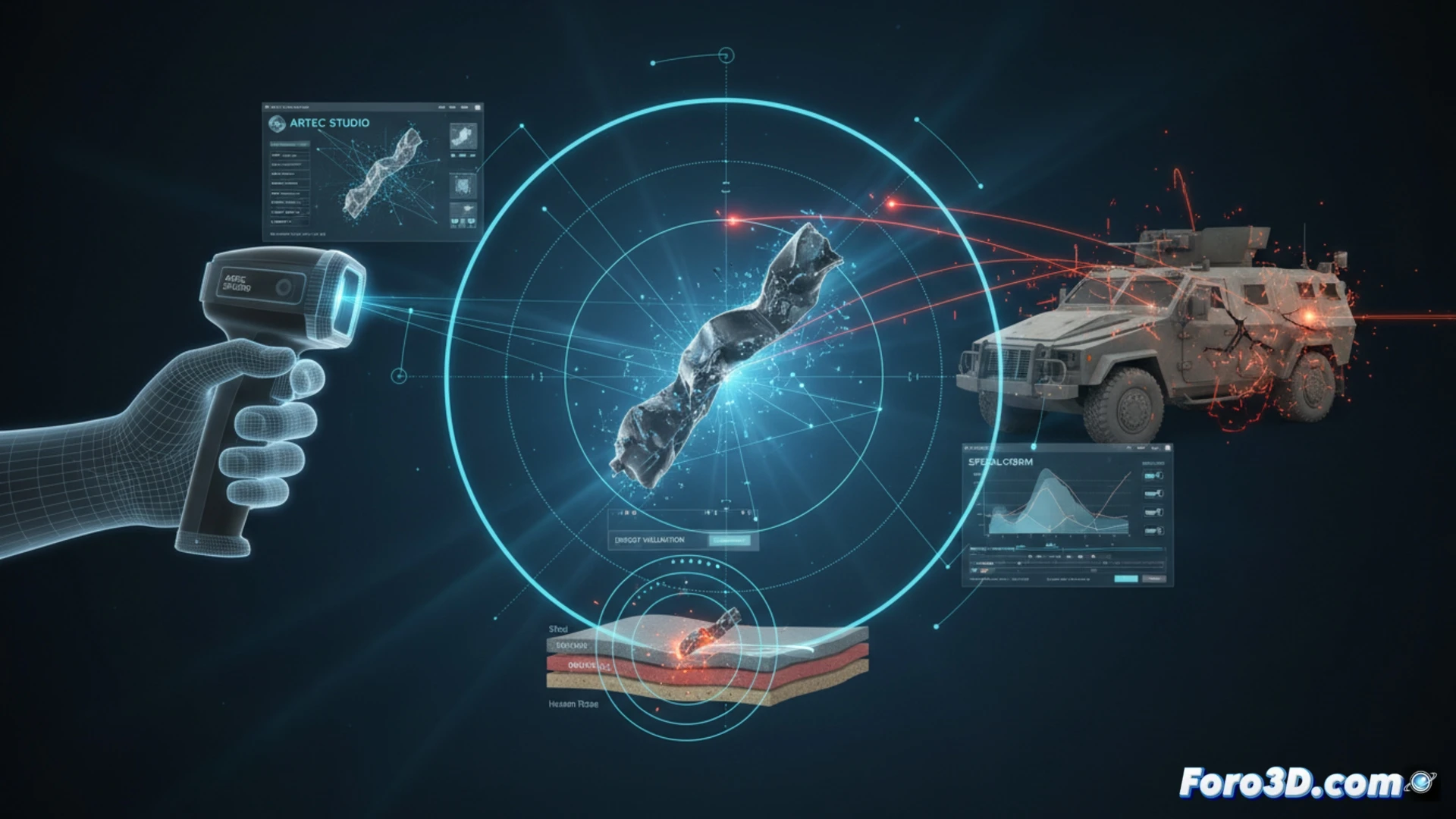
Scanning, simulation, and ballistic triangulation pipeline 🔍
The process begins with 3D scanning of the damaged vehicle using Artec Studio, generating a high-resolution mesh that captures every deformation and entry hole. This geometry is imported into SpeedForm, where the IED is modeled as a fragment source with mass and initial velocity. The impact simulation in Visual-Crash allows tracking the penetration of each fragment into the armor, calculating the kinetic energy loss through material resistance models. With this data, an inverse triangulation is performed: from the impact points inside the vehicle, vectors are traced back to the explosion source, correcting for deviation and fragmentation. Total energy is estimated by integrating the residual kinetic energy of the fragments that perforated the armor, comparing it with calibration curves of known explosives.
The forensic value of multi-tool integration ⚙️
This methodology demonstrates that combining high-precision forensic scanning with dedicated impact simulators overcomes the limitations of traditional ballistic analyses, which often rely solely on photographs or manual calculations. By validating the trajectory of each fragment through material penetration, a robust estimate of the explosive charge is obtained, essential for expert reports. This pipeline, replicable in military or security environments, reinforces the role of 3D simulation as a central tool in the investigation of incidents involving explosive devices.
How can you ensure the accuracy of ballistic shrapnel simulation when integrating 3D scan data from real explosions with armor deformation models?
(PS: In the forensic pipeline, the most important thing is not to mix the evidence with the reference models... or you'll end up with a ghost in the scene.)