The reconstruction of a ballistic incident in space presents unique challenges that break with terrestrial forensic paradigms. In a microgravity environment, the absence of a dominant gravitational direction transforms projectile trajectories into infinite linear vectors, interrupted only by impacts and three-dimensional rebounds against the walls of an orbital capsule. This article details the technical pipeline for simulating such a scenario, combining particle dynamics, inverse modeling, and forensic physics animation.
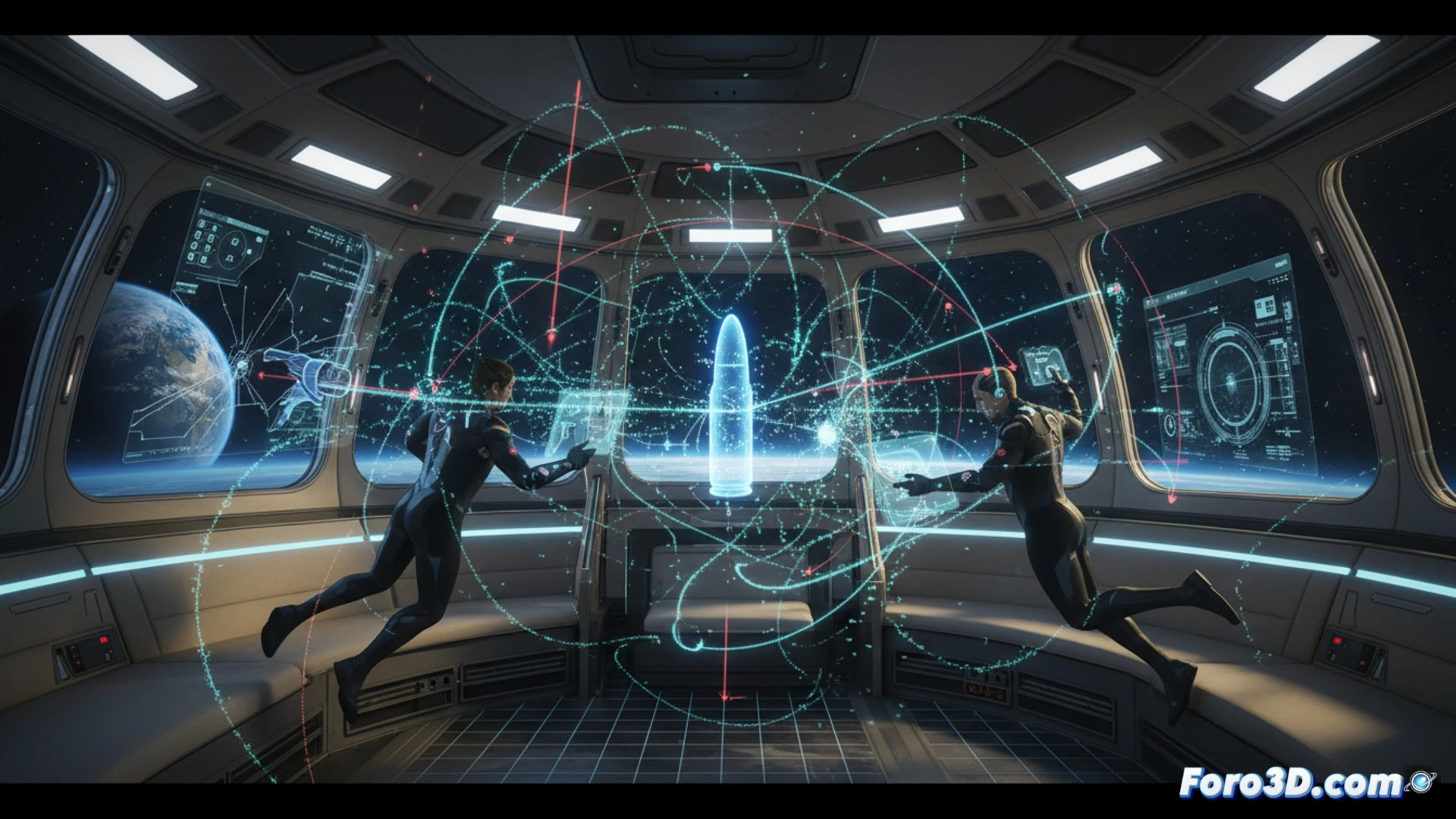
Technical Pipeline: From PC-Crash to Maya with Geomagic Design X 🚀
The workflow begins with the adaptation of PC-Crash, a software traditionally used for traffic accidents, to calculate ballistic trajectories in zero gravity. The gravitational acceleration parameter is disabled, and restitution coefficients for capsule materials (aluminum alloys and composite) are introduced. Impact coordinates are exported to Autodesk Maya, where a rigid body dynamics engine is applied to animate three-dimensional rebounds, respecting the conservation of linear momentum in all directions. In parallel, Geomagic Design X is used to scan and model the exact geometry of the capsule's interior, including panels, seats, and equipment, ensuring that each rebound surface matches the reality of the cabin.
Challenges and Forensic Applications in Space 🔍
The main technical challenge lies in simulating three-dimensional rebounds without gravity, where a projectile can impact the ceiling, then the floor, and finally an opposite wall without losing linear velocity. This requires a segment-by-segment trajectory calculation, where each collision generates a new output vector based on the angle of incidence and surface friction. For forensic investigation in space tourism, this pipeline allows determining the origin of the shot, the shooter's position, and the sequence of damage to the structure, offering a critical tool for documenting incidents in environments where physical evidence does not follow the rules of terrestrial ballistics.
Would you use a laser scanner or photogrammetry to document this case?