Last month, an incident on a Dark Ride attraction left two vehicles out of service after a collision on a closed section of the track. To clarify the causes, the forensic team deployed a digital workflow combining LiDAR scanning with FARO Focus, modeling in FARO Zone 3D, and physical simulation in game engines like Unity and Unreal Engine. This article details each stage of the process, from scene capture to virtual recreation of the impact.
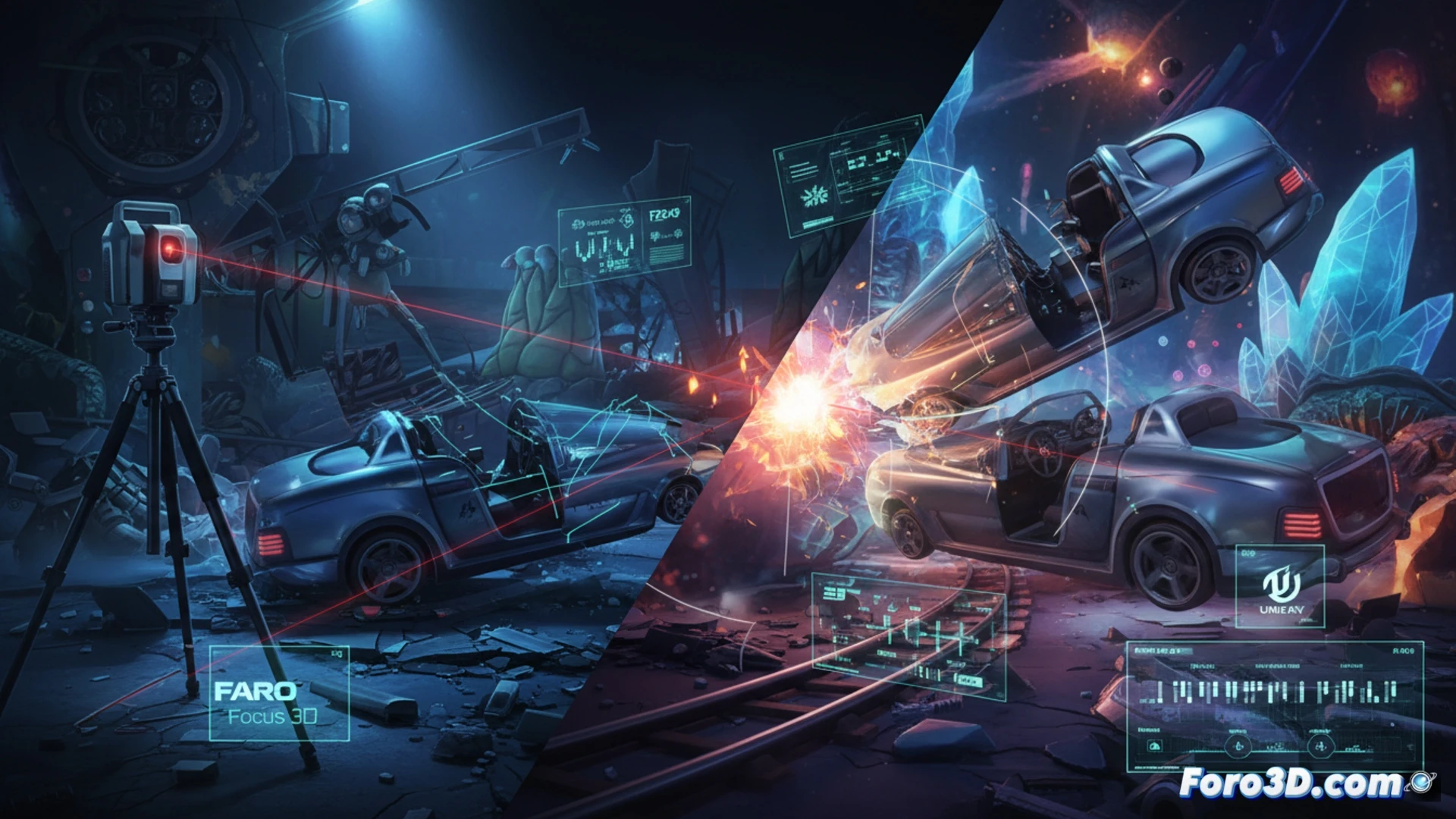
Forensic pipeline: from LiDAR scanning to physical simulation 🛠️
The investigation began with three-dimensional scanning of the collision area using a FARO Focus S350, which captured the exact geometry of the rails, the stopped vehicles, and the surrounding environment with millimeter precision. The resulting point cloud was processed in FARO Zone 3D to generate a digital twin of the scene, including braking marks and body deformations. Subsequently, this model was exported to Unity and Unreal Engine, where physical properties were assigned to the vehicles (mass, friction, coefficients of restitution) to recreate the impact dynamics. Trajectory analysis allowed testing hypotheses such as a failure in the electromagnetic braking system or an error in the dispatch sequence, without needing to restart the actual attraction.
Simulation as a risk-free verification tool 🎯
The great advantage of this pipeline is that it eliminates the risk of dangerous physical maneuvers. By varying parameters such as initial speed, entry angle, or delay in proximity sensors, engineers were able to identify the exact combination that produced the documented collision. The visual recreation also served as expert evidence for the technical report, clearly showing how the rear vehicle did not slow down in time in the transfer zone. This forensic method, which integrates capture equipment with simulation engines, is becoming a standard for investigations in theme parks and guided transport systems.
What specific challenges does integrating LiDAR data with 3D simulation software present for accurately recreating the collision dynamics in a Dark Ride, considering the lighting conditions and reflective materials of the environment?
(PS: In the forensic pipeline, the most important thing is not to mix the evidence with the reference models... or you'll end up with a ghost in the scene.)