The collapse of a hyperbaric chamber during a home medical treatment triggered a high-level forensic investigation. The reinforced polymer of the hull suddenly gave way, generating an implosion that scattered dozens of fragments. The expert analysis had to answer two key questions: where the lethal crack originated and whether the relief valves were tampered with. To this end, a workflow was implemented that combined high-resolution computed tomography with finite element simulation.
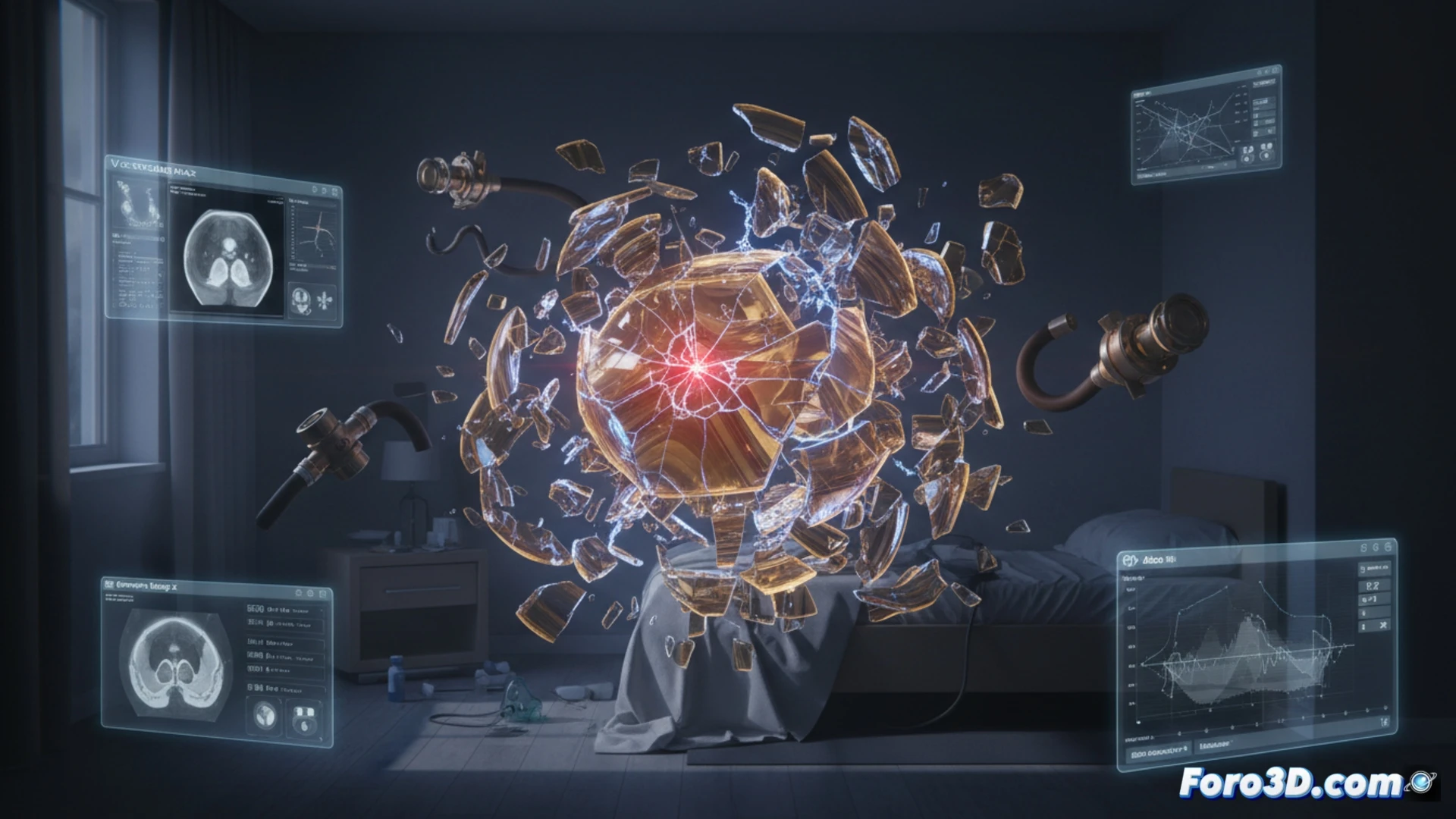
Forensic workflow: from CT scan to nonlinear simulation 🔍
The process began in VGSTUDIO MAX, where all recovered fragments were scanned using industrial CT. A volumetric mesh was generated, allowing the pieces to be virtually joined like a three-dimensional puzzle, identifying complementary fracture surfaces. This digital reconstruction was exported to Geomagic Design X to refine the geometry and repair scanning artifacts. Subsequently, the relief valves and missing structural reinforcements were modeled in Rhinoceros 3D. The complete assembly was taken to Abaqus, where internal pressure conditions were applied and the equipment's historical load cycles were simulated, using a progressive damage model for the reinforced polymer.
Material fatigue as a guarantee of medical safety ⚙️
The simulation revealed that the crack initiation point was located in a stress concentration zone near the hull's junction with the entry port. Fatigue analysis indicated that the material had exceeded its estimated service life due to unrecorded microcycles. Furthermore, the valve simulation showed that they had not been tampered with; the failure was exclusively due to polymer fatigue. This case underscores the need to integrate fatigue simulation into the certification processes of portable medical devices, where a structural failure implies a direct life-threatening risk.
How finite element simulation data was integrated with 3D scanning of the fractures to determine the exact crack propagation sequence in the portable hyperbaric chamber collapse
(PS: Material fatigue is like yours after 10 hours of simulation.)