The illegal felling of a centuries-old tree during the night left only a stump and several scattered trunk segments as evidence. To quantify the environmental damage and calculate the corresponding fine, a forensic team applied a 3D scanning and modeling pipeline. This article details the technical process of drone photogrammetry, bark scanning with Artec Studio, virtual reassembly in Rhino, and volumetric calculation with V-Ray.
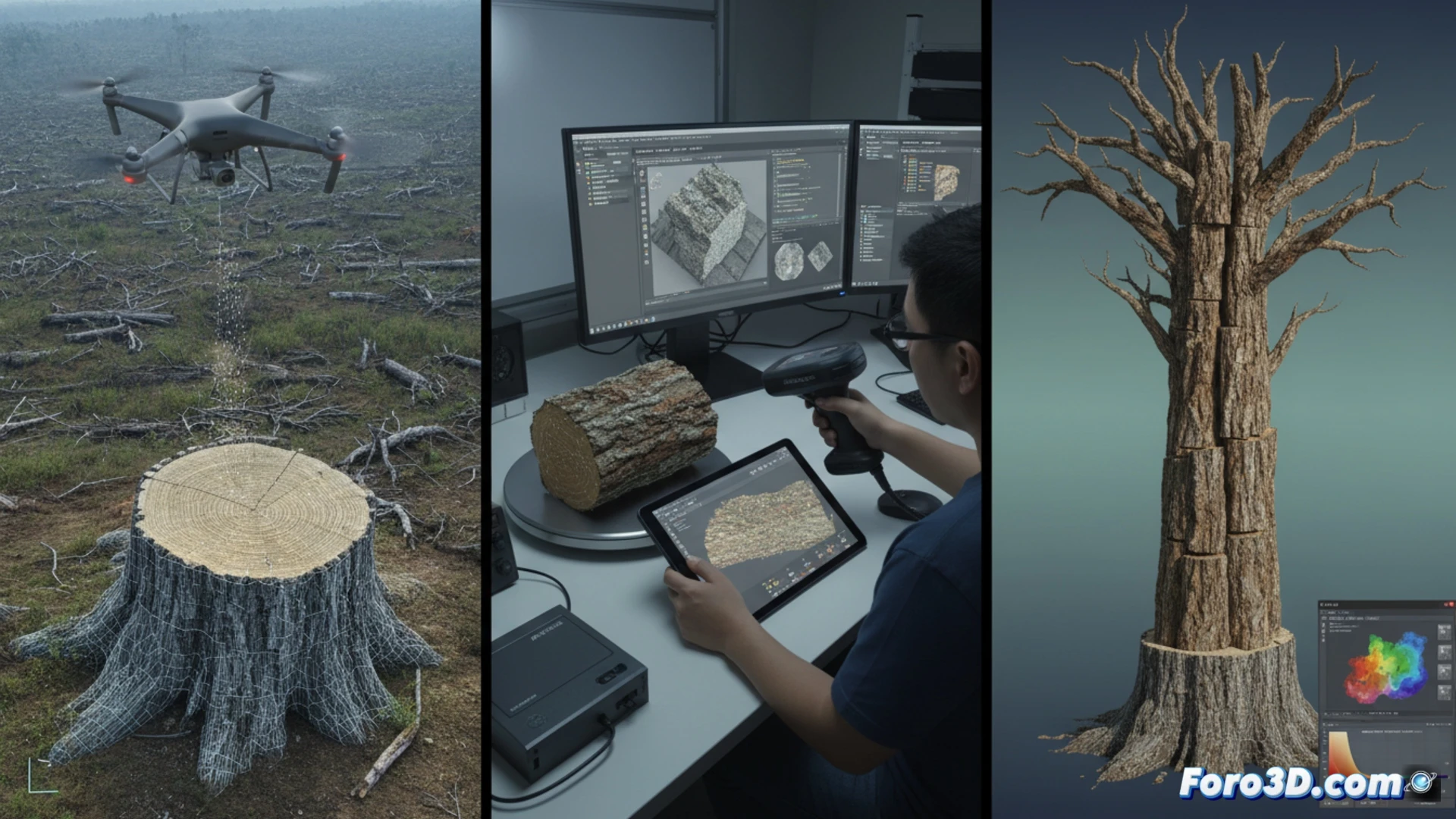
Forensic pipeline: from stump to virtual volume 🌲
The process began with a drone flight equipped with Pix4D to capture the stump from multiple angles, generating a georeferenced point cloud of the crime scene. Subsequently, each recovered trunk section was scanned with Artec Studio to obtain high-resolution meshes, preserving bark details and saw marks. These pieces were imported into Rhino, where virtual reassembly was performed by aligning fractures and cuts. Finally, V-Ray calculated the exact volume of extracted wood through solid simulation, providing irrefutable data for the economic valuation of the environmental fine.
Digital precision as an irrefutable witness 🔍
This case demonstrates how 3D technology transcends design to become a tool for environmental justice. Virtual reassembly not only reconstructs the lost tree but offers a volumetric measurement impossible to refute in a court of law. For forensic professionals, this pipeline represents a replicable standard in crimes against natural heritage, where data accuracy is the only defense against vandalism.
How can the 3D reconstruction of an illegally felled ancient tree be carried out from a stump and scattered fragments, using photogrammetry techniques and growth ring analysis, to generate precise forensic evidence in a judicial process?
(PS: In the forensic pipeline, the most important thing is not to mix evidence with reference models... or you'll end up with a ghost at the scene.)