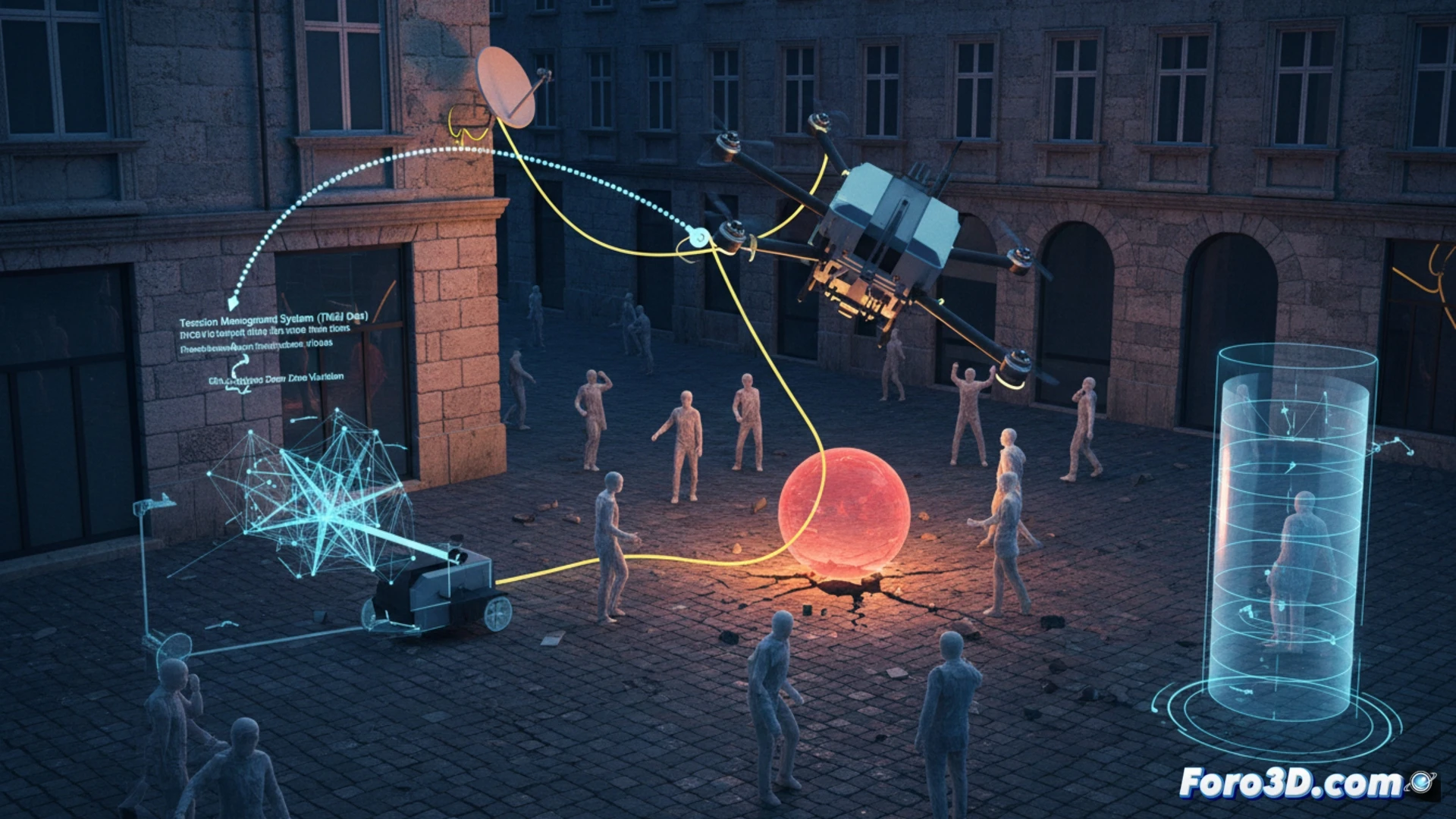
The accident occurred during a routine facade cleaning operation on a corporate building. The tethered drone, powered by a fiber optic and power cable, lost control after becoming entangled in a telecommunications antenna. The fall onto a congested pedestrian area left several people with minor injuries. The forensic investigation focused on reconstructing the drone's 3D trajectory and analyzing the cable dynamics to determine if the tension management software (TMS) was directly responsible for the incident.
Technical workflow: From point cloud to cable simulation 🛸
The forensic team used photogrammetry with Pix4D and Bentley ContextCapture to generate an accurate point cloud of the building, the antenna, and the impact zone. On this model, the drone's kinematics were imported from flight logs (IMU and GPS) into Autodesk Maya. There, the cable dynamics were simulated using the nCloth engine, adjusting parameters for stiffness, mass, and friction with the environment. The simulation revealed that upon reaching the antenna, the cable generated an asymmetric tension loop that exceeded the TMS correction limit, causing an undamped oscillation and subsequent collision with the facade before falling.
Lessons for disaster simulation and operational safety ⚠️
This case demonstrates that current tension management systems lack predictive models for vertical linear obstacles such as antennas or masts. The reconstruction in Unreal Engine 5 allowed visualizing the accident from perspectives impossible in reality, identifying the exact point of software failure. For future operations over populated areas, it is recommended to integrate real-time LiDAR sensors and cable simulation algorithms into the drone's control loop, capable of anticipating entanglements before critical tension is unleashed.
What specific limitations of forensic photogrammetry algorithms were evident when reconstructing the fall trajectory and impact of the tethered drone on a dense crowd, considering the structural deformation of the power cable and the dynamic occlusions caused by bystanders?
(PS: Simulating disasters is fun until the computer crashes and you are the disaster.)