The team of digital archaeologists has achieved a milestone in virtual preservation: the recreation of a mummy's clothing using photogrammetry and 3D modeling techniques. The textile remains, extremely fragile due to their age, were scanned without physical contact. The process generated a point cloud that served as the basis for digitally reconstructing every fold and seam of the funerary garments.
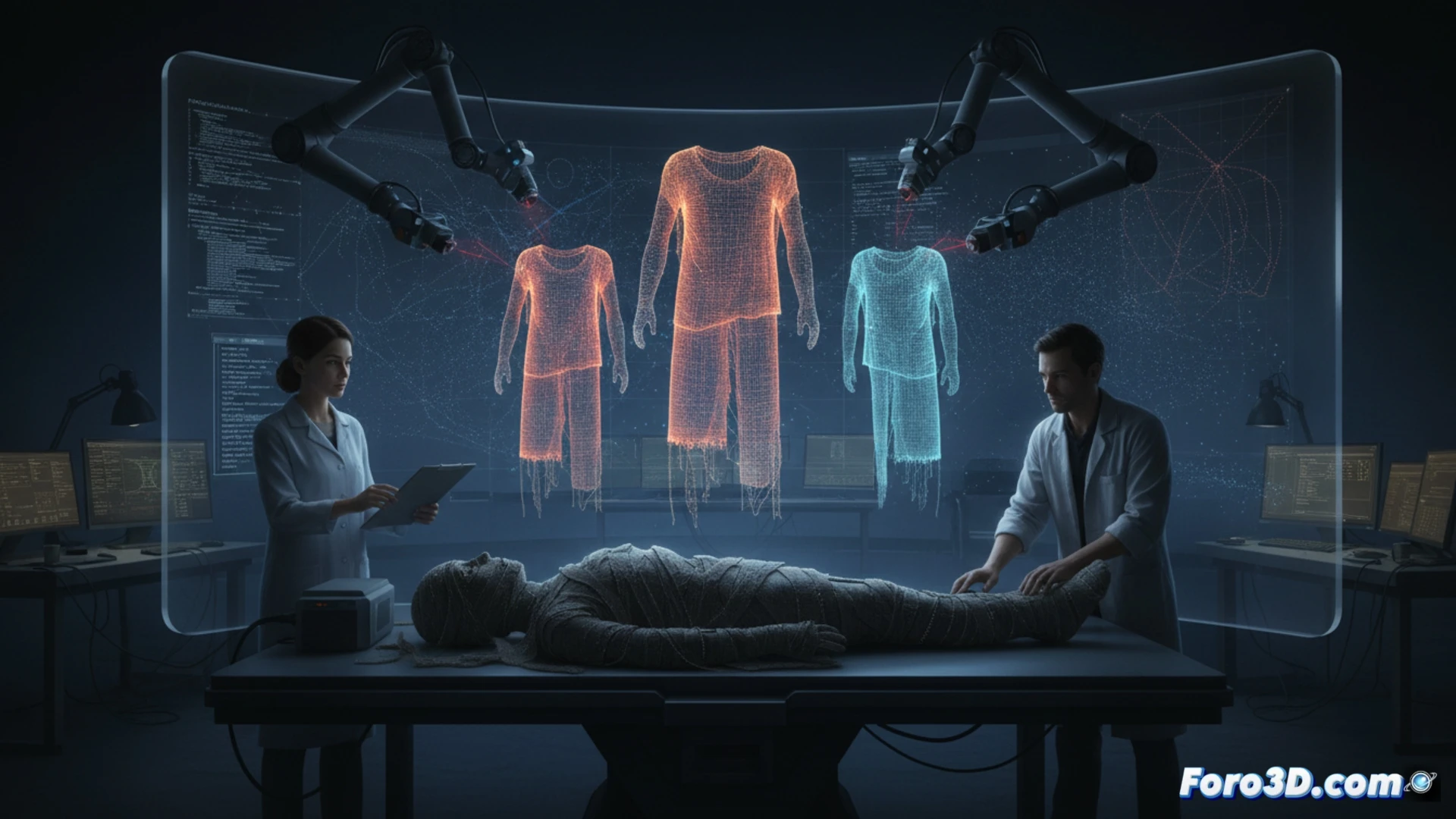
Technical workflow: from fragments to virtual fabric 🧵
The digitization began with high-resolution photogrammetric capture of the original textile fragments. Cross lighting was used to avoid shadows that would distort the geometry of the threads. Using modeling software, the polygonal mesh of each piece was reconstructed, adjusting the topology to simulate the behavior of the fabric. Texturing required precise UV mapping based on the photographs, with color calibrated using reference charts. Archaeological validation was performed by comparing the virtual model with documented weaving patterns from the same period. For the final simulation, cloth physics were applied to recreate the natural drape of linen and wool, respecting the seams and folds observed on the mummy.
Contactless preservation: the future of textile heritage 🏛️
This technique demonstrates that it is possible to study ancient fabrics without exposing them to the physical manipulation that degrades them. Digital recreation not only allows for detailed analysis of the construction and use of the garments but also opens the door to interactive exhibitions. The 3D model of the mummy's clothing thus becomes a virtual time capsule, accessible to researchers worldwide without risk to the original.
How is the challenge of digitally recreating the texture and behavior of ancient textiles, such as those of a mummy, addressed to ensure a visually accurate and scientifically reliable 3D reconstruction?
(PS: and remember: if you can't find a bone, you can always model it yourself)