The school minibus accident on the Ban-etsu Expressway in Fukushima presents a forensic puzzle. A vehicle carrying the Hokuriku School boys' soft tennis team struck a safety barrier, resulting in one fatality. The recovery of an envelope containing 33,000 yen and notes such as allocation and gasoline introduces a critical element for scene reconstruction, challenging the official version of the trip.
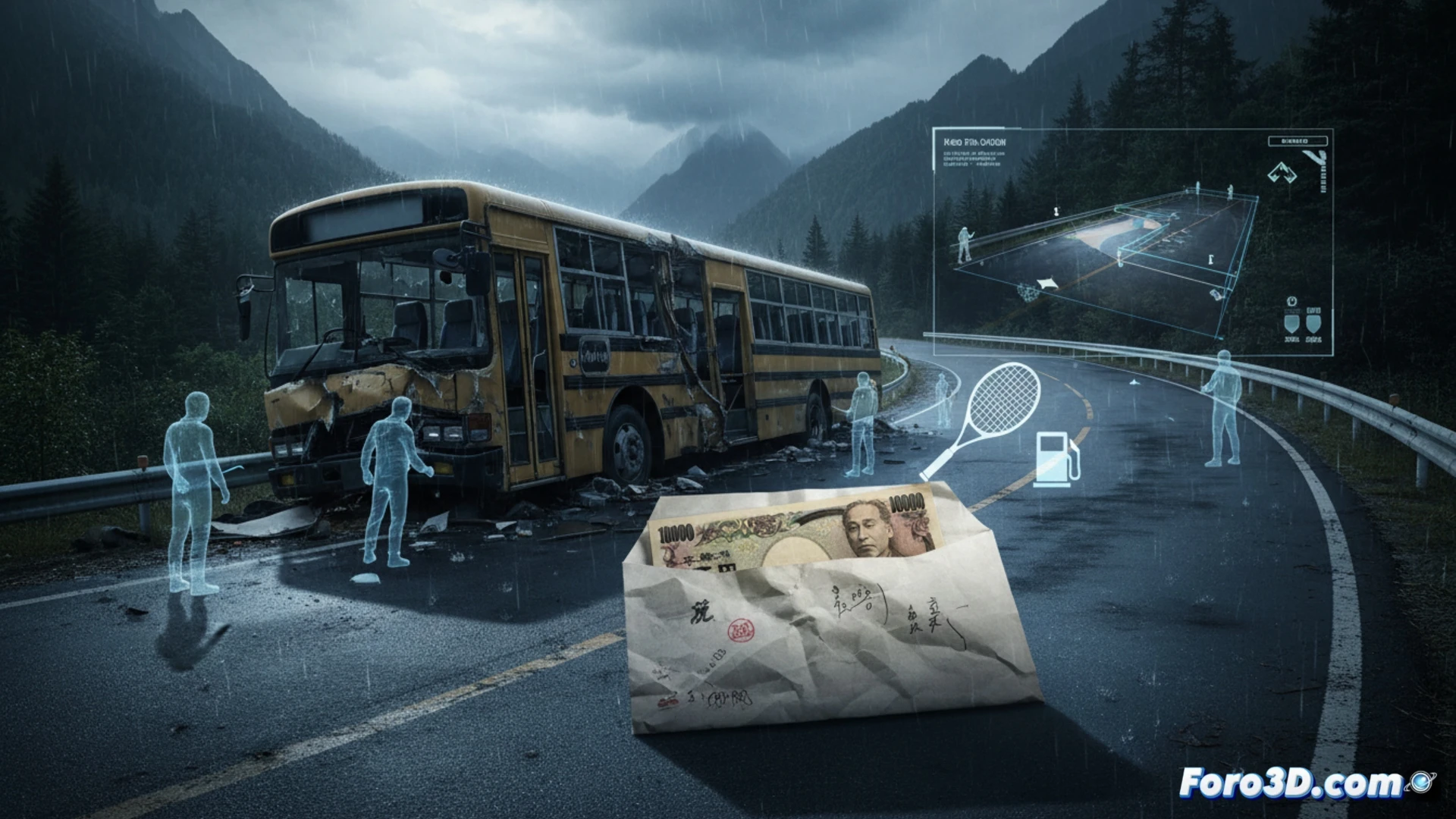
Analysis of impact dynamics and positional evidence 🚍
To model the sequence in 3D, we must place the minibus on the Ban-etsu lane and calculate the deviation trajectory toward the barrier. According to the school, the envelope was found among the luggage debris. The simulation must integrate the force of the impact, the dispersion of objects, and the exact location of the envelope. The notes on the front of the envelope suggest a direct payment for route expenses. By contrasting the school's statement (which expected a charter bus with a driver) with the physical evidence of the money, the 3D reconstruction allows us to visualize whether the minibus driver was carrying out a parallel operation, indicating a possible deviation from the contracted route.
The material contradiction: route payment or concealed bribe? 🔍
The central question is not just how the impact occurred, but why the driver was carrying that envelope. The forensic simulation must show the timeline: the delivery of the envelope by the sales representative, the manual notation of expenses, and the exact moment of the accident. If the money was intended for tolls or fuel, its presence contradicts the school's claim that everything was covered by the charter. The 3D reconstruction not only clarifies the physics of the accident but also exposes the discrepancy between the service requested and the actual logistics, pointing to possible shared responsibilities between the bus company and the school administration.
What minimum resolution would you need for this analysis?