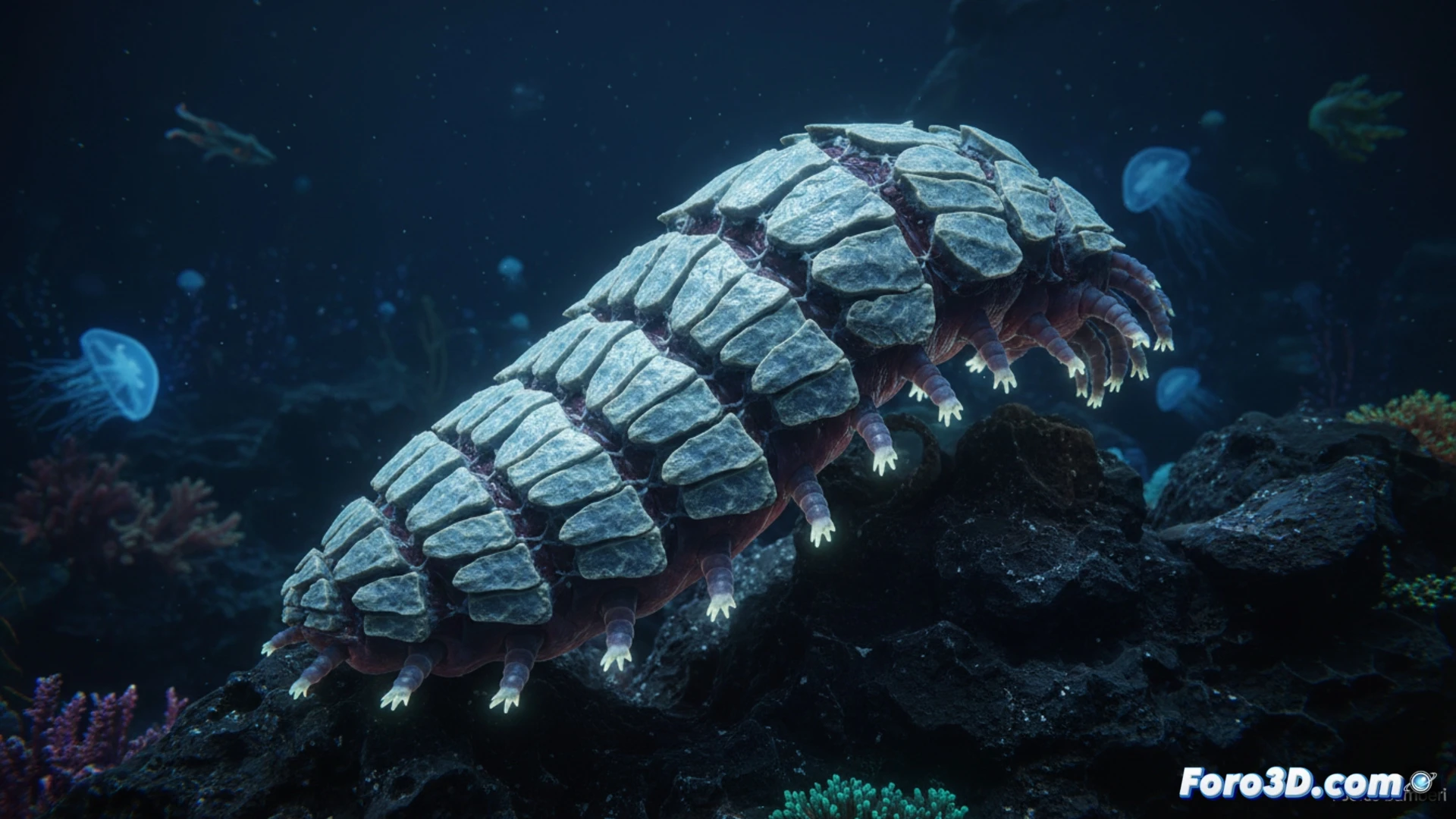
The discovery of Psolus bamberi in the Gascoyne Canyon has surprised the scientific community due to its unusual armor of calcareous plates. For scientific visualization specialists, this species represents a fascinating technical challenge. The three-dimensional reconstruction of its external and internal morphology allows analysis of how these plates articulate, offering clues about their protective function in an environment of high pressure and total darkness. 🐚
Technical workflow: From tomography to polygonal model 🖥️
The modeling process for Psolus bamberi begins with data acquisition using micro-computed tomography (micro-CT) of preserved holotypes. This scan generates a point cloud that is processed in software such as Blender or ZBrush to reconstruct the polygonal mesh. The difficulty lies in accurately representing the imbricated arrangement of the calcareous plates, reminiscent of medieval armor. High-resolution photogrammetry is used to capture the texture and color of fixed specimens, while volumetric lighting simulation recreates the dim light conditions of the submarine canyon. The final result allows marine biologists to rotate and section the model to study the biomechanics of this shell without needing to dissect real specimens.
Visualization as a tool for conservation and outreach 🌊
Beyond anatomical analysis, the 3D model of Bamber's sea cucumber plays a crucial role in scientific communication. By rendering animations showing its movement across the seabed or its interaction with the rocky environment, public understanding of a species that, due to its rarity, has never been filmed alive is facilitated. This digital representation becomes an educational resource for museums and documentaries, helping to raise awareness about the biodiversity of submarine canyons and the need to protect these fragile ecosystems before new species disappear without being known.
How the challenge of digitally reconstructing the complex calcareous plates of Psolus bamberi from underwater scanning data for scientific 3D visualization is addressed
(PS: fluid physics for simulating the ocean is like the sea: unpredictable and you always run out of RAM)