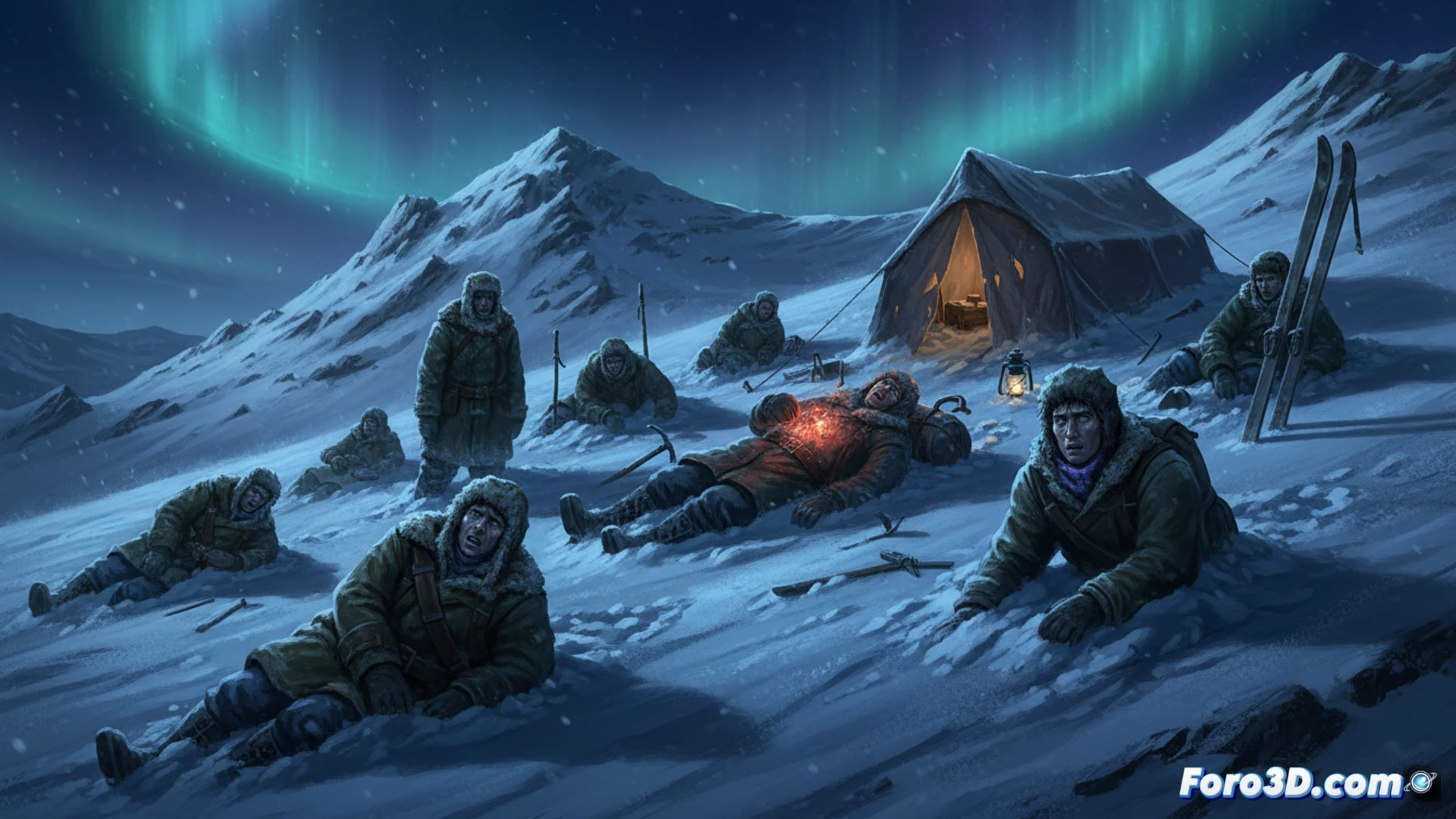
On February 2, 1959, nine Soviet hikers perished in the Ural Mountains under conditions that defy conventional forensic logic. The bodies exhibited severe internal trauma without significant external damage, along with anomalous radiation levels on their clothing. This case has become a perfect study object for the forensic pipeline, where virtual reconstruction through photogrammetry and 3D simulation allows for millimeter-precision scene analysis, contrasting hypotheses ranging from avalanches to military phenomena.
Virtual Reconstruction and Trajectory Analysis 🏔️
To address the mystery, the original camp has been modeled using photogrammetry from archival images and topographic data of the Kholat Syakhl slope. The 3D simulation traces the hikers' trajectories from the tent, torn from the inside, to the final positions of the bodies. Collision and deformation analysis is applied to digital anatomical models to replicate trauma patterns, such as massive rib fractures without skin lacerations. Additionally, residual radiation levels are visualized using volumetric heat maps, integrating historical dosimeter data to evaluate the hypothesis of exposure to unconventional sources.
Hypotheses and the Limit of Digital Evidence 🔍
The 3D forensic reconstruction does not solve the mystery, but it narrows it down. The simulation rules out a classic avalanche due to the lack of compact snow along the trajectories, while the internal trauma patterns suggest a high-intensity pressure wave, such as that generated by infrasound or a controlled explosion. The radiation visualization is inconclusive but points to secondary contamination. At Foro3D, we believe that technology is not an oracle, but a tool to refine questions. The Dyatlov Pass remains a reminder that, sometimes, the best simulation only reveals the depth of what we do not know.
As an expert in digital forensic pipeline and 3D simulation, what specific methodology of reconstructive data capture do you consider most effective for validating the hypothesis of an avalanche or an unusual acoustic phenomenon in the Dyatlov Pass case, and how would you integrate the conflicting historical data into that pipeline?
(PS: In the forensic pipeline, the most important thing is not to mix evidence with reference models... or you'll end up with a ghost at the scene.)