The ruins of Great Zimbabwe represent one of the greatest achievements of pre-industrial African engineering. However, for centuries, Western historiography denied its indigenous origin, attributing its dry stone walls to Phoenicians or biblical kingdoms. Today, digital archaeology allows us to dismantle these prejudices through the virtual reconstruction of its imposing walls, revealing a construction sophistication that rivals any medieval European fortress.
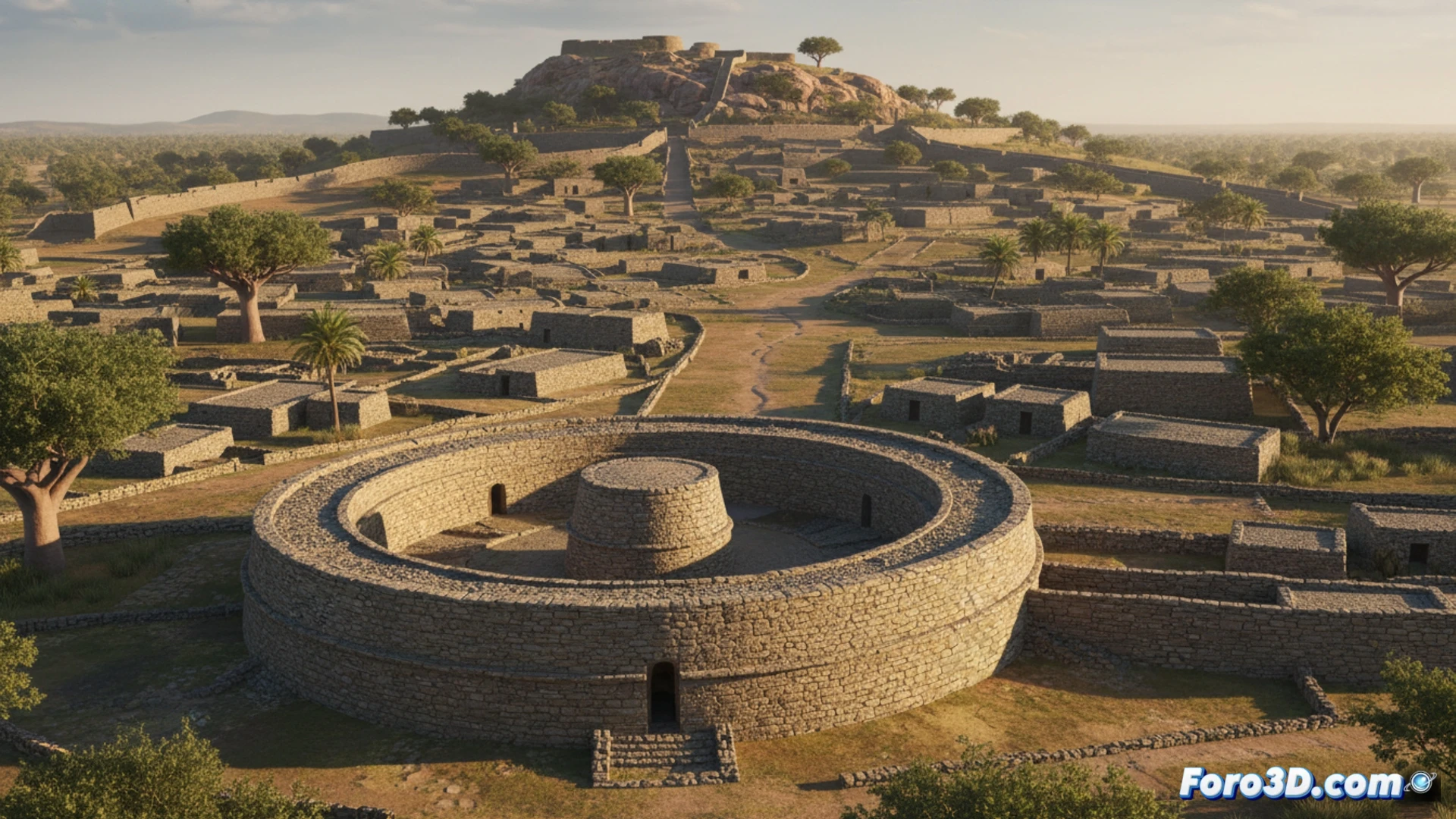
Photogrammetry and parametric modeling of dry stone walls 🏛️
The main technical challenge lies in the absence of mortar. The granite walls of the royal enclosure, up to 11 meters high, are held together solely by the precise carving of each block. Using aerial photogrammetry with drones and LiDAR scanning, we have generated a point cloud with submillimeter resolution. Subsequent parametric modeling replicates the interlocking pattern, where each stone fits at specific angles to distribute the load. Comparison with Inca structures such as Sacsayhuamán shows similar principles of seismic engineering, although with a unique curved design in the Great Wall of the Enclosure.
From colonial denial to digital validation 🔍
The 3D model not only documents the geometry but also allows simulating the construction process. By calculating the volume of stone displaced and the friction force between blocks, it is demonstrated that the construction required advanced knowledge of geometry and soil mechanics. This analysis, impossible without digital tools, definitively dismantles the myth of a primitive civilization. 3D technology thus acts as an objective witness that returns cultural credit to its true Shona builders.
How can the 3D reconstruction of Great Zimbabwe correct distorted historical narratives and restore prominence to pre-colonial African construction techniques
(PS: and remember: if you can't find a bone, you can always model it yourself)