On March 18, 1925, a monstrous supercell swept through Missouri, Illinois, and Indiana for 350 kilometers. Known as the Great Tri-State Tornado, this F5 intensity phenomenon left a trail of unprecedented devastation. Today, thanks to tools like Houdini, WRF, and AutoCAD 3D, we can reconstruct its path and analyze its behavior to improve responses to future catastrophes.
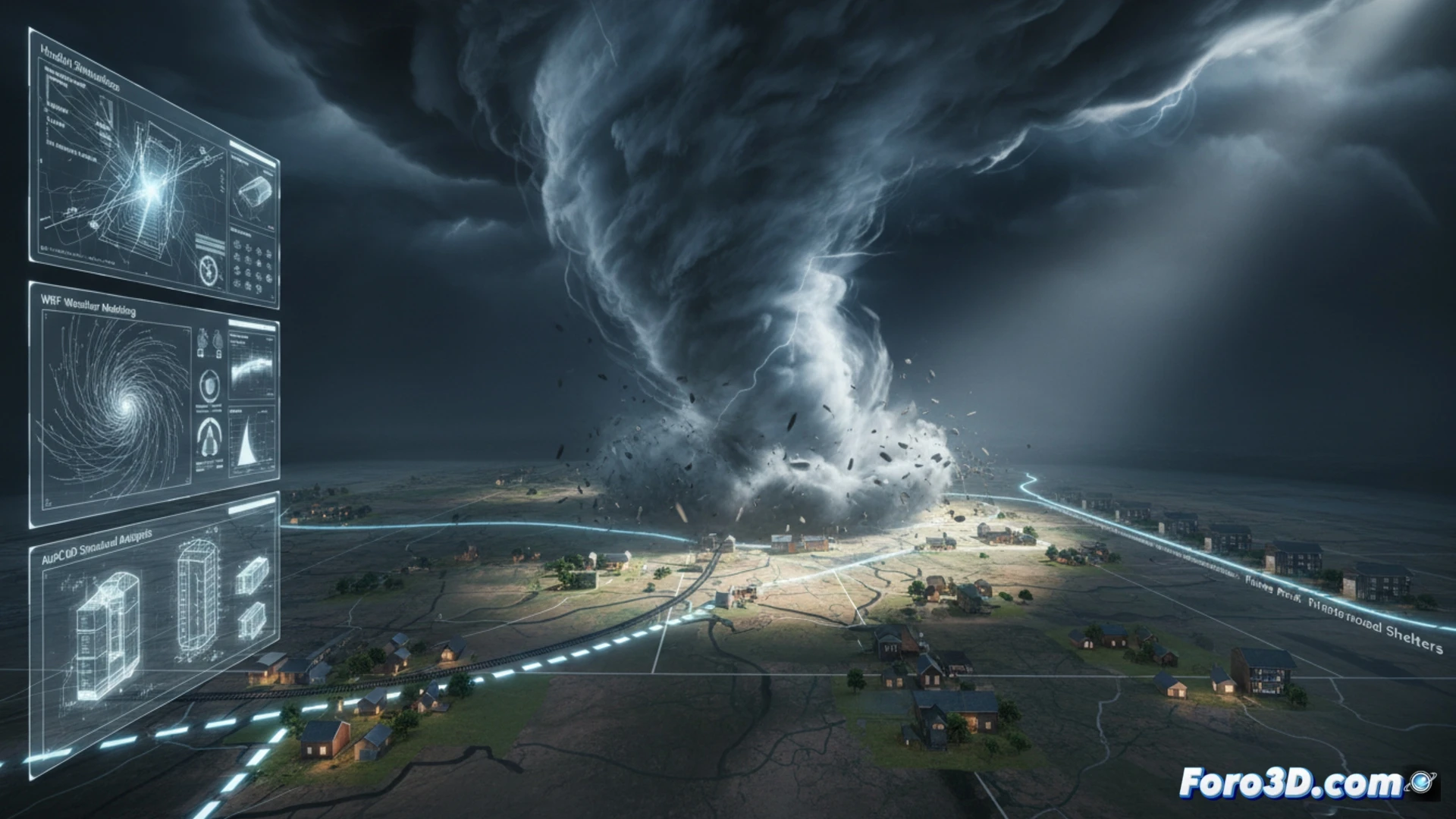
Technical Vortex Modeling with Houdini and WRF 🌪️
The simulation begins with historical meteorological data processed in WRF (Weather Research and Forecasting). This model generates wind, pressure, and humidity fields that feed the fluid dynamics in Houdini. Here, we recreate the 1.6-kilometer-wide vortex, with rotational speeds exceeding 480 km/h. In parallel, AutoCAD 3D models the rural and urban terrain of the route, including the towns of Murphysboro, Gorham, and Griffin. The integration allows us to visualize how topography influenced the tornado's acceleration and debris dispersion.
Lessons for Disaster Mitigation 🛡️
This reconstruction is not just a visual exercise. By adjusting variables such as wind shear or soil moisture, we can predict how a similar event would impact modern infrastructure. The 3D analysis reveals that the tornado's extreme duration (over three hours) was key to the mortality rate. Understanding these patterns allows for designing more efficient shelters and early warning systems tailored to long-track supercells, saving lives in future storms.
Could the 3D reconstruction of the Great 1925 Tornado reveal atmospheric patterns that current prediction models do not yet detect, and if so, how could that information be integrated into early warning systems to prevent future similar catastrophes?
(PS: Simulating catastrophes is fun until the computer crashes and you become the catastrophe.)