Last weekend, a tragic accident in Totana (Murcia) shocked the caravanning sector. A 50-year-old man died crushed by his own motorhome while performing maintenance work. According to initial reports, the vehicle, raised on hydraulic jacks, lost stability and collapsed onto the victim. This event opens a crucial technical debate on safety in lifting processes and the need for precise forensic investigation.
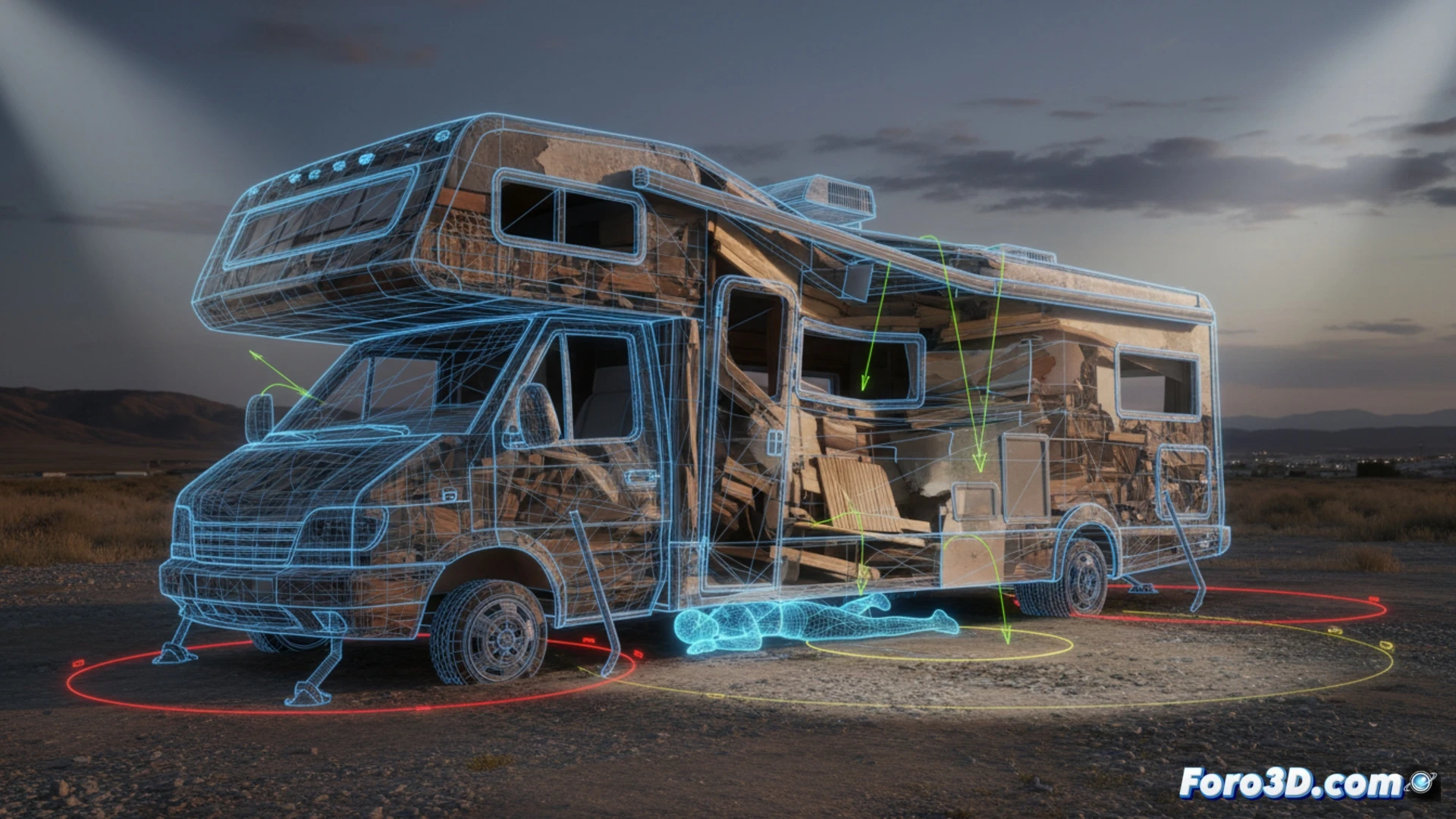
Photogrammetry and laser scanning to determine the point of failure 🛠️
In a case like this, 3D scanning technology allows experts to capture the accident scene with millimeter precision. Through photogrammetry, point clouds can be generated to document the exact position of the hydraulic jacks, their deformation, and the tilt angle of the vehicle at the moment of collapse. Digital analysis of the model allows recreating the sequence of the fall, identifying whether the failure was due to material fatigue in the jack, an unstable ground base, or an error in weight distribution. This method eliminates guesswork, offering objective data to classify the accident as mechanical or human.
Technical lessons to prevent a new tragedy ⚠️
Virtual reconstruction not only serves to clarify what happened but also to redesign safety protocols. The 3D model can simulate alternative loads and demonstrate that the exclusive use of hydraulic jacks, without safety chocks or auxiliary supports, is a high-risk practice. The technical community must demand that these analyses become standard for any workplace investigation, transforming a fatal error into a documented lesson that saves lives in future maintenance.
Would you combine scanning with photogrammetry? 🤔