The fatal accident on the Ban-etsu Expressway, where a minibus from the Hokuei Institute crashed into a safety barrier, has sparked a debate about the suitability of the vehicle used. The ministry's investigation focuses on the rental contract, but the forensic key lies in the physics of the impact. Through 3D reconstruction of the scene, we can analyze the variables that determined the dissipated kinetic energy and structural deformation, offering objective data to clarify whether a private bus would have mitigated the tragedy.
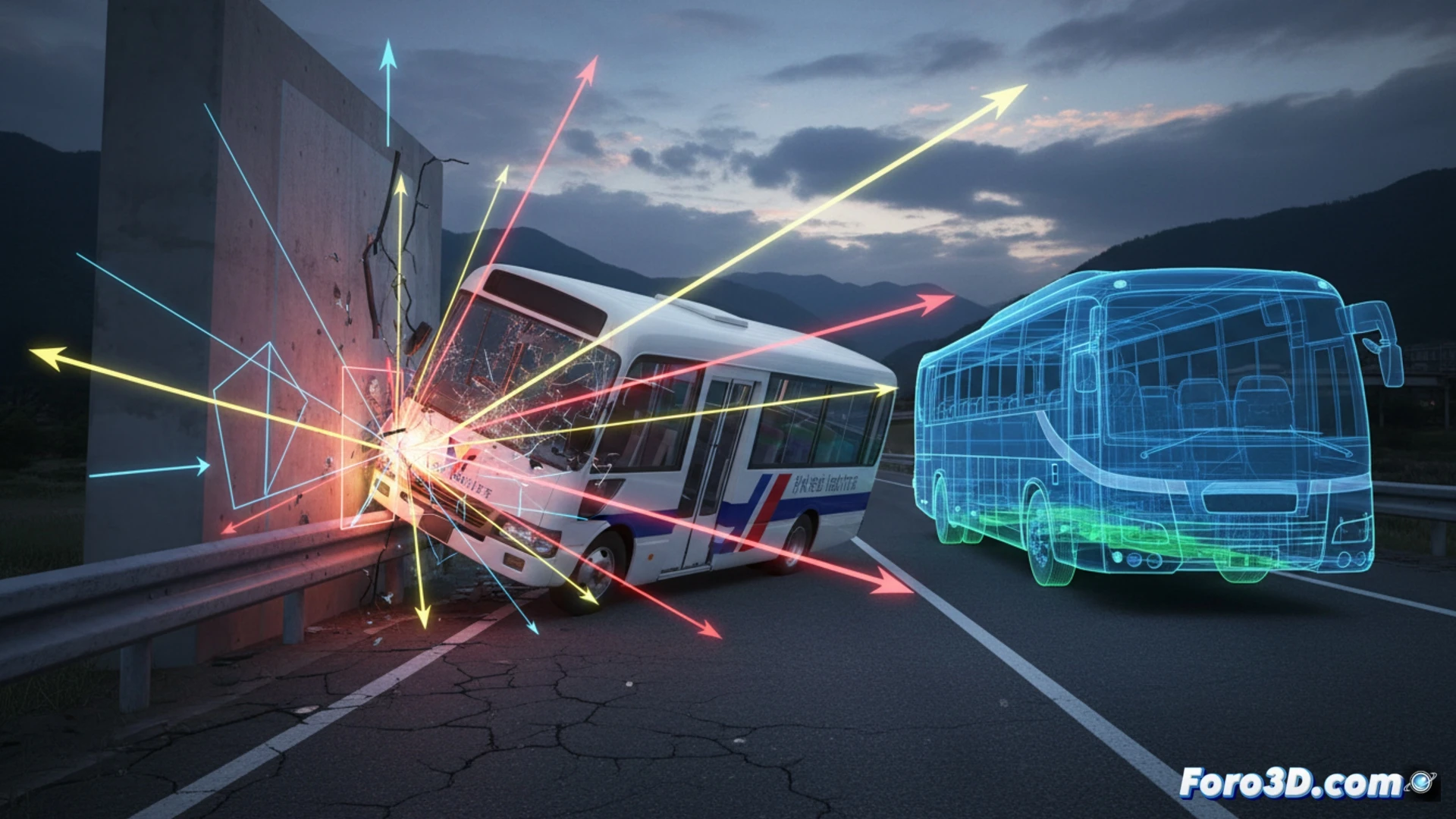
Impact dynamics and deformation analysis 🚗
The 3D forensic simulation allows modeling the pre-impact trajectory, closing speed, and collision angle against the barrier. By inputting the specific masses and geometries of the minibus (higher center of gravity and lower torsional rigidity) compared to those of a conventional bus, we can calculate the energy transfer. Barrier deformation and cabin intrusion become critical parameters. This vector analysis not only validates the mechanics of the crash but also contrasts the hypothesis that the choice of rental vehicle directly influenced the lethality of the accident, supporting the official investigation.
Forensic lessons for school safety 🛡️
Beyond contractual fault, 3D technology forces us to reflect on risk management in school transportation. The simulation reveals that the structural difference between a minibus and a private bus can be decisive in a side or frontal impact against rigid barriers. This case underscores the need for educational institutions to demand vehicle compatibility studies for their routes, using digital twins to predict structural response in crashes and prevent an administrative error from becoming a sentence of applied physics.
Would you place scale markers before scanning?